Ciphers
How historical ciphers work, from the scytale to the Enigma machine: the rule behind each one, who used it, and how codebreakers broke it, step by step.
4 entries
Definitions: frequency fingerprint
-
Caesar Cipher: Why 'Find the E' Is the Weak Way to Break It
How the Caesar cipher works, what Suetonius says Caesar wrote, and a 10,000-message test: on 20 letters, matching all 26 counts beat hunting for E, 95% to 30%.
 Illustration
Picture credit
Illustration: Codes & Letters. Generated schematic image — not a photograph or historical record. Reuse: CC BY 4.0 (https://creativecommons.org/licenses/by/4.0/), to the extent any copyright exists in this image. -
Letter Frequency: E Is Commoner in German Than in English
Letter frequency tables counted from nine novels: e is 12.5% of English letters, 16.0% of German and 17.2% of French. Umlauts, accents and letter pairs too.
 Illustration
Picture credit
Illustration: Codes & Letters. Generated schematic image — not a photograph or historical record. Reuse: CC BY 4.0 (https://creativecommons.org/licenses/by/4.0/), to the extent any copyright exists in this image. -
Vigenère Cipher: Named for a Man Who Didn't Invent It
How the Vigenère cipher works, why Bellaso's 1553 keyword cipher came before Vigenère's book, and how repeats and letter counts give away the keyword.
 Illustration
Picture credit
Illustration: Codes & Letters. Generated schematic image — not a photograph or historical record. Reuse: CC BY 4.0 (https://creativecommons.org/licenses/by/4.0/), to the extent any copyright exists in this image. -
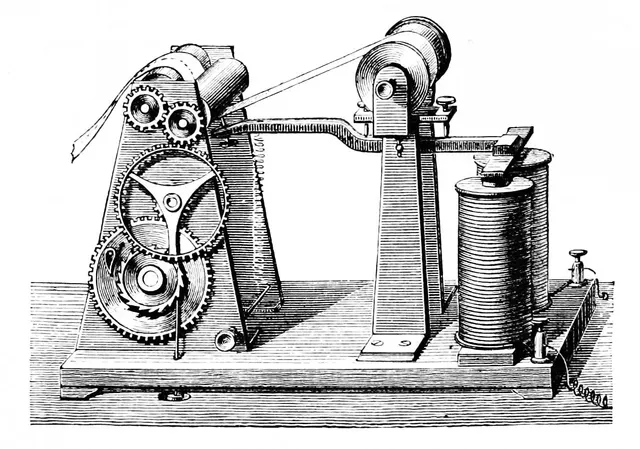
Morse Code: Why the Common O Takes as Long as a Rare Z
International Morse code chart and timing rules: a dot is 1 unit, a dash 3. O and Z both take 11 units, though O is about 86 times as common in English novels.
Picture credit
"PSM V03 D423 Morse telegraph" by unknown author, fig. 9 of "Electric Telegraphs" by A. P. Deschanel, Popular Science Monthly, vol. 3 (1873) — Public domain (figure 9, "Morse's Telegraph", of the article "Electric Telegraphs" by A. P. Deschanel, Popular Science Monthly, vol. 3, p. 409, August 1873, abridged from Deschanel's Natural Philosophy, Part III; the source names no engraver or draughtsman; public domain in the US as a work published in 1873, before 1931; in the EU the 70-year term from publication for an anonymous work ended at the end of 1943, and if the figure is credited to the article's author, Augustin Privat-Deschanel (1821-1883), his life plus 70 years ended at the end of 1953; an engraver whose work was printed in 1873 would still be protected only after dying in 1956 or later, at about 98 or older, or, for the French 30-year extension, dying for France in 1939-1945 at about 81 or older, which is not a realistic case; a faithful scan of a two-dimensional printed page adds no new rights in the US (Bridgeman principle) or the EU (DSM Directive Article 14); Commons PD-old) — https://commons.wikimedia.org/wiki/File:PSM_V03_D423_Morse_telegraph.jpg
