Ciphers, scripts, symbols — every code humans write, taken apart.
A decoding guide for readers curious about how messages are encoded, with letter counts, glyph measurements and language maps that anyone can check.
Five ways in
One entry from each of the five sections.
-
 Illustration
Picture credit
Illustration: Codes & Letters. Generated schematic image — not a photograph or historical record. Reuse: CC BY 4.0 (https://creativecommons.org/licenses/by/4.0/), to the extent any copyright exists in this image.How the Caesar and Vigenère ciphers work, where they came from and how each is broken, plus Morse code and letter counts in English, German and French.
Flagship entryCaesar Cipher: Why 'Find the E' Is the Weak Way to Break It
-
 Illustration
Picture credit
Illustration: Codes & Letters. Generated schematic image — not a photograph or historical record. Reuse: CC BY 4.0 (https://creativecommons.org/licenses/by/4.0/), to the extent any copyright exists in this image.How the world's writing systems work, from alphabets and abjads to syllabaries and logosyllabic scripts, how they changed, and how lost ones were deciphered.
Newest entryEvery Writing System in Unicode: Alphabets Are Outnumbered
-
 Illustration
Picture credit
Illustration: Codes & Letters. Generated schematic image — not a photograph or historical record. Reuse: CC BY 4.0 (https://creativecommons.org/licenses/by/4.0/), to the extent any copyright exists in this image.Linguistic typology for curious readers: the different ways the world's languages solve the same grammatical problem, such as ordering subject, verb and object.
Flagship entryWord Order: English's SVO Isn't the World's Most Common
-
 Illustration
Picture credit
Illustration: Codes & Letters. Generated schematic image — not a photograph or historical record. Reuse: CC BY 4.0 (https://creativecommons.org/licenses/by/4.0/), to the extent any copyright exists in this image.Public symbol systems such as road signs and hazard symbols: where each came from, what makes a symbol readable at a distance, and how readings vary by culture.
Flagship entryRoad Signs: A Red Triangle Means Danger Only by Treaty
-
 Illustration
Picture credit
Illustration: Codes & Letters. Generated schematic image — not a photograph or historical record. Reuse: CC BY 4.0 (https://creativecommons.org/licenses/by/4.0/), to the extent any copyright exists in this image.Letters taken apart in openly licensed typefaces: the names of their parts, the optical corrections designers make for the eye, and the spacing between them.
Flagship entryAnatomy of a Letter: Why the O Is Drawn Taller Than the H
Latest entries
-
Caesar Cipher: Why 'Find the E' Is the Weak Way to Break It
How the Caesar cipher works, what Suetonius says Caesar wrote, and a 10,000-message test: on 20 letters, matching all 26 counts beat hunting for E, 95% to 30%.
IllustrationPicture credit
Illustration: Codes & Letters. Generated schematic image — not a photograph or historical record. Reuse: CC BY 4.0 (https://creativecommons.org/licenses/by/4.0/), to the extent any copyright exists in this image. -
Every Writing System in Unicode: Alphabets Are Outnumbered
Unicode 18.0.0 encodes 175 scripts. By the Unicode Standard's own typology, 66 are abugidas and 59 alphabets; 37 run right to left. Full table and CSV.
IllustrationPicture credit
Illustration: Codes & Letters. Generated schematic image — not a photograph or historical record. Reuse: CC BY 4.0 (https://creativecommons.org/licenses/by/4.0/), to the extent any copyright exists in this image. -
Word Order: English's SVO Isn't the World's Most Common
In WALS, 564 of 1,376 languages put the verb last (SOV) and 488 use English-style SVO. Count by genus and the gap widens; German has no dominant order.
IllustrationPicture credit
Illustration: Codes & Letters. Generated schematic image — not a photograph or historical record. Reuse: CC BY 4.0 (https://creativecommons.org/licenses/by/4.0/), to the extent any copyright exists in this image. -
Road Signs: A Red Triangle Means Danger Only by Treaty
Why warning signs are red triangles across much of Europe and yellow diamonds in the US: treaties from 1909 to 1968 set the shapes, and Vienna allows both.
IllustrationPicture credit
Illustration: Codes & Letters. Generated schematic image — not a photograph or historical record. Reuse: CC BY 4.0 (https://creativecommons.org/licenses/by/4.0/), to the extent any copyright exists in this image. -
Anatomy of a Letter: Why the O Is Drawn Taller Than the H
The parts of a letter, from baseline and x-height to stem, bowl, counter, serif and terminal, measured in two open fonts, and why the O is drawn taller than H.
IllustrationPicture credit
Illustration: Codes & Letters. Generated schematic image — not a photograph or historical record. Reuse: CC BY 4.0 (https://creativecommons.org/licenses/by/4.0/), to the extent any copyright exists in this image. -
Letter Frequency: E Is Commoner in German Than in English
Letter frequency tables counted from nine novels: e is 12.5% of English letters, 16.0% of German and 17.2% of French. Umlauts, accents and letter pairs too.
 Illustration
Picture credit
Illustration: Codes & Letters. Generated schematic image — not a photograph or historical record. Reuse: CC BY 4.0 (https://creativecommons.org/licenses/by/4.0/), to the extent any copyright exists in this image. -
Latin Alphabet: How 21 Letters Became 26, and Why Z Is Last
Why Z is the last letter: Latin dropped it, gave its seventh place to G, then added it back at the end. How Cicero's 21 letters grew to 26, step by step.
 Illustration
Picture credit
Illustration: Codes & Letters. Generated schematic image — not a photograph or historical record. Reuse: CC BY 4.0 (https://creativecommons.org/licenses/by/4.0/), to the extent any copyright exists in this image. -
Thou vs You: Thou Was the Familiar Form, Not the Formal One
In Chaucer's and Shakespeare's English, thou was the familiar word and the plural ye or you the polite one. How thou faded, and where 207 WALS languages stand.
 Illustration
Picture credit
Illustration: Codes & Letters. Generated schematic image — not a photograph or historical record. Reuse: CC BY 4.0 (https://creativecommons.org/licenses/by/4.0/), to the extent any copyright exists in this image. -
Peace Symbol: Semaphore N and D, by Its Designer's Account
Who designed the peace symbol in 1958, why Gerald Holtom said it combines semaphore N and D, his second story about Goya, and what CND says about copyright.
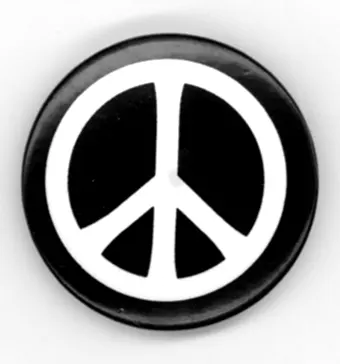
Picture credit
"Cnd button" by Marshall Colman — Public domain (photograph released into the public domain worldwide by its author, with an unconditional grant of use where that is not legally possible (Commons PD-self); the symbol shown is simple geometry not protected in the US (Commons PD-shape), and CND states the symbol has "quite deliberately never been copyrighted" and is free for all, https://cnduk.org/the-symbol/) — https://commons.wikimedia.org/wiki/File:Cnd_button.JPG -
X-Height: Same Font Size, Different Letter Sizes, Measured
X-height measured from 13 open font files: at one font size, the lowercase x stands 40.5% of that size in EB Garamond and 55.0% in JetBrains Mono.
Picture credit
"Hydesville CA Interchange" by Ellin Beltz — Public domain (released into the public domain by the photographer, Ellin Beltz, who also grants anyone the right to use it for any purpose where such a release is not legally possible; the sign shows only place names, distances, arrows and a route shield) — https://commons.wikimedia.org/wiki/File:Hydesville_CA_Interchange.jpg -
Vigenère Cipher: Named for a Man Who Didn't Invent It
How the Vigenère cipher works, why Bellaso's 1553 keyword cipher came before Vigenère's book, and how repeats and letter counts give away the keyword.
 Illustration
Picture credit
Illustration: Codes & Letters. Generated schematic image — not a photograph or historical record. Reuse: CC BY 4.0 (https://creativecommons.org/licenses/by/4.0/), to the extent any copyright exists in this image. -
Egyptian Hieroglyphs: Picture Signs That Spell Consonants
Egyptian hieroglyphics explained: one sign as a word, a sound or a silent label, the 24 consonant signs, why vowels went unwritten, and how many signs exist.
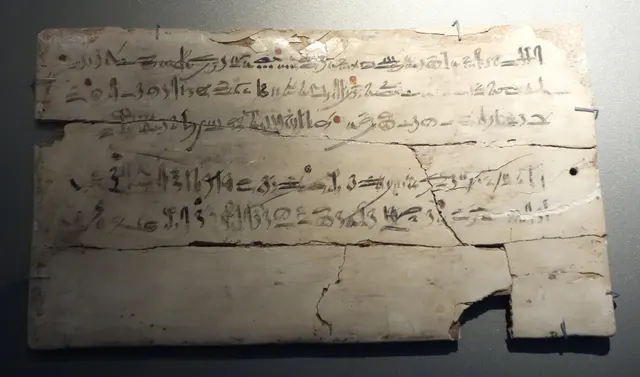
Picture credit
"Scribe's Exercise Board with Hieratic Text - Egypt, New Kingdom, Dynasty 18, reign of Amunhotep I, c. 1514-1493 BC, wood - Brooklyn Museum - Brooklyn, NY - DSC08694" by Daderot — https://commons.wikimedia.org/wiki/File:Scribe%27s_Exercise_Board_with_Hieratic_Text_-_Egypt,_New_Kingdom,_Dynasty_18,_reign_of_Amunhotep_I,_c._1514-1493_BC,_wood_-_Brooklyn_Museum_-_Brooklyn,_NY_-_DSC08694.JPG — CC0 1.0 (https://creativecommons.org/publicdomain/zero/1.0/)


