Word Order: English's SVO Isn't the World's Most Common
Codes & Letters
- Published
- Last substantive revision
Grammar featureSpec card
- Feature
- Order of subject, object and verbSource: WALS chapter 81 (Dryer 2013)
- Typology database feature ID
- WALS 81A; Grambank GB131–GB133Source: WALS v2020.6; Grambank v1.0.3
- Main values and distribution
- SOV 564, SVO 488, VSO 95, VOS 25, OVS 11, OSV 4, no dominant order 189 (of 1,376 languages)Source: WALS 81A (v2020.6), counted from the data
- Example languages
- SOV: Japanese, Turkish; SVO: English, Mandarin; VSO: Irish; VOS: Nias; OVS: Hixkaryana; OSV: Nadëb; no dominant order: GermanSource: WALS 81A (v2020.6) values; all but Turkish are example languages in WALS chapter 81
word-order-spec.csv the values on this card, as CSVData: WALS Online v2020.6, feature 81A by Matthew S. Dryer, ed. Matthew S. Dryer and Martin Haspelmath (https://doi.org/10.5281/zenodo.23010827), CC BY 4.0, retrieved 2026-10-15; Grambank v1.0.3, Hedvig Skirgård et al. (https://doi.org/10.5281/zenodo.7844558), CC BY 4.0, retrieved 2026-10-15
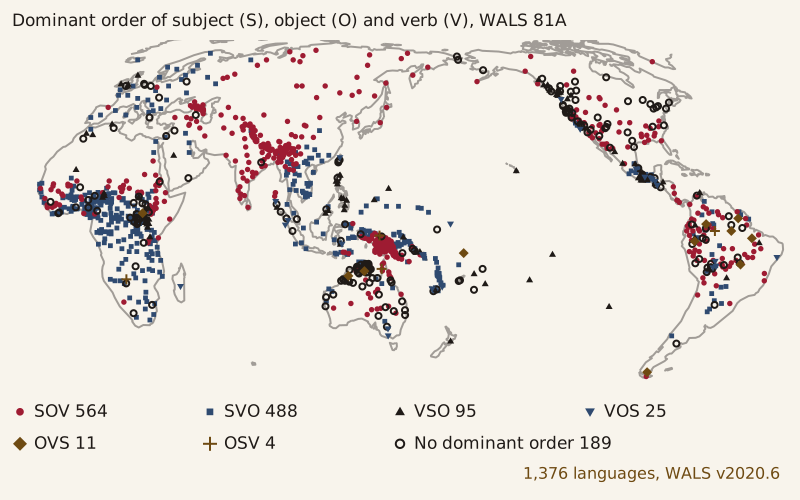
Each mark is one of the 1,376 languages with a value for WALS feature 81A, placed at its WALS coordinates; open circles mark languages with no dominant order.
Map the word order of 1,376 languages, and English's subject-verb-object pattern comes second, not first. In the World Atlas of Language Structures (WALS Online v2020.6), 564 of those 1,376 languages put the verb last, after subject and object (SOV), as Japanese and Turkish do. Another 488 use SVO, as English and Mandarin do.
Verb-first orders follow, with 95 VSO and 25 VOS languages, and only 15 languages start with the object. A further 189 have no dominant order at all. Count groups of closely related languages instead of single languages, and SOV's lead grows.
Think of word order as part of how a language encodes a message: three pieces (subject, verb and object) can be lined up in six ways. That comparison is a way in, nothing more. This site does not rank any order as more efficient or more advanced, and holds that no language is primitive.
Which word order is most common?
The counts come from WALS feature 81A, Order of Subject, Object and Verb, part of Matthew S. Dryer's chapter 81 in the 2013 edition of the atlas. The data used here are WALS Online v2020.6, released on Zenodo on 2026-09-28. Feature 81A covers one kind of sentence: a statement with a transitive verb whose subject and object are both nouns, not just pronouns, as in the chapter's example "The dog chased the cat." Subject here means the more agent-like participant and object the more patient-like one.
WALS assigns each language its dominant order, which is either the only order possible or the one used more often. Where counts from texts exist, Dryer's rule of thumb is that an order is dominant only if it is "more than twice as common as the next most frequent order." Otherwise the language goes into the no-dominant-order group.
| Order | Languages | Share of 1,376 | Example in WALS chapter 81 |
|---|---|---|---|
| SOV | 564 | 41.0% | Japanese |
| SVO | 488 | 35.5% | English, Mandarin |
| VSO | 95 | 6.9% | Irish |
| VOS | 25 | 1.8% | Nias (Sumatra, Indonesia) |
| OVS | 11 | 0.8% | Hixkaryana (Brazil) |
| OSV | 4 | 0.3% | Nadëb (Brazil) |
| No dominant order | 189 | 13.7% | German |
SOV covers about two languages in five and SVO a little over one in three. These are shares of a sample, the 1,376 languages that have an 81A value in WALS v2020.6, not of every language spoken today. The same atlas maps many other features, from polite and familiar forms of "you" (Thou vs You) to grammars that mark how a speaker knows something (Evidentiality).
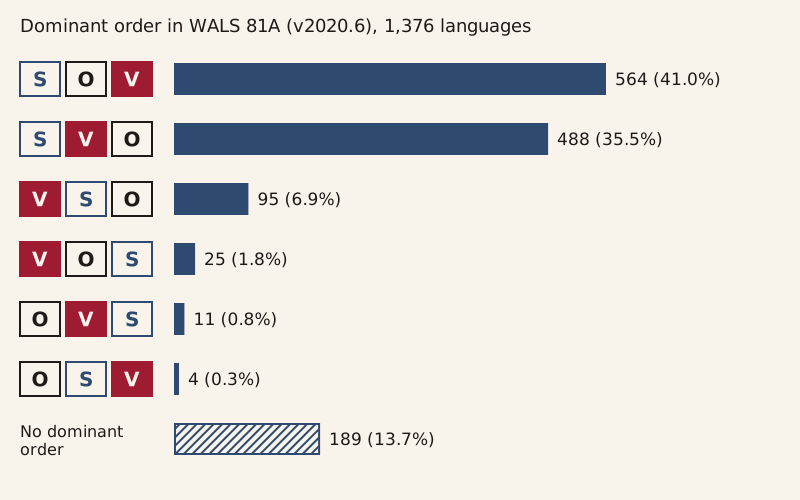
The six orders and "no dominant order," counted by language in WALS v2020.6. The verb tile in each row is red.
Does counting by genus change the answer?
A count of languages can lean toward a few large groups of close relatives. Bantu, a single genus in WALS, contributes 88 languages to feature 81A, and 84 of them are SVO. Oceanic contributes 107 languages, 67 of them SVO.
In WALS, a genus is a group of languages "whose relatedness is fairly obvious without systematic comparative analysis," with a time depth of no more than about 3,500 to 4,000 years. Dryer's examples are the Germanic, Slavic and Celtic branches of Indo-European. He calls the choice of genera "educated guesses."
Chapter 81 counts languages only, so the genus and family shares on this page are this site's own calculation from the WALS data. Each of the 502 genera in the 81A sample gets one vote. When the sampled languages of a genus differ, the vote is split among them: a genus with three SVO languages and one SOV language adds 0.75 to SVO and 0.25 to SOV.
Counted by genus, SOV takes 48.0% of the 502 genera and SVO 27.5% by this page's count, against 41.0% and 35.5% of languages. Counted the same way, the 205 families widen the gap again, to 53.8% for SOV and 19.5% for SVO. The method simplifies in one way: a genus's split depends on which of its languages WALS happened to sample. Under all three counts, SOV leads; only the margin changes.
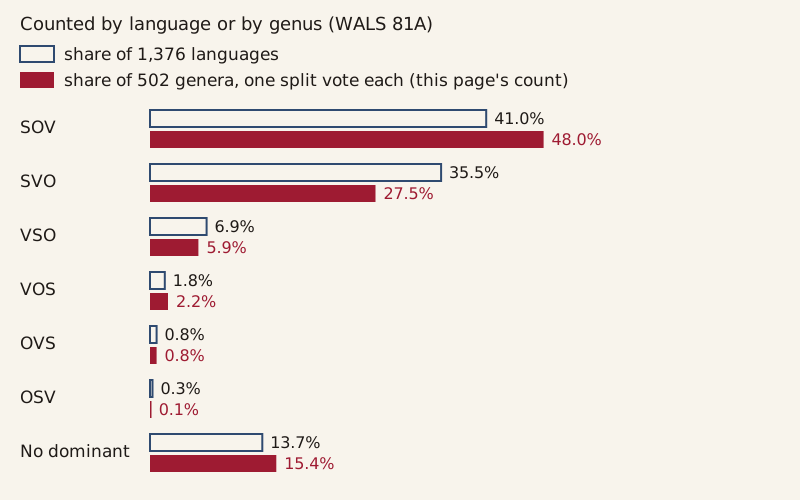
Each genus counts once, its vote split among its sampled languages. SOV's share rises from 41.0% of languages to 48.0% of genera.
Which languages put the verb first?
VSO and VOS together cover 120 languages, 8.7% of the sample. In Irish, "Léann na sagairt na leabhair" means "The priests are reading the books," with the verb léann first, then the priests, then the books.
Chapter 81 finds VSO scattered widely: among Eastern Sudanic languages in eastern Africa, in Berber in North Africa, in Celtic at the western edge of Europe, in and around the Philippines, among Polynesian languages, in Mesoamerica and in the Pacific Northwest. By this page's count, more than half of the 120 verb-first languages come from three families: Austronesian (35), Oto-Manguean (17) and Eastern Sudanic (13).
VOS is rarer. Chapter 81 reports no examples on the mainland of Africa or Eurasia. In Nias, an Austronesian language that the chapter places in Sumatra, Indonesia, "i-rino vakhe ina-gu" means "My mother cooked rice": verb, then vakhe "rice," then ina-gu "my mother."
Philippine languages show why WALS defines subject loosely. Linguists debate which noun in a Cebuano clause is the subject, but the verb normally comes first, then the more agent-like noun, then the more patient-like one. By the atlas's definition, Cebuano is VSO.
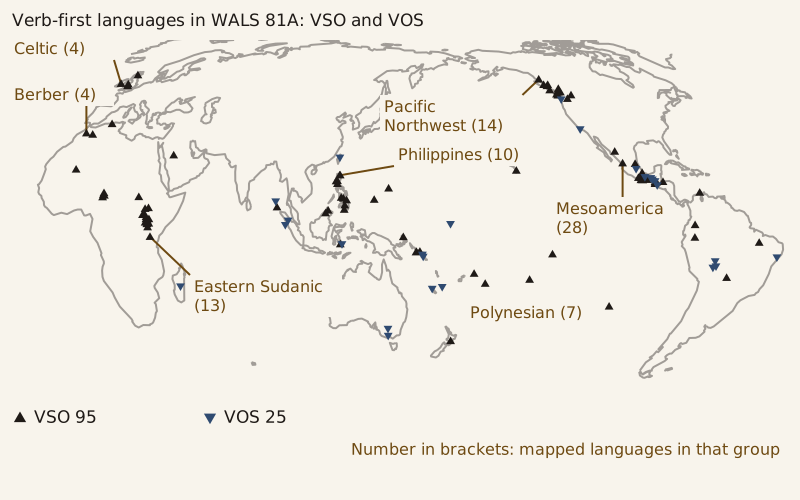
The 120 verb-first languages in WALS 81A. Labels use region names from chapter 81, but the groups and counts are this page's selection from WALS coordinates and genealogy, not a WALS classification.
Which languages put the object first?
Only 15 languages in WALS v2020.6 start with the object, 11 OVS and 4 OSV, about 1% of the sample together. Hixkaryana, a Cariban language of Brazil, is the chapter's OVS example: "toto y-ahosɨ-ye kamara" means "The jaguar grabbed the man," with toto "man" first as the object and kamara "jaguar" last as the subject. For OSV, the example is Nadëb, also of Brazil: "awad kalapéé hapʉ́h" means "The child sees the jaguar," in the order jaguar, child, see.
The chapter text and the data disagree on the details. The text, from the 2013 edition, counts nine OVS languages and names Warao of Venezuela among four OSV languages. The v2020.6 data list 11 OVS languages, and their four OSV languages are Kxoe, Nadëb, Tobati and Wik Ngathana; Warao has no 81A value. This page follows the data.
| Language | WALS 81A | Genus (family) | WALS area | Grambank v1.0.3: unmarked verb position |
|---|---|---|---|---|
| Asuriní | OVS | Maweti-Guarani (Tupian) | South America | not in Grambank |
| Cubeo | OVS | Tucanoan | South America | medial |
| Hixkaryana | OVS | Cariban | South America | medial |
| Kuikúro | OVS | Cariban | South America | final |
| Mangarrayi | OVS | Mangarrayi (Mangarrayi-Maran) | Australia | medial, final |
| Päri | OVS | Western Nilotic (Eastern Sudanic) | Africa | not in Grambank |
| Selknam | OVS | Chonan Proper (Chonan) | South America | medial |
| Tiriyo | OVS | Cariban | South America | medial |
| Tuvaluan | OVS | Oceanic (Austronesian) | Papunesia | initial |
| Ungarinjin | OVS | Worrorran | Australia | initial, medial, final |
| Urarina | OVS | Urarina | South America | medial |
| Kxoe | OSV | Khoe-Kwadi | Africa | initial, medial, final |
| Nadëb | OSV | Nadahup | South America | initial |
| Tobati | OSV | Oceanic (Austronesian) | Papunesia | not in Grambank |
| Wik Ngathana | OSV | Northern Pama-Nyungan (Pama-Nyungan) | Australia | not in Grambank |
Grambank cannot tell OVS from SVO, because its verb-medial question covers both. Of the 9 OVS languages it codes, 5 are verb-medial only, which fits OVS; Kuikúro is coded verb-final and Tuvaluan verb-initial. For Nadëb, WALS says OSV and Grambank says verb-initial, so the two databases disagree. Both values stand in the table above.
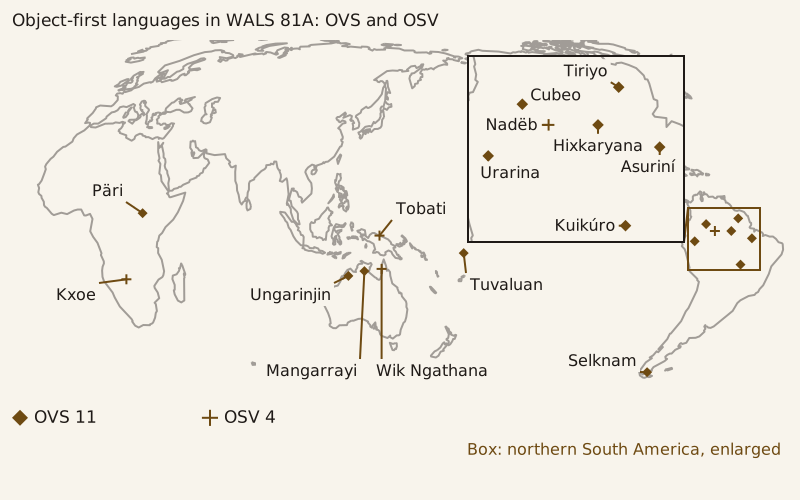
All 15 object-first languages in WALS v2020.6. Eight are in South America, and seven of those are enlarged in the box.
What does "no dominant order" mean?
The 189 languages without a dominant order, 13.7% of the sample, are not one kind of language. Chapter 81 describes three subtypes:
- Highly flexible order. In Nunggubuyu of northern Australia, all or most orders are possible and common.
- Two common orders. In Syrian Arabic, SVO and VSO are both common, and the description Dryer used gives no reason to call either one dominant.
- Order set by syntax. In German, Dutch and Dinka, the order depends on the clause, for example on whether it has an auxiliary verb.
Text counts can override a grammar's own label. A description of Macushi, a Cariban language of Brazil, calls OVS basic, but the text counts it cites show OVS and SOV about equally common, so WALS lists Macushi with no dominant order. By this page's count, the type is most common in Australia, 43 of 95 languages (45%), and North America, 55 of 176 (31%), the two regions where chapter 81 also finds it concentrated.
Grambank v1.0.3 asks a different question. Its features GB131, GB132 and GB133 ask whether "the pragmatically unmarked order between full NP constituents (not pronouns)" is verb-initial, verb-medial or verb-final, and a language with free order can be coded yes on more than one. WALS asks which single order dominates.
Where both databases cover a language, matched by its Glottolog code, they mostly agree. Among the languages Grambank codes on all three features, 332 of 359 WALS SOV languages (92%) are verb-final only, and 282 of 321 SVO languages (88%) are verb-medial only. Of the 108 WALS no-dominant-order languages that Grambank codes on all three features, 39 (36%) have two or three unmarked positions, but 66 have exactly one.
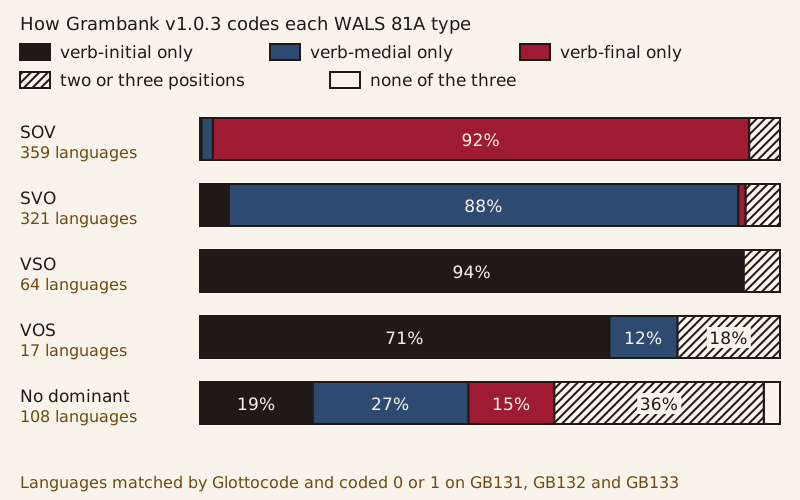
Languages coded in both databases, matched by Glottocode. Grambank mostly agrees on SOV, SVO and VSO and splits the WALS no-dominant-order group several ways.
Is German SOV? English, German and French
WALS codes English and French as SVO and German as lacking a dominant order. On the map, German is neither SOV nor SVO. Dryer explains why: "in German and Dutch, the dominant order is SVO in main clauses lacking an auxiliary and SOV in subordinate clauses and clauses containing an auxiliary." Because both orders are common, neither counts as dominant.
The chapter's German examples, written here without its morpheme hyphens, show the switch. "Der Lehrer trinkt das Wasser" means "The teacher is drinking the water," in the order subject, verb, object. In "Der Lehrer hat das Wasser getrunken," meaning "The teacher has drunk the water," the auxiliary hat comes second and the main verb getrunken moves to the end. At the level of grammar, the chapter says, German is "simply verb-second."
On a second WALS map, 81B, German is listed among the languages with two dominant orders, SOV and SVO. Grambank v1.0.3 codes English and French as verb-medial only and has no entry for German. It codes Dutch as verb-medial only, while WALS gives Dutch no dominant order, another case where the two databases disagree.
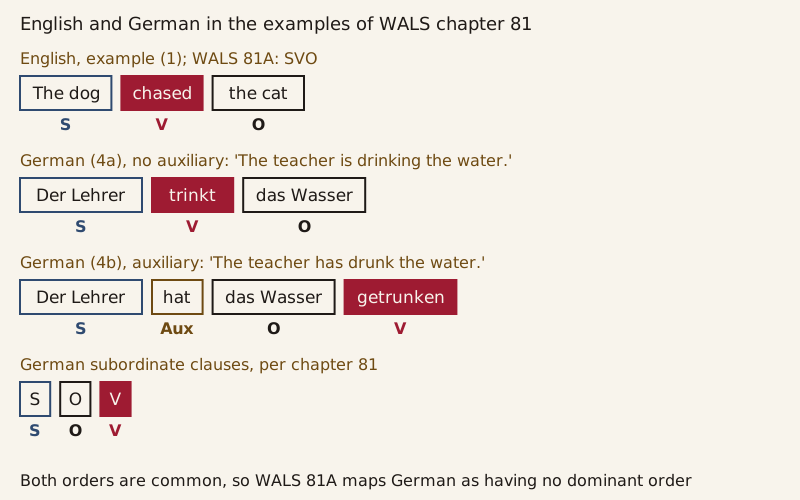
The English example and the two German examples from WALS chapter 81, with the subordinate-clause order the chapter gives for German. German words appear without the chapter's morpheme hyphens.
Why is SOV the most common order?
Scholars disagree. The published explanations point in different directions. Murray Gell-Mann and Merritt Ruhlen (2011) start from the proposal that all or almost all languages may descend from one earlier language. If so, they argue, comparing today's order types with a proposed family tree points to SOV in that ancestor, with later change running mostly from SOV to SVO and from SVO to VSO or VOS.
Other work looks at how people describe events without speaking. In a 2008 study by Susan Goldin-Meadow and colleagues, speakers of English, Turkish, Spanish and Chinese described events in gesture without speech and rebuilt events from pictures. Whatever order their own language favored, all four groups used actor, patient, act, which the authors compare to SOV.
 Generated illustration
In a 2008 study, speakers of English, Turkish, Spanish and Chinese described events in gesture without speech; all four groups used the order actor, patient, act.
Edward Gibson and colleagues (2013) cite recent work suggesting that SOV may be the default and ask why SVO is so common. Their "noisy-channel" hypothesis predicts a shift from SOV to SVO for "semantically reversible events," where SOV would put two plausible agents on the same side of the verb. They report support from a gesture task with speakers of English, Japanese and Korean. The same account, they write, explains why case marking is common in SOV languages and relatively rare in SVO ones.
Luke Maurits and Thomas Griffiths (2014) object that psychological explanations rest only on modern word-order frequencies and cannot explain proposed patterns of historical change; they infer that change, and the likely ancestral orders, within major language families. The counts on this page do not decide between these ideas. They show only that SOV leads whether languages, genera or families are counted.
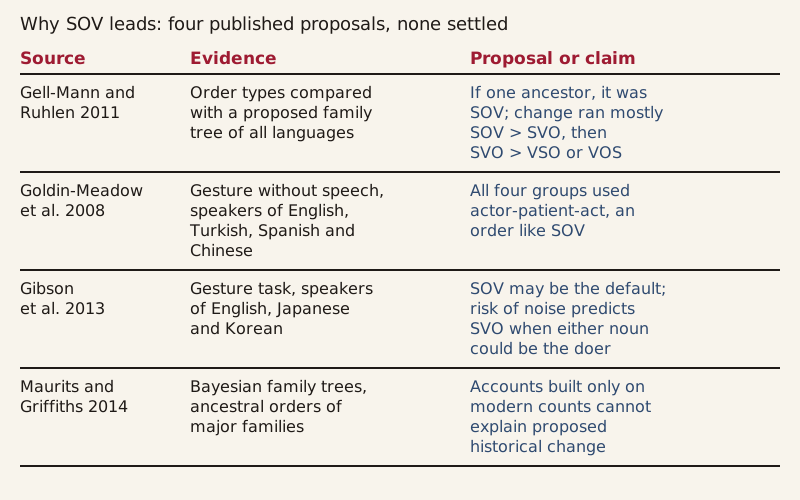
Four published proposals about the SOV lead, summarized from each paper's abstract or, for Maurits and Griffiths, its significance statement. None has settled the question.
Gender is another feature the same atlas counts language by language, and Grammatical Gender picks up there.
Sources
- 1
Matthew S. Dryer. 2013. Order of Subject, Object and Verb. In: Dryer, Matthew S. & Haspelmath, Martin (eds.) WALS Online (v2020.6) [Data set]. Zenodo. https://doi.org/10.5281/zenodo.23010827 (Available online at http://wals.info/chapter/81, Accessed on 2026-10-15.)
https://wals.info/chapter/81 (full text, including maps 81A and 81B)
- 2
Dryer, Matthew S. & Haspelmath, Martin (eds.) 2013. WALS Online (v2020.6) [Data set]. Zenodo. https://doi.org/10.5281/zenodo.23010827 (Available online at https://wals.info, Accessed on 2026-10-15.)
https://doi.org/10.5281/zenodo.23010827 (data tables for features 81A and 81B: values, languages and codes; release notes)
- 3
Matthew S. Dryer. 2013. Determining Dominant Word Order. In: Dryer, Matthew S. & Haspelmath, Martin (eds.) WALS Online (v2020.6) [Data set]. Zenodo. https://doi.org/10.5281/zenodo.23010827 (Available online at http://wals.info/chapter/s6, Accessed on 2026-10-15.)
https://wals.info/chapter/s6 (full text)
- 4
Matthew S. Dryer. 2013. Genealogical Language List. In: Dryer, Matthew S. & Haspelmath, Martin (eds.) WALS Online (v2020.6) [Data set]. Zenodo. https://doi.org/10.5281/zenodo.23010827 (Available online at https://wals.info/languoid/genealogy, Accessed on 2026-10-15.)
https://wals.info/languoid/genealogy (introduction, with the definition of genus)
- 5
Skirgård, Hedvig et al. 2023. Grambank v1.0.3 [Data set]. Zenodo. https://doi.org/10.5281/zenodo.7844558 (Available online at https://grambank.clld.org, Accessed on 2026-10-15.)
https://doi.org/10.5281/zenodo.7844558 (feature definitions and coding procedures for GB131, GB132 and GB133, and their values)
- 6
Natural Earth. Coastline, 1:110m physical vectors, version 4.1.0. Public domain. Made with Natural Earth.
https://www.naturalearthdata.com/downloads/110m-physical-vectors/110m-coastline/ (download page and terms of use)
- 7
Susan Goldin-Meadow, Wing Chee So, Aslı Özyürek and Carolyn Mylander. 2008. The natural order of events: How speakers of different languages represent events nonverbally. Proceedings of the National Academy of Sciences 105(27): 9163–9168.
https://doi.org/10.1073/pnas.0710060105 (abstract)
- 8
Murray Gell-Mann and Merritt Ruhlen. 2011. The origin and evolution of word order. Proceedings of the National Academy of Sciences 108(42): 17290–17295.
https://doi.org/10.1073/pnas.1113716108 (abstract)
- 9
Edward Gibson, Steven T. Piantadosi, Kimberly Brink, Leon Bergen, Eunice Lim and Rebecca Saxe. 2013. A Noisy-Channel Account of Crosslinguistic Word-Order Variation. Psychological Science 24(7): 1079–1088.
https://doi.org/10.1177/0956797612463705 (abstract)
- 10
Luke Maurits and Thomas L. Griffiths. 2014. Tracing the roots of syntax with Bayesian phylogenetics. Proceedings of the National Academy of Sciences 111(37): 13576–13581.
https://doi.org/10.1073/pnas.1319042111 (significance statement)
Download the data: 1,376 languages with WALS and Grambank values (CSV) (Data: WALS Online v2020.6, feature 81A by Matthew S. Dryer, ed. Matthew S. Dryer and Martin Haspelmath (https://doi.org/10.5281/zenodo.23010827), CC BY 4.0, retrieved 2026-10-15; Grambank v1.0.3, Hedvig Skirgård et al. (https://doi.org/10.5281/zenodo.7844558), CC BY 4.0, retrieved 2026-10-15) · counts by language, genus and family (CSV) (Data: WALS Online v2020.6, feature 81A by Matthew S. Dryer, ed. Matthew S. Dryer and Martin Haspelmath (https://doi.org/10.5281/zenodo.23010827), CC BY 4.0, retrieved 2026-10-15) · WALS and Grambank compared (CSV) (Data: WALS Online v2020.6, feature 81A by Matthew S. Dryer, ed. Matthew S. Dryer and Martin Haspelmath (https://doi.org/10.5281/zenodo.23010827), CC BY 4.0, retrieved 2026-10-15; Grambank v1.0.3, Hedvig Skirgård et al. (https://doi.org/10.5281/zenodo.7844558), CC BY 4.0, retrieved 2026-10-15)
Corrections
No corrections yet. Report an error through the corrections address in the page footer; every change is logged here as YYYY-MM-DD — what changed and why.
Decode next:
- Grammatical Gender: the same atlas counts how many genders each language sorts its nouns into, from none to five or more.
- Every Writing System on One Page: the order of words is separate from the direction a script runs, and this table lists the scripts that run right to left.
Cite this page
Codes & Letters. “Word Order: English's SVO Isn't the World's Most Common.” Codes & Letters. Published 2026-10-16. Last substantive revision 2026-10-16. https://codesandletters.com/grammar/word-order/. Accessed [the date you read it].