Grammatical Gender: 145 of 257 Languages in WALS Have None
Codes & Letters
- Published
- Last substantive revision
Grammar featureSpec card
- Feature
- Number of genders, with sex-based or non-sex-based systems and how nouns are assignedSource: WALS chapters 30-32 (Greville G. Corbett, 2013)
- Typology database feature ID
- WALS 30A; WALS 31A and 32A; Grambank GB051, GB192 and GB030Source: WALS Online v2020.6; Grambank v1.0.3
- Main values and distribution
- None 145, Two 50, Three 26, Four 12, Five or more 24 (257 languages)Source: WALS 30A (v2020.6), this page's count
- Example languages
- None: Finnish, Mandarin, Turkish; Two: French, Hindi, Qafar; Three: English, German, Russian; Four: Archi, Lak, Tsez; Five or more: Fula (Guinean), Arapesh (Mountain), SwahiliSource: WALS 30A (v2020.6)
grammatical-gender-spec.csv the values on this card, as CSVData: WALS Online v2020.6, feature 30A by Greville G. Corbett, ed. Matthew S. Dryer and Martin Haspelmath (https://doi.org/10.5281/zenodo.23010827), CC BY 4.0, retrieved 2026-10-16; Grambank v1.0.3, Hedvig Skirgård et al. (https://doi.org/10.5281/zenodo.7844558), CC BY 4.0, retrieved 2026-10-16
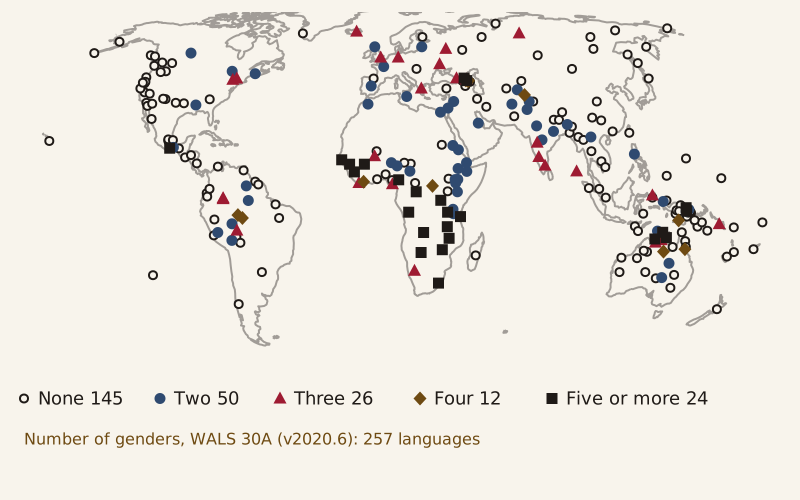
Each mark is one of the 257 languages coded for number of genders in WALS feature 30A (v2020.6), at its WALS coordinates. Open circles are the 145 languages with no gender.
Of the 257 languages that the World Atlas of Language Structures (WALS) checks for grammatical gender, 145 have none. That is 56.4% of the sample in WALS Online v2020.6. German, with three genders, and French, with two, are on the smaller side of the split. English sits there too, but only because of he, she and it.
In the atlas, the test for gender is agreement, not male and female. "The defining characteristic of gender is agreement," writes Greville G. Corbett, author of three atlas chapters on gender: "there must be evidence for gender outside the nouns themselves." Think of a gender as a code that each noun carries and the words around it must repeat. The same atlas supplies the counts on this site's word order page.
How can you tell that a language has gender?
Corbett's chapter shows the test with three Russian sentences, romanized as in WALS. "Žurnal ležal na stole" means "The magazine lay on the table." Put kniga, "book," in place of the magazine and the verb becomes ležal-a; put in pis´mo, "letter," and it becomes ležal-o. Nothing else changes, so the verb ending is tracking the noun, which is masculine, feminine or neuter.
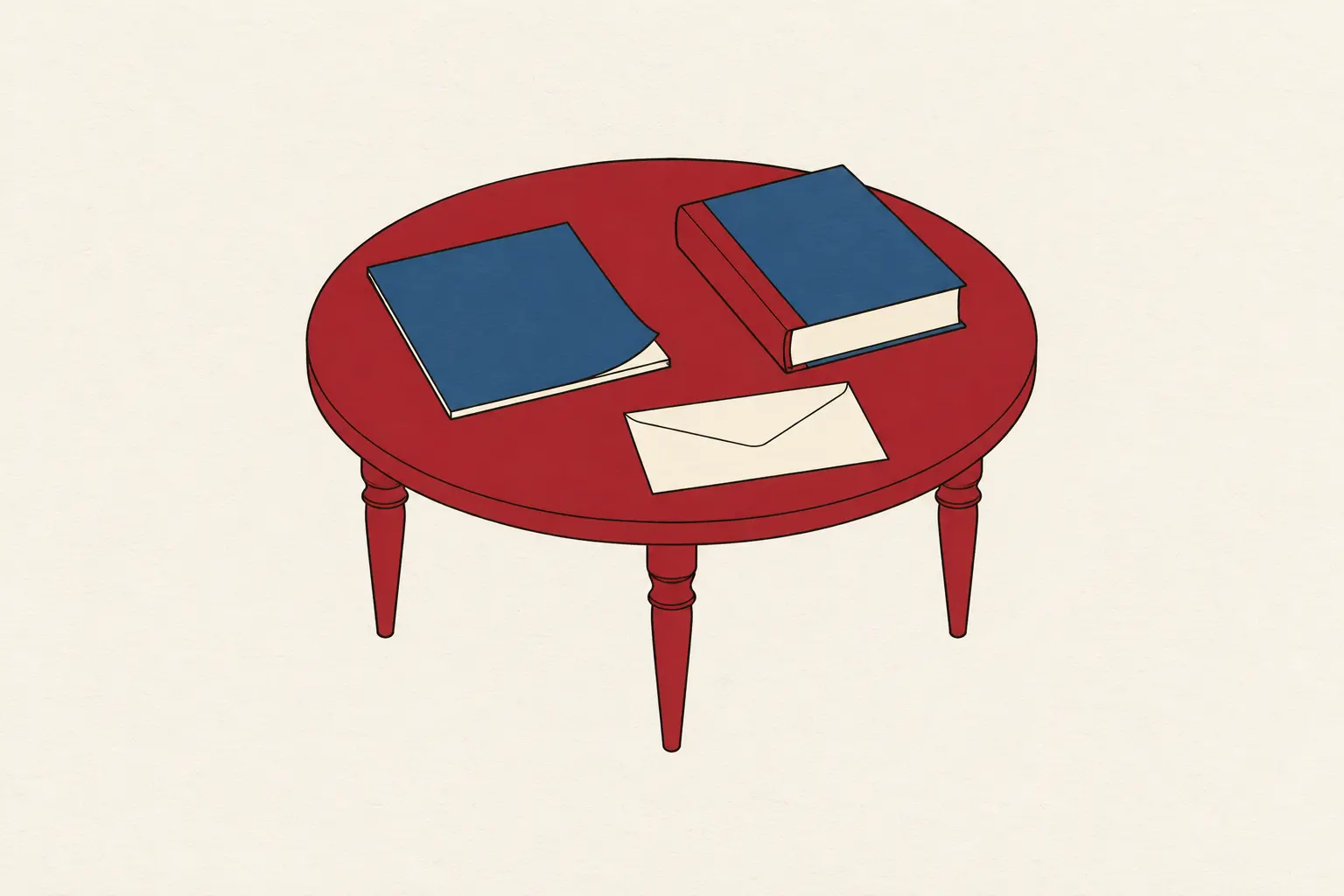 Generated illustration
A magazine, a book and a letter on a table. In Russian, "lay" is ležal for the magazine, ležal-a for the book and ležal-o for the letter.
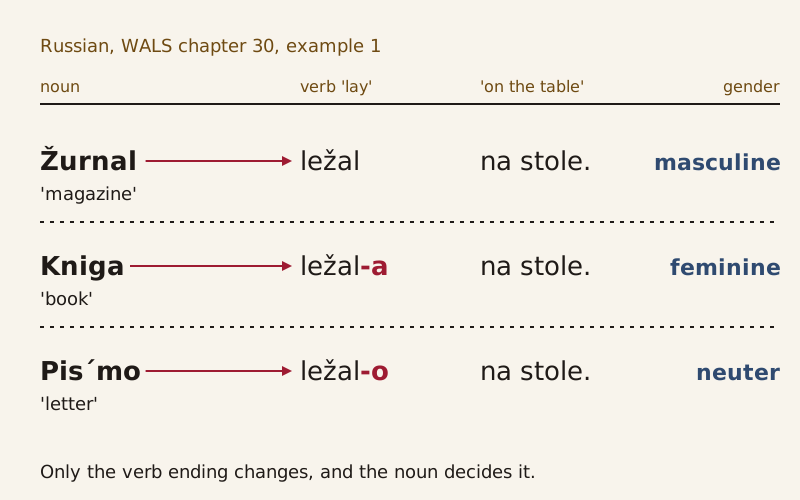
Three Russian sentences from WALS chapter 30. Apart from the noun, only the verb "lay" changes: its ending follows the noun's gender, with no added ending for the masculine.
Words for males and females are not enough on their own. Kanuri, spoken in Nigeria, has separate words for "boy" and "girl," but Corbett calls that "a matter of lexical semantics, and not a gender system," and WALS codes Kanuri with no gender. Corbett puts English poet and poetess in the same category. A noun's own ending does not settle it either: Russian djadja, "uncle," ends in -a like kniga but takes masculine agreement.
Does English have grammatical gender?
By the atlas's definition, yes. WALS codes English with three genders, shown only in its third-person pronouns. A 1913 grammar by George Lyman Kittredge and Frank Edgar Farley lists them as "different forms for masculine, feminine, and neuter in the singular (he, she, it)." Corbett counts a pronoun that matches its noun, as in "the girl ... she," as agreement, and he calls English "typologically unusual in this respect."
Other sources draw the line elsewhere. Grambank v1.0.3 codes English 1 on feature GB030, "Is there a gender distinction in independent 3rd person pronouns?" It codes English 0 on GB051, "Is there a gender/noun class system where sex is a factor in class assignment?", with the note "There is no gender agreement between dependents and head noun, but personal pronouns and their antecedents can agree in sex within NP structure." The 1911 Encyclopaedia Britannica goes further and calls grammatical gender something "which has no existence in English."
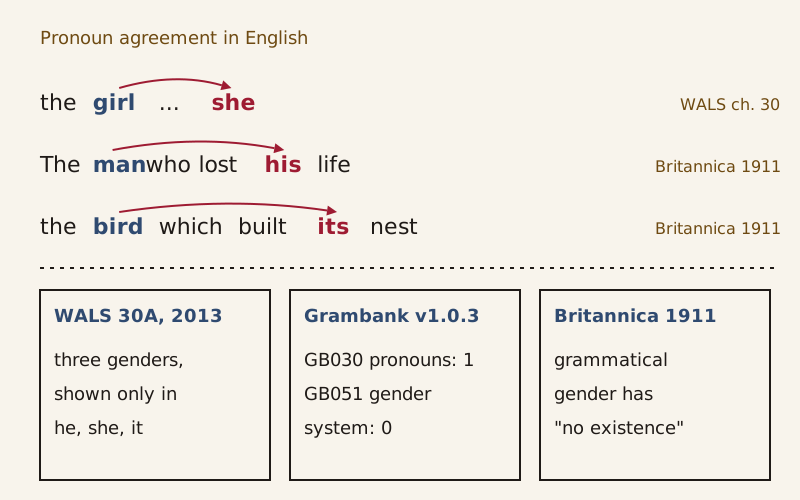
Pronoun agreement in English, with examples from WALS chapter 30 and the 1911 Britannica, and three verdicts on whether English has grammatical gender.
The Britannica article, "English Language," also tells how the nouns lost it. In Old English, "the good horse," "the good hound" and "the good book" each took a different form of the word for "the." Once such endings were "levelled to final e, or other weak sounds," it says, "grammatical gender had ceased to exist," and pronouns now follow "rationality and sex," as in "the bird which built its nest." WALS also maps other distinctions that pronouns make, such as a polite form of "you," covered on Thou vs You.
How many genders can a language have?
When a language has gender at all, two is the commonest number. WALS v2020.6 codes 50 languages with two genders, 26 with three, 12 with four and 24 with five or more. Counted by genus instead, the share with no gender rises from 56.4% to 59.9%, by this page's count. Each of the 172 genera, groups of languages "whose relatedness is fairly obvious without systematic comparative analysis," gets one vote, split among its languages.
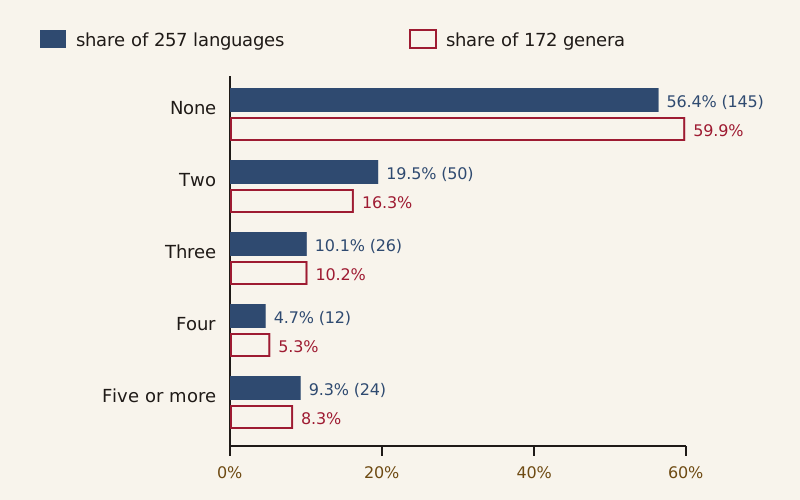
WALS 30A counted two ways: by language, and by genus, with each genus given one vote split among its languages (this page's count).
The chapter text describes a 256-language map with 144 languages lacking gender, while the v2020.6 data has 257 and 145. This page follows the data.
The atlas puts every system of five or more in one group, so it names no single winner. Corbett's chapter names three large ones: Nigerian Fula has "around twenty genders, depending on the dialect," Mountain Arapesh in Papua New Guinea has 13, and Ngan'gityemerri in northern Australia "arguably" has 15. He counts noun classes as genders too. Counting a noun's singular and plural together, "a typical Bantu language may have 7-10 genders rather than around 20 noun classes."
On German's three, the chapter says that in Indo-European "many languages retain three genders (like Icelandic and German), while many others have reduced to two (like French and Spanish)." A minority, such as Armenian, have lost gender altogether. This site reads the whole range as variety, not rank: no language is primitive, with genders or without them.
Is grammatical gender about male and female?
Usually in part, but not always. Of the 112 languages in the sample with gender, 84 (75.0%) have sex-based systems and 28 (25.0%) do not, matching Corbett's "three quarters." Even then, sex does not account for every noun: in French or Russian, he writes, the masculine includes "a large proportion of nouns which do not denote males." In Russian, "shark" is feminine and "dolphin" masculine.
The other systems "are all based on some type of animacy." In Maasina Fulfulde, nouns for men and women share one gender. But "the elephant," "the boat" and "the tree" each take a different article. Eastern Ojibwa treats persons, animals, spirits and trees as animate, along with a few surprises: "star," "raspberry" and "kettle."
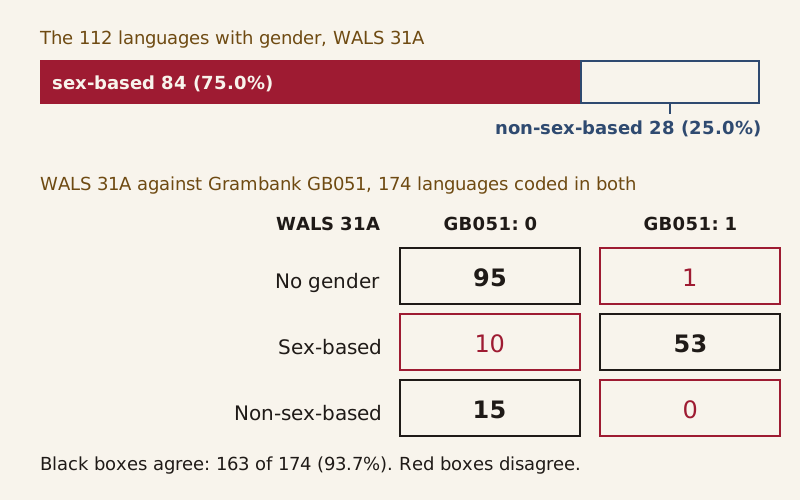
Top: WALS 31A splits the 112 languages with gender into sex-based and non-sex-based systems. Bottom: WALS 31A against Grambank GB051 for 174 languages coded in both.
Grambank's GB051 asks the sex question directly. Where both databases code a language and its Glottolog code matches, they agree on 163 of 174 (93.7%), by this page's count. In 10 of the 11 mismatches, WALS has a sex-based system and Grambank codes 0, English and Qafar among them; Kilivila goes the other way. Grambank's procedure looks for gender markers in agreement within the noun phrase, on the noun or in verb indexing, while WALS also counts pronouns.
The signs that stand for male and female are another kind of code, traced on Male and Female Symbols. In 28 of the 112 gender systems in WALS, sex is not the core at all.
How does a noun get its gender?
WALS splits the 112 gender languages almost evenly: 53 assign gender by meaning and 59 by meaning and form. In Kannada, meaning is enough. Nouns for male humans are masculine and those for female humans feminine, with deities, demons and heavenly bodies also placed in these two; "all remaining nouns, including those denoting infants and animals, are neuter." So candra, "moon," is masculine and na:yi, "dog," is neuter.
Russian needs form as well. Its words for "magazine," "newspaper" and "letter" (žurnal, gazeta and pis´mo) mean similar things yet fall into three genders. The noun's inflection class decides. Meaning still wins a conflict: djadja, "uncle," belongs to a class whose nouns are typically feminine, yet it is masculine.
In Qafar, a Cushitic language of Ethiopia and Djibouti, nouns outside the male and female rules go by sound, so karmà, "autumn," which ends in an accented vowel, is feminine.
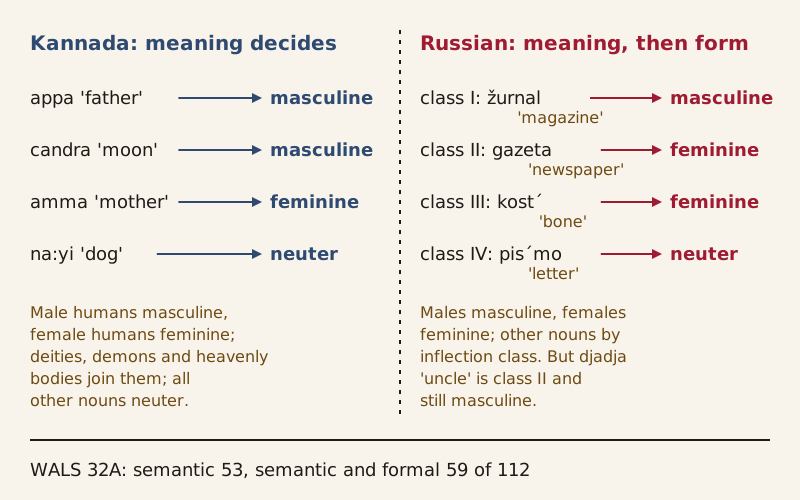
Gender assignment in two languages from WALS chapter 32. In Kannada, meaning decides gender; in Russian, nouns outside the male and female rules follow their inflection class.
Corbett writes that languages may assign gender by meaning or by meaning and form, "but not just on formal rules," and that where careful research has been done, gender is predictable for "at least 85% of the noun inventory." WALS codes German and French as "semantic and formal" and English as "semantic."
In WALS, "formal" covers rules of sound and of morphology, such as Russian inflection class, while Grambank's GB192 asks about sound only. Among languages both databases code, matched by Glottolog code, GB192 is 1 for 17 of the 35 that WALS calls "semantic and formal" and for none of the 30 it calls "semantic."
Some grammars mark something else: how the speaker knows what is reported. That is the subject of Evidentiality.
Sources
- 1
Greville G. Corbett. 2013. Number of Genders. In: Dryer, Matthew S. & Haspelmath, Martin (eds.) WALS Online (v2020.6) [Data set]. Zenodo. https://doi.org/10.5281/zenodo.23010827 (Available online at http://wals.info/chapter/30, Accessed on 2026-10-16.)
https://wals.info/chapter/30 (full text, including map 30A and its table of values)
- 2
Greville G. Corbett. 2013. Sex-based and Non-sex-based Gender Systems. In: Dryer, Matthew S. & Haspelmath, Martin (eds.) WALS Online (v2020.6) [Data set]. Zenodo. https://doi.org/10.5281/zenodo.23010827 (Available online at http://wals.info/chapter/31, Accessed on 2026-10-16.)
https://wals.info/chapter/31 (full text, including map 31A and its table of values)
- 3
Greville G. Corbett. 2013. Systems of Gender Assignment. In: Dryer, Matthew S. & Haspelmath, Martin (eds.) WALS Online (v2020.6) [Data set]. Zenodo. https://doi.org/10.5281/zenodo.23010827 (Available online at http://wals.info/chapter/32, Accessed on 2026-10-16.)
https://wals.info/chapter/32 (full text, including map 32A and its table of values)
- 4
Dryer, Matthew S. & Haspelmath, Martin (eds.) 2013. WALS Online (v2020.6) [Data set]. Zenodo. https://doi.org/10.5281/zenodo.23010827 (Available online at https://wals.info, Accessed on 2026-10-16.)
https://doi.org/10.5281/zenodo.23010827 (data tables for features 30A, 31A and 32A: values, languages and codes)
- 5
Matthew S. Dryer. 2013. Genealogical Language List. In: Dryer, Matthew S. & Haspelmath, Martin (eds.) WALS Online (v2020.6) [Data set]. Zenodo. https://doi.org/10.5281/zenodo.23010827 (Available online at https://wals.info/languoid/genealogy, Accessed on 2026-10-16.)
https://wals.info/languoid/genealogy (introduction, with the definition of genus)
- 6
Skirgård, Hedvig et al. 2023. Grambank v1.0.3 [Data set]. Zenodo. https://doi.org/10.5281/zenodo.7844558 (Available online at https://grambank.clld.org, Accessed on 2026-10-16.)
https://doi.org/10.5281/zenodo.7844558 (features GB030, GB051 and GB192: names, definitions, coding procedures and values, with the coding note for English)
- 7
"English Language." Encyclopaedia Britannica, 11th edition, vol. 9 (signed J. A. H. M.; H. M. R. M.). Project Gutenberg eBook #35306.
https://www.gutenberg.org/ebooks/35306 (passage on the loss of grammatical gender in English)
- 8
George Lyman Kittredge and Frank Edgar Farley. 1913. An Advanced English Grammar with Exercises. Boston: Ginn and Company. Section 116. Project Gutenberg eBook #45814.
https://www.gutenberg.org/ebooks/45814 (sections 65–67 (gender) and 116 (gender and number of personal pronouns))
- 9
Natural Earth. Coastline, 1:110m physical vectors, version 4.1.0. Public domain. Made with Natural Earth.
https://www.naturalearthdata.com/downloads/110m-physical-vectors/110m-coastline/ (download page and terms of use)
Download the data: languages and values (CSV) (Data: WALS Online v2020.6, features 30A, 31A and 32A by Greville G. Corbett, ed. Matthew S. Dryer and Martin Haspelmath (https://doi.org/10.5281/zenodo.23010827), CC BY 4.0, retrieved 2026-10-16; Grambank v1.0.3, Hedvig Skirgård et al. (https://doi.org/10.5281/zenodo.7844558), CC BY 4.0, retrieved 2026-10-16) · counts by language and genus (CSV) (Data: WALS Online v2020.6, features 30A, 31A and 32A by Greville G. Corbett, ed. Matthew S. Dryer and Martin Haspelmath (https://doi.org/10.5281/zenodo.23010827), CC BY 4.0, retrieved 2026-10-16; Grambank v1.0.3, Hedvig Skirgård et al. (https://doi.org/10.5281/zenodo.7844558), CC BY 4.0, retrieved 2026-10-16) · WALS and Grambank compared (CSV) (Data: WALS Online v2020.6, feature 31A by Greville G. Corbett, ed. Matthew S. Dryer and Martin Haspelmath (https://doi.org/10.5281/zenodo.23010827), CC BY 4.0, retrieved 2026-10-16; WALS Online v2020.6, chapter and feature 32A by Greville G. Corbett, ed. Matthew S. Dryer and Martin Haspelmath (https://doi.org/10.5281/zenodo.23010827), CC BY 4.0, retrieved 2026-10-16; Grambank v1.0.3, Hedvig Skirgård et al. (https://doi.org/10.5281/zenodo.7844558), CC BY 4.0, retrieved 2026-10-16)
Corrections
No corrections yet. Report an error through the corrections address in the page footer; every change is logged here as YYYY-MM-DD — what changed and why.
Decode next:
- Male and Female Symbols: the two signs biology uses for male and female, and the code points Unicode gives them.
- Evidentiality: grammars that can mark whether the speaker saw, heard or inferred what is reported.
Cite this page
Codes & Letters. “Grammatical Gender: 145 of 257 Languages in WALS Have None.” Codes & Letters. Published 2026-10-16. Last substantive revision 2026-10-16. https://codesandletters.com/grammar/grammatical-gender/. Accessed [the date you read it].