Thou vs You: Thou Was the Familiar Form, Not the Formal One
Codes & Letters
- Published
- Last substantive revision
Grammar featureSpec card
- Feature
- Politeness distinctions in second-person pronounsSource: WALS chapter 45 (Helmbrecht 2013)
- Typology database feature ID
- WALS 45A; Grambank GB415Source: WALS v2020.6; Grambank v1.0.3
- Main values and distribution
- no distinction 136, binary 49, multiple 15, pronouns avoided 7 (of 207 languages)Source: WALS 45A (v2020.6), counted from the data
- Example languages
- no distinction: English, Irish; binary: German, French, Russian; multiple: Hindi, Hungarian, Marathi; pronouns avoided: Japanese, Korean, ThaiSource: WALS 45A (v2020.6) values
thou-vs-you-spec.csv the values on this card, as CSVData: WALS Online v2020.6, feature 45A by Johannes Helmbrecht, ed. Matthew S. Dryer and Martin Haspelmath (https://doi.org/10.5281/zenodo.23010827), CC BY 4.0, retrieved 2026-10-16; Grambank v1.0.3, Hedvig Skirgård et al. (https://doi.org/10.5281/zenodo.7844558), CC BY 4.0, retrieved 2026-10-16
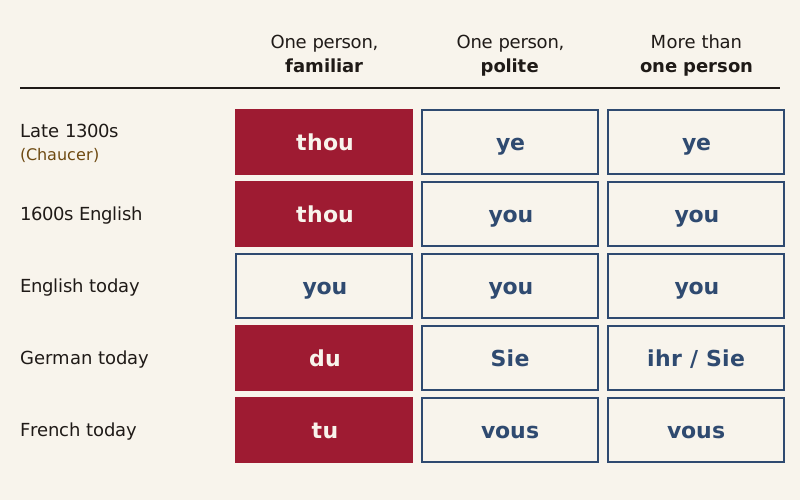
Subject forms of "you" in older English, English today, German and French. Solid red tiles are familiar singular forms; outlined blue tiles are polite or plural forms.
A 1660 London book complained that children who said thou to one person were called clowns. In that century thou was the familiar word, used for family and friends, and for people of lower rank. The polite way to speak to one person was you, a word that began as a plural.
Standard English later kept you for everyone, and thou survived in prayer, scripture and poetry. In 1913, the grammarians George Lyman Kittredge and Frank Edgar Farley listed it among old forms "still found in poetry and the solemn style."
Losing the split put English in the majority of one large sample. In the World Atlas of Language Structures (WALS), 136 of 207 languages make no politeness distinction in their pronouns. German still has du and Sie, and French has tu and vous.
What was the difference between thou, thee and ye?
Thou and ye were the subject forms, for one person and for more. Thee and you were the object forms, split the way he and him still are. Goold Brown's The Grammar of English Grammars, dated 1851, says the King James Bible keeps them all apart:
| One person | More than one | |
|---|---|---|
| Subject | thou | ye |
| Object | thee | you |
| Possessive | thy, thine | your, yours |
Fashionable speech had already moved on when that Bible appeared in 1611. Before it, Brown writes, fashionable usage "had commonly substituted you for ye." That made you a subject form too, "applying it to one hearer as well as to more."
Middle English spelling looked different again. An 1888 dictionary of Middle English by A. L. Mayhew and Walter W. Skeat lists þou and þu for thou, and ȝe for ye. The letter þ, called thorn, came from the runic alphabet. The eleventh edition of the Encyclopaedia Britannica says that in Old English manuscripts it was "revived from the old Runic alphabet" for a sound the Roman alphabet had no letter for; Elder Futhark covers those runes.
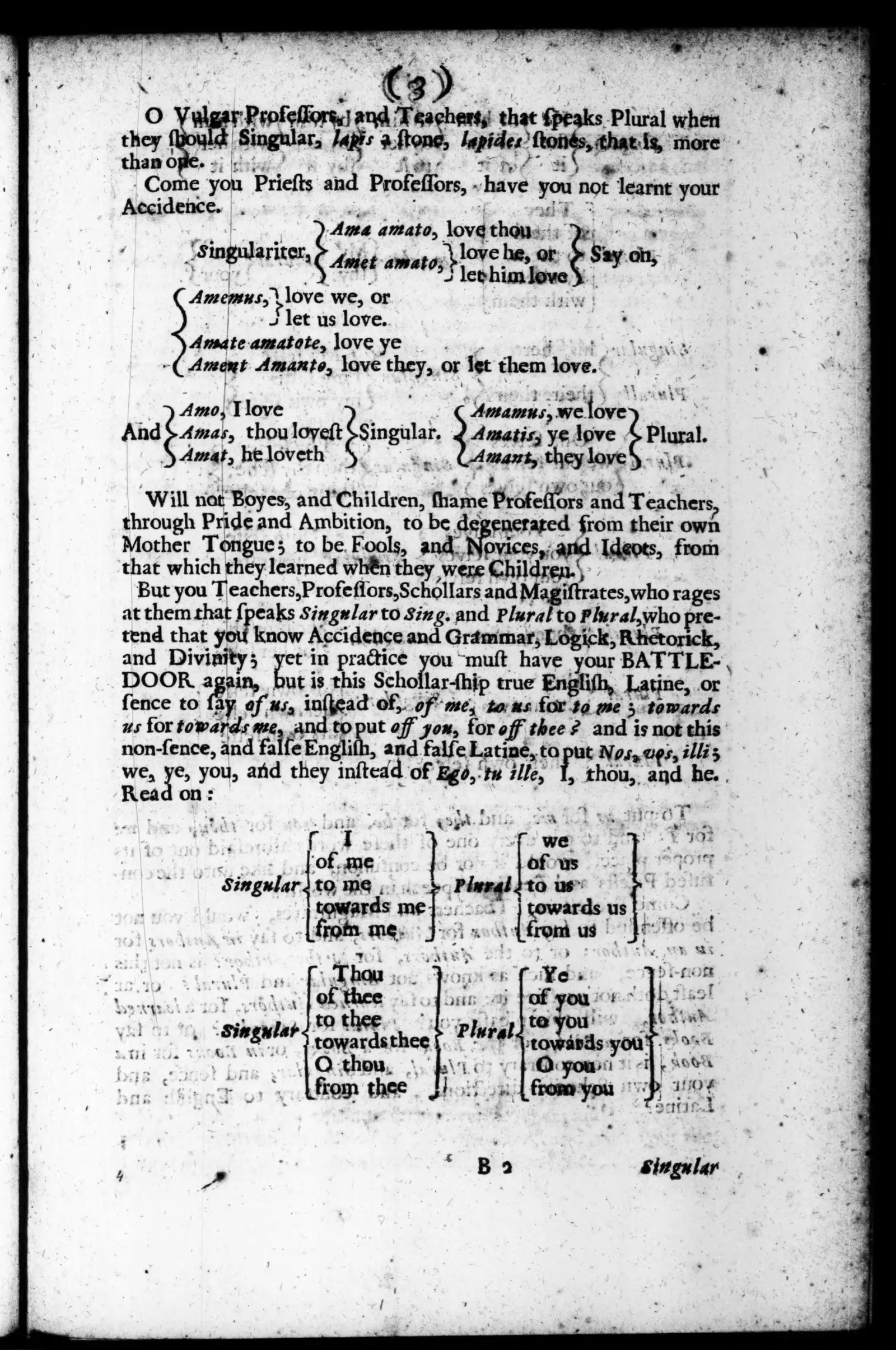
Image credit and license (full text)
"A battle-door for teachers ... 1660 (IA bim early-english-books-1641-1700 a-battle-door-for-teache fox-george 1660)" by George Fox, John Stubbs and Benjamin Furly — Public domain (printed in London in 1660; its compilers George Fox (died 1691), Benjamin Furly (died 1714) and John Stubbs (an adult by 1660) all died far more than 70 years ago, so it is public domain in the US and the EU; a faithful copy of a flat page) — https://commons.wikimedia.org/wiki/File:A_battle-door_for_teachers_..._1660_%28IA_bim_early-english-books-1641-1700_a-battle-door-for-teache_fox-george_1660%29.pdf; modifications: page 7 of the 229-page PDF rendered at 300 ppi in grayscale, 32 px cropped from the bottom edge to remove a microfilm frame labelA page of A Battle-Door for Teachers & Professors (London, 1660) by George Fox, John Stubbs and Benjamin Furly, setting singular "Thou, of thee, to thee" against plural "Ye, of you, to you."
Who was called thou?
Think of the pair as two ways to encode the same listener. The choice itself carried part of the message. In his notes to Chaucer's Canterbury Tales (second edition, 1900), Walter W. Skeat put the Middle English pattern this way: thou "is the language of a lord to a servant, of an equal to an equal." Ye "is the language of a servant to a lord, and of compliment."
Skeat drew the rule from one romance, William of Palerne, and called it "generally true" of Middle English. The same note says thou could also express "love" or "scorn."
Writers on the 1600s describe the same two edges. Richard Chenevix Trench, in English Past and Present, calls thou in that century "the sign of familiarity, whether that familiarity was of love, or of contempt and scorn." He also quotes Wallis's Latin grammar of English (1654), which says that speaking to someone in the singular usually showed disdain or fond familiarity.
At Sir Walter Raleigh's trial in 1603, Trench writes, Coke insulted the defendant with "I thou thee, thou traitor." In Shakespeare's Twelfth Night, Sir Toby tells Sir Andrew how to word a challenge: "If thou 'thou'st' him some thrice, it shall not be amiss."
Trench also quotes Thomas Fuller, who answered the Quakers in his Church History by grading the word by rank. Said to an inferior, thou was "proper, as a sign of command." Between equals it was "passable." Said to a superior, it showed "a smack of clownishness" or "a tone of contempt."
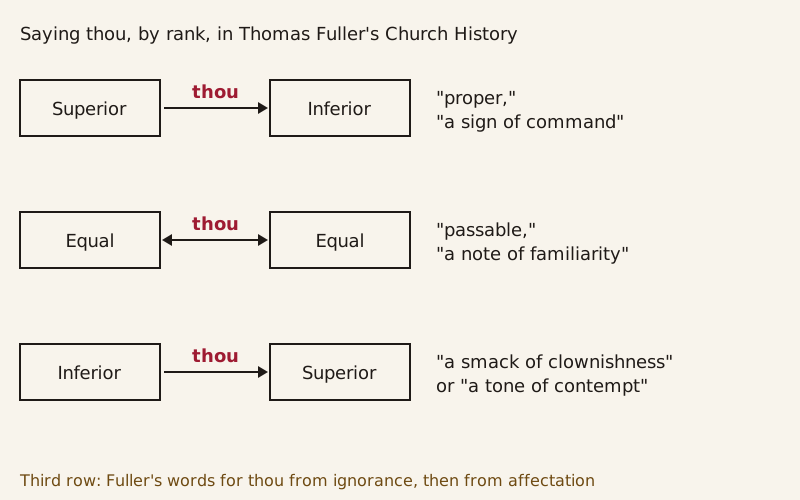
Thomas Fuller's verdicts on saying "thou" to inferiors, equals and superiors, as quoted by Richard Chenevix Trench. The words in quotation marks are Fuller's.
Why did English stop using thou?
The sources describe how polite you spread better than they explain why. Brown gave the history as it "appears to be." Speaking to great people in the plural began as "a species of court flattery," "as if a great man were something more than one person." Humbler speakers followed, he says, until the habit reached all ranks.
Johannes Helmbrecht, who wrote the WALS chapter on politeness in pronouns, gives a different motive for French vous. In his account it "presumably" became polite because a plural "renders the reference less direct and less specific."
Refusing the polite plural drew notice. George Fox, founder of the Quakers, wrote in his Journal, first published in 1694, that he "was required to Thee and Thou all men and women, without any respect to rich or poor, great or small." Quakers who did so, he recorded, were "often beaten and abused." Many Quaker tradesmen lost customers at first, he wrote, when Friends would not say you to one person or take off their hats.
 Generated illustration
A customer leaves a shop. Many Quaker tradesmen lost customers at first, George Fox wrote, when Friends would not say you to one person or take off their hats.
Fox wrote that John Stubbs and Benjamin Furly compiled the 1660 Battle-Door at his request. Using examples from about thirty languages, it set out to show that thou was the proper word for one person in all of them.
By 1851, Brown wrote, the plural had become "the customary mode of address to individuals of every rank." Quakers kept the singular in everyday talk. The singular was still used for God and generally preferred in poetry. Kittredge and Farley's 1913 grammar notes one trace of the plural past: you, "even when denoting a single person, always takes the verb-forms that go with plural subjects," as in you were.
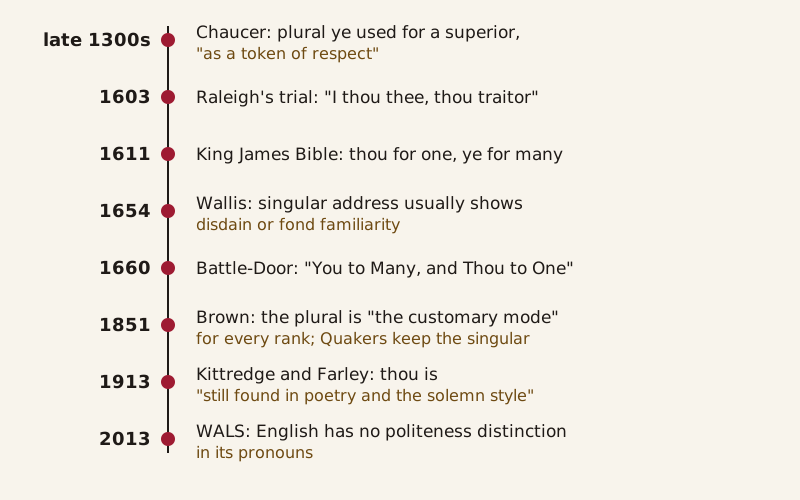
Eight dated points in the history of "thou" and "you," from Chaucer's usage, as Skeat's notes describe it, to the WALS coding of English.
Which languages still have a formal you?
WALS is also the database behind this site's pages on word order and evidentiality. Its feature 45A sorts 207 languages into four types. By this page's count of the v2020.6 data, 136 make no politeness distinction in their pronouns (65.7%). Another 49 have a two-way split (23.7%), 15 have several levels (7.2%) and 7 avoid pronouns to be polite (3.4%).
English is in the first group. The WALS note on English says thou "disappeared in Standard English" and is "used only in liturgical speech, mostly to address god."
In WALS, the two-way type is the European pattern of German du and Sie, French tu and vous and Russian ty and vy. Helmbrecht calls Europe and nearby areas its "hotbed." Several levels are rare and found mostly in South Asia. Marathi, in the WALS spelling, has tū for family and intimates, te and he for people of higher status, and āpaṇ for priests, teachers and very formal settings.
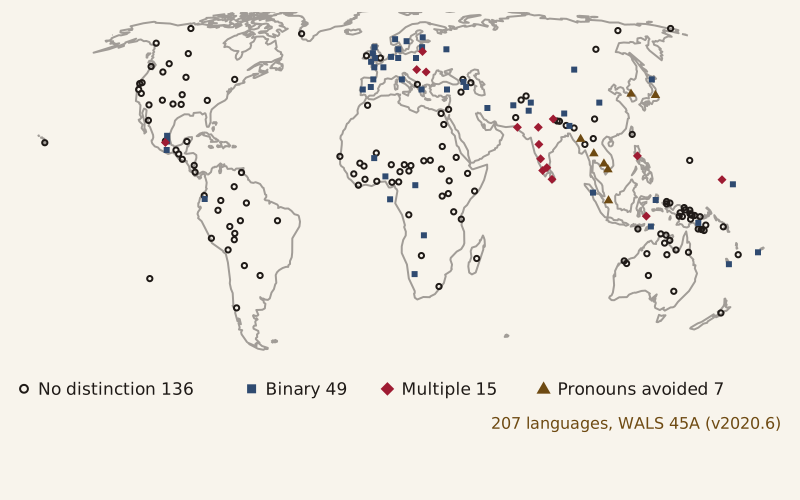
The 207 languages with a value for WALS feature 45A, at their WALS coordinates. Two-way systems cluster in Europe, several levels in South Asia, and pronoun avoidance in East and Southeast Asia.
Polite forms come from different places. WALS notes that Spanish usted is a worn-down vuestra merced, "Your honour." English, like French, took the plural route.
The sample is not the world. Helmbrecht notes that the 207 languages lean toward Europe and East and Southeast Asia, where the split is common. On a more representative subset, he puts the share without it at "around three quarters." Counted by genus, with each group of clearly related languages getting one vote (split when its members differ), the data give 74.0% without it, by this page's count.
Grambank v1.0.3 asks a simpler yes-or-no question: whether second-person forms change with respect or closeness. It says yes for 242 of the 1,739 languages it codes either way (13.9%). Where both databases code a language and its Glottolog code matches, they agree on 92 of 107 by this page's count, counting WALS's three other types as yes. Italian and Portuguese, two-way in WALS, are "absent" in Grambank with the note "3rd person"; WALS calls Italian lei a third-person pronoun "used for polite address."
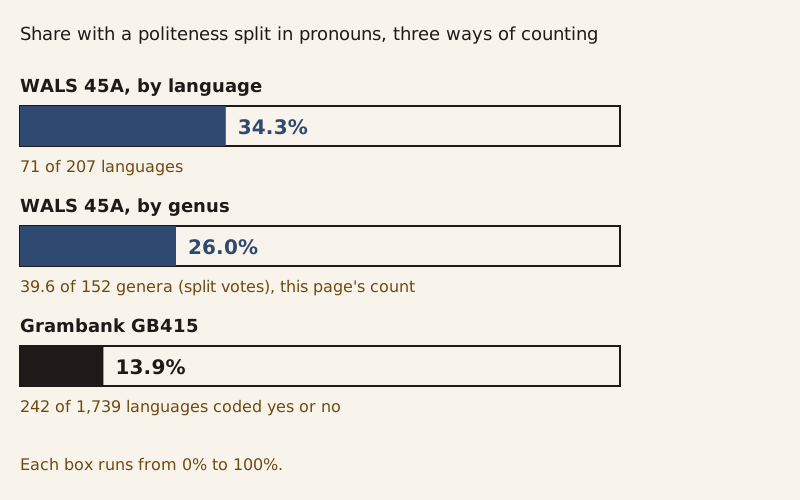
Share of languages with a politeness split in second-person pronouns: WALS 45A counted by language and by genus, and Grambank GB415. WALS includes avoidance; Grambank asks yes or no.
How do languages manage without a polite you?
WALS codes seven languages as avoiding pronouns to be polite: Burmese, Indonesian, Japanese, Khmer, Korean, Thai and Vietnamese. In these languages, Helmbrecht writes, "status and kinship terms, titles and other complex nominal expressions" do the polite work, and any second-person pronouns "are used to address social equals and inferiors."
The WALS notes give examples. For Korean, citing Ho-Min Sohn (1999), they list apeci "Father," sensayng-nim "teacher" and sacang-nim "company president" as stand-ins for a pronoun. For Vietnamese, the chapter names kinship nouns such as anh "elder brother" and ông "grandfather." These also refer to the speaker or to others, so WALS leaves them out of the pronoun data.
Japanese anata is listed for "equals and inferiors," and its polite stand-in o-taku is an honorific plus "house." Grambank has no separate avoidance type. It covers five of these languages and codes each of them as having the split.
Two entries loop back to English. WALS records Thai juu´ and Burmese yu, both borrowed from English you, as familiar forms: the Thai one for a friend, the Burmese one as university slang.
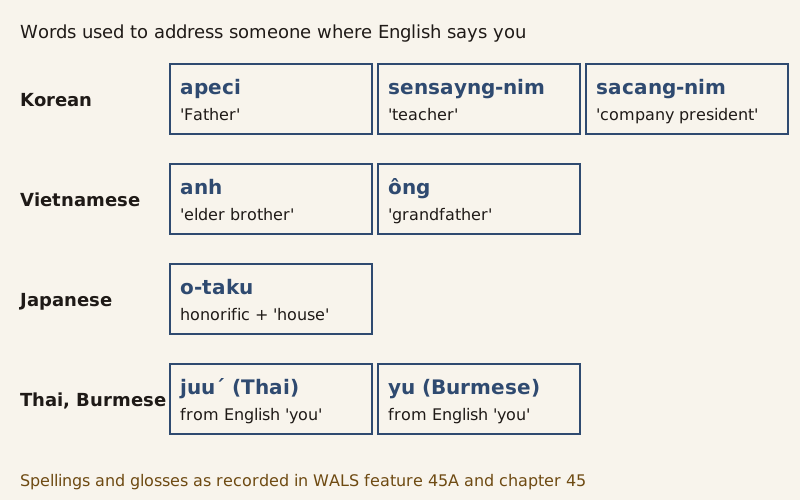
Address words that WALS records for languages coded as avoiding pronouns for politeness, plus two familiar borrowings of English "you." Spellings and glosses follow WALS.
The first letter of Middle English þou came from the runic alphabet, and Elder Futhark goes back to the runes themselves.
Sources
- 1
George Fox, John Stubbs and Benjamin Furly. 1660. A Battle-Door for Teachers & Professors to Learn Singular & Plural; You to Many, and Thou to One. London: Printed for Robert Wilson. Microfilm scan on Wikimedia Commons.
https://commons.wikimedia.org/wiki/File:A_battle-door_for_teachers_..._1660_%28IA_bim_early-english-books-1641-1700_a-battle-door-for-teache_fox-george_1660%29.pdf (title page, introduction and pronoun tables (PDF pages 1, 3, 6, 7 and 8))
- 2
George Fox. George Fox: An Autobiography. Edited by Rufus M. Jones. Philadelphia: Ferris & Leach, 1903 (1909 printing). Project Gutenberg eBook #43031.
https://www.gutenberg.org/ebooks/43031 (passages on Thee and Thou and on the Battle-Door)
- 3
William Shakespeare. Twelfth Night; or, What You Will. Act 3, scene 2. Project Gutenberg eBook #1526.
https://www.gutenberg.org/ebooks/1526 (act 3, scene 2)
- 4
Walter W. Skeat, ed. 1900. The Complete Works of Geoffrey Chaucer. Vol. 5, Notes to the Canterbury Tales. 2nd ed. Oxford: Clarendon Press. Notes to lines A 1, A 356 and B 1677. Project Gutenberg eBook #43016.
https://www.gutenberg.org/ebooks/43016 (notes to lines A 1, A 356 and B 1677)
- 5
A. L. Mayhew and Walter W. Skeat. 1888. A Concise Dictionary of Middle English from A.D. 1150 to 1580. Oxford: Clarendon Press. Project Gutenberg eBook #10625.
https://www.gutenberg.org/ebooks/10625 (entries for thou and ye)
- 6
Richard Chenevix Trench. English Past and Present. Edited by A. Smythe Palmer. London: George Routledge & Sons, 1905 (text of Trench's fifth edition). Project Gutenberg eBook #20900.
https://www.gutenberg.org/ebooks/20900 (lecture passages on thou and thee and on the 1611 edition of the Bible, with notes 195 and 196)
- 7
Goold Brown. The Grammar of English Grammars. Preface dated Lynn, Mass., 1851. Part II, chapter V (pronouns), observation 21, and chapter VI (verbs), observations 6 and 7. Project Gutenberg eBook #11615.
https://www.gutenberg.org/ebooks/11615 (chapter V, observation 21; chapter VI, observations 6 and 7)
- 8
George Lyman Kittredge and Frank Edgar Farley. 1913. An Advanced English Grammar with Exercises. Boston: Ginn and Company. Sections 115–117. Project Gutenberg eBook #45814.
https://www.gutenberg.org/ebooks/45814 (sections 115–117 (personal pronouns))
- 9
Johannes Helmbrecht. 2013. Politeness Distinctions in Pronouns. In: Dryer, Matthew S. & Haspelmath, Martin (eds.) WALS Online (v2020.6) [Data set]. Zenodo. https://doi.org/10.5281/zenodo.23010827 (Available online at http://wals.info/chapter/45, Accessed on 2026-10-16.)
https://wals.info/chapter/45 (full text, including map 45A)
- 10
Dryer, Matthew S. & Haspelmath, Martin (eds.) 2013. WALS Online (v2020.6) [Data set]. Zenodo. https://doi.org/10.5281/zenodo.23010827 (Available online at https://wals.info, Accessed on 2026-10-16.)
https://doi.org/10.5281/zenodo.23010827 (data tables for feature 45A: values, value notes, languages and codes)
- 11
Matthew S. Dryer. 2013. Genealogical Language List. In: Dryer, Matthew S. & Haspelmath, Martin (eds.) WALS Online (v2020.6) [Data set]. Zenodo. https://doi.org/10.5281/zenodo.23010827 (Available online at https://wals.info/languoid/genealogy, Accessed on 2026-10-16.)
https://wals.info/languoid/genealogy (introduction, with the definition of genus)
- 12
Skirgård, Hedvig et al. 2023. Grambank v1.0.3 [Data set]. Zenodo. https://doi.org/10.5281/zenodo.7844558 (Available online at https://grambank.clld.org, Accessed on 2026-10-16.)
https://doi.org/10.5281/zenodo.7844558 (feature GB415: definition, coding procedure and values)
- 13
"English Language." Encyclopaedia Britannica, 11th edition, vol. 9 (signed J. A. H. M.; H. M. R. M.). Project Gutenberg eBook #35306.
https://www.gutenberg.org/ebooks/35306 (section on the letters of Old English manuscripts)
- 14
"Fox, George." Encyclopaedia Britannica, 11th edition, vol. 10 (signed A. N. B.). Project Gutenberg eBook #36104.
https://www.gutenberg.org/ebooks/36104 (full article)
- 15
Natural Earth. Coastline, 1:110m physical vectors, version 4.1.0. Public domain. Made with Natural Earth.
https://www.naturalearthdata.com/downloads/110m-physical-vectors/110m-coastline/ (download page and terms of use)
Download the data: WALS 45A languages with Grambank GB415 (CSV) (Data: WALS Online v2020.6, feature 45A by Johannes Helmbrecht, ed. Matthew S. Dryer and Martin Haspelmath (https://doi.org/10.5281/zenodo.23010827), CC BY 4.0, retrieved 2026-10-16; Grambank v1.0.3, Hedvig Skirgård et al. (https://doi.org/10.5281/zenodo.7844558), CC BY 4.0, retrieved 2026-10-16) · counts and cross-tab (CSV) (Data: WALS Online v2020.6, feature 45A by Johannes Helmbrecht, ed. Matthew S. Dryer and Martin Haspelmath (https://doi.org/10.5281/zenodo.23010827), CC BY 4.0, retrieved 2026-10-16; Grambank v1.0.3, Hedvig Skirgård et al. (https://doi.org/10.5281/zenodo.7844558), CC BY 4.0, retrieved 2026-10-16)
Corrections
No corrections yet. Report an error through the corrections address in the page footer; every change is logged here as YYYY-MM-DD — what changed and why.
Decode next:
- Elder Futhark: the runes in their own right, for the alphabet behind thorn, the first letter of þou.
- Grammatical Gender: the other split that pronouns and nouns can carry, and how many WALS languages do without it.
Cite this page
Codes & Letters. “Thou vs You: Thou Was the Familiar Form, Not the Formal One.” Codes & Letters. Published 2026-10-16. Last substantive revision 2026-10-16. https://codesandletters.com/grammar/thou-vs-you/. Accessed [the date you read it].