Elder Futhark: 24 Runes, but the Vikings Wrote With Only 16
Codes & Letters
- Published
- Last substantive revision
Writing systemSpec card
- Name
- Elder Futhark (the older 24-rune row)Source: Unicode Standard 18.0.0, section 8.7; Schulte 2006
- Type
- AlphabetSource: Unicode Standard 18.0.0, Table 6-1
- Direction of writing
- Left to right, right to left, or turning back and forth (boustrophedon)Source: Unicode Standard 18.0.0, section 8.7
- Period of use
- Runic writing from about the 1st century AD; in Scandinavia a 16-rune row was in use by about AD 725Source: Unicode Standard 18.0.0, section 8.7; Schulte 2006
- Languages written
- Early Germanic languages, including Proto-Norse in ScandinaviaSource: Liestøl 1981; Schulte 2006
- Status today
- HistoricalSource: Unicode Standard 18.0.0, section 8.7
- Unicode blocks
- Runic (U+16A0 to U+16FF, 89 characters assigned)Source: Unicode 18.0.0 Blocks.txt and UnicodeData.txt
elder-futhark-spec.csv the values on this card, as CSVData: Unicode Character Database 18.0.0 (https://www.unicode.org/Public/18.0.0/ucd/), © Unicode, Inc., Unicode License v3 (https://www.unicode.org/license.txt), retrieved 2026-10-15
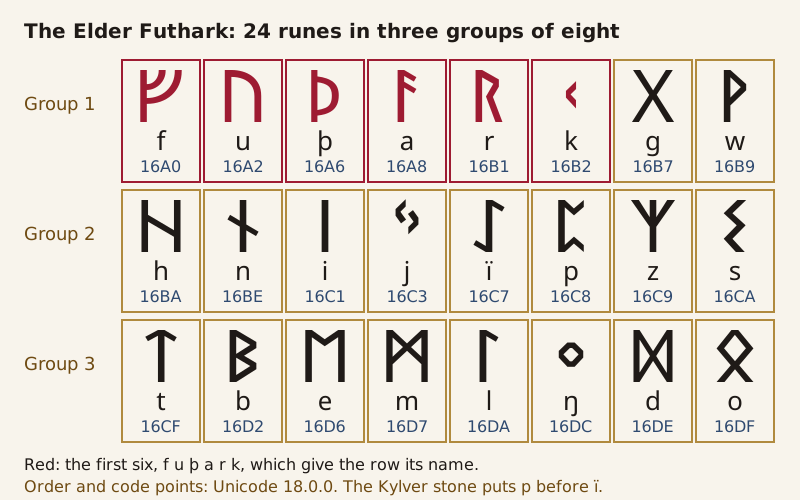
The 24 Elder Futhark runes in three groups of eight, each with its usual Roman letter and its Unicode code point. The first six give the row its name.
The Elder Futhark is a row of 24 runes, cut in stone and wood, named for its first six letters. In Scandinavia the row later shrank to 16, even as the spoken language gained new vowel sounds. It was the original runic alphabet, invented somewhere among the Germanic peoples around the beginning of the Common Era, Aslak Liestøl wrote in 1981.
The shorter row was in use in Denmark by about AD 725, before the Viking Age, and the Vikings went on writing with it. With fewer runes for more sounds, one rune often had to stand for several. Why the row shrank is still disputed.
Why is it called the futhark?
Say the first six runes in order, f, u, þ, a, r, k, and you have the name. The letter þ, called thorn, stands for the sound that English spells th, so the word is usually written futhark. The Unicode Standard classes Runic as an alphabet, and each rune has a conventional Roman letter, its transliteration. This page uses the letters printed in the Unicode Standard 18.0.0, where the 15th rune is z and the 22nd is ŋ, the ng sound; Michael Schulte writes the 15th as R instead.
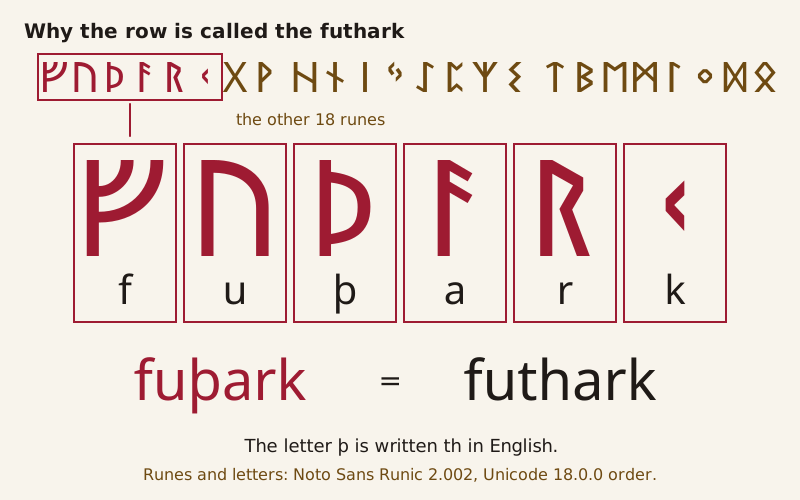
Read in order, the first six runes spell the row's name, usually written futhark in English.
The grouping into three sets of eight is old, too. Two round medallions called bracteates, found at Grumpan and Vadstena in Sweden, split the row into three groups of eight; Schulte dates them to about AD 475–500 and 500–530. The groups were later called ættir. The Kylver stone, which Schulte dates earlier, shows no such breaks.
Where does the full row of 24 survive?
The Kylver stone is a limestone slab from a grave at Kylver, on the Swedish island of Gotland, about 105 cm wide and 75 cm high. Along one edge it carries all 24 runes, followed by a sign like a fir twig, with the word sueus nearby.
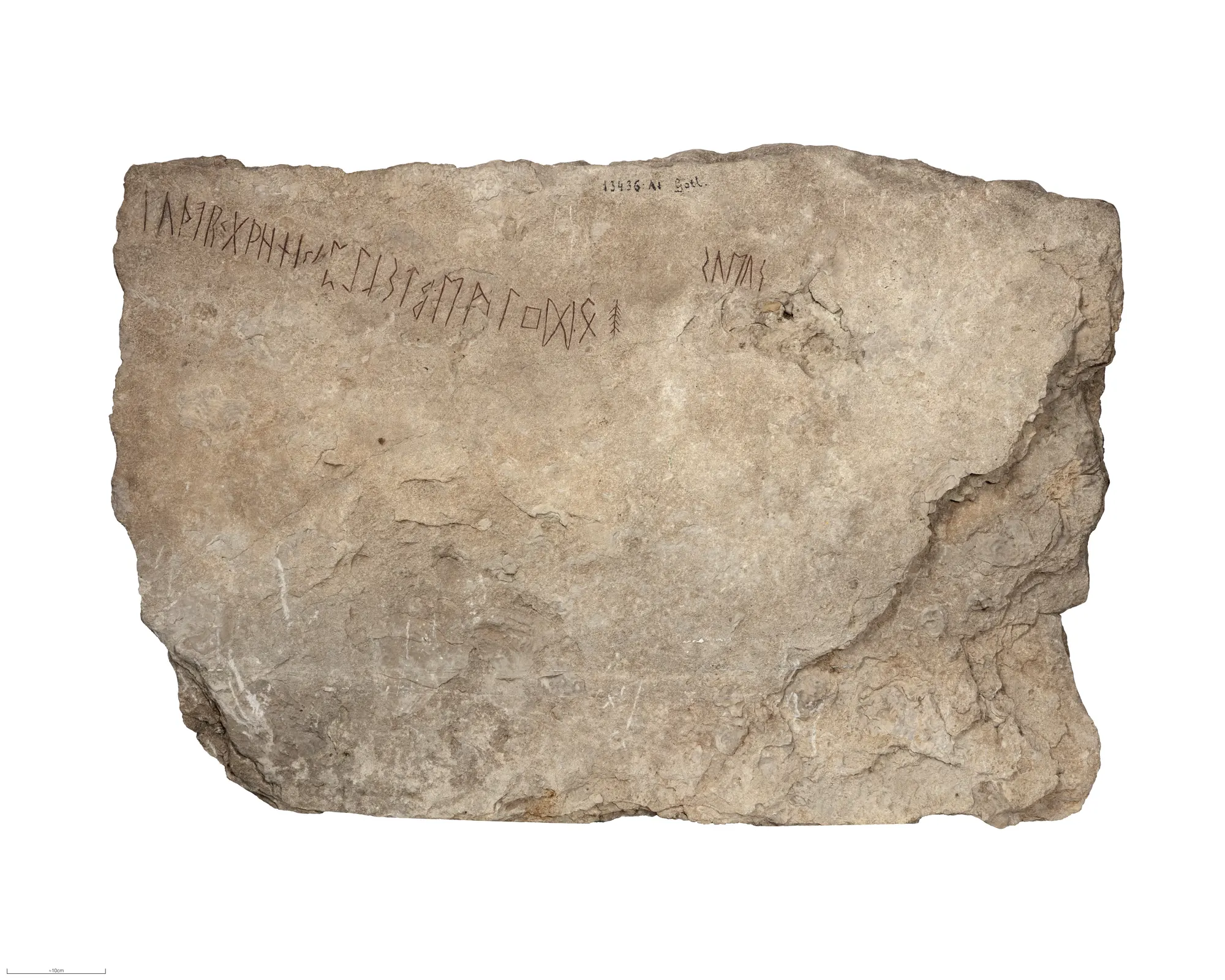

The Kylver stone from Gotland, Sweden: the full row of 24 runes runs along the top and ends in a fir-twig sign, and a short word is cut at upper right. Swedish History Museum.
The Swedish History Museum, which holds the stone, dates it to AD 400–550; Schulte gives the early 5th century, and Liestøl the 5th century. The order on the stone differs slightly from the chart above: Kylver puts p before ï, the 13th and 14th runes. Like the chart, it ends ŋ d o, while both bracteates end ŋ o d. Liestøl adds that all Anglo-Saxon rows, and some Scandinavian ones, swap runes 13 and 14 compared with Kylver.
Runic writing is older than the Kylver stone. The Unicode Standard dates the first runic writing to the first century, the date given for Runic on Every Writing System on One Page. Where the letters came from is still open: the Standard says one of the Old Italic alphabets of northern Italy "may have influenced" the runes.
What do the rune names mean?
Most rune names were ordinary words, Liestøl notes. Schulte glosses *fehu as "cattle, wealth" and *jāra as "year," and Liestøl gives *ansuR, meaning god, and the likely name *ehwaR, meaning horse. In most cases a rune's name began with the rune's own sound, a habit called the acrophonic principle, which Schulte notes also shows up in Semitic scripts and in Egyptian hieroglyphs.
The names were written down late. Manuscripts record rune names from the 8th century on, Schulte writes, and rune poems survive in Old English, Norwegian and Icelandic. The Icelandic poem gives one stanza to each rune of the 16-rune row, and its two earliest manuscripts date from about 1500 and the 16th century, according to Page's 1998 study of the poem.
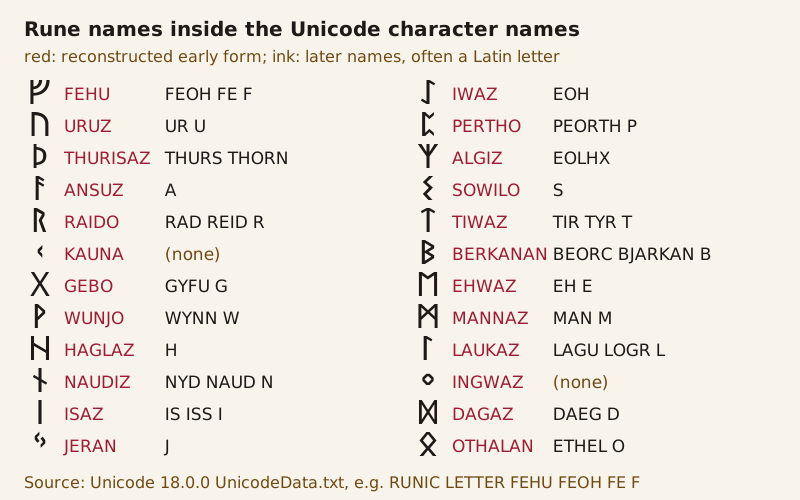
Most Unicode 18.0.0 names for Elder Futhark runes string together traditional names: a reconstructed early form in red, then later names, often with a Roman letter at the end.
The early forms are reconstructions, so scholars mark them with an asterisk. Liestøl prints *fehu and *ansuR in a column of Proto-Scandinavian names that he marks as assumed, set beside the Old English and Old Norse names. Reconstructions differ in detail: Unicode's name for the l-rune starts with LAUKAZ, where Liestøl has *laguR, and Schulte calls the p-rune's name disputed, perhaps "fruit tree" or "sinew."
In the 20th century Nazi ideology gave runes new meanings; Lisbeth Imer of the National Museum of Denmark writes that the s-rune was renamed the "victory rune" in 1929 and became the emblem of the SS.
Why did the later row keep only 16 runes?
Why the row shrank "still remains disputed," Schulte wrote in 2006, but what changed is clear. The shorter row kept 16 of the 24 runes and dropped eight: g, w, ï, p, e, ŋ, d and o. The z rune moved to the end.
Meanwhile, between about AD 500 and 700, sound changes such as umlaut and breaking gave the language new vowels. No new runes were made for them. So one rune now did several jobs: k stood for k, g and ng, t for t, d and nd, and b for b, p and mb.
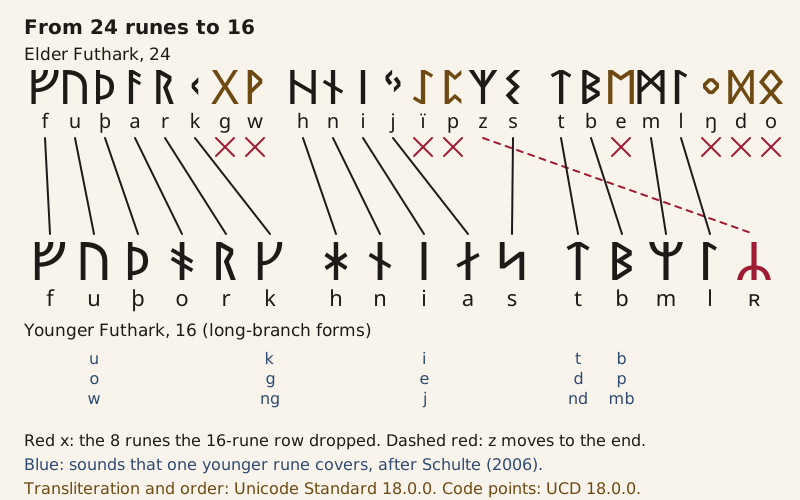
The 16-rune row keeps 16 of the 24 runes, moves the 15th rune to the end and drops eight. Blue labels show sounds that one rune covered, after Schulte (2006).
One explanation is number magic. In 1908 Magnus Olsen tied the numbers 24 and 16, both multiples of eight, to magic. Schulte answers that number magic, if it played any part, cannot have driven the loss of runes, and Liestøl dismissed the idea as pointless.
Others point to easier carving, and Liestøl pictured one reformer who cut the average number of strokes per rune from three to two. Schulte replies with a skull fragment from Ribe, Denmark, that was in the ground by AD 725. It already uses the smaller set of runes but keeps older, more complex shapes for h, m and a, so fewer runes came before some simpler shapes.
Most investigators, Schulte writes, look to the language itself. Rune names changed along with speech: when *jāra lost its j sound, its rune came to stand for a. Schulte gives the rune names the most important part in the story but says they still do not explain why d and g were dropped. The two scholars also disagree on whether there was a single reform: Liestøl argued for one deliberate pre-Viking reform, while Schulte sees a consensus that grew step by step from at least the 6th century.
What does the shorter row cost a reader today?
Anyone reading a Viking Age inscription today has to decide which sound each rune stands for. On the Ribe skull, tuirk is read as Old Norse dverg, "dwarf," with t for d and k for g, Schulte notes. Liestøl concluded in 1981 that several inscriptions needed a fresh look to pin down which sounds their runes stand for.
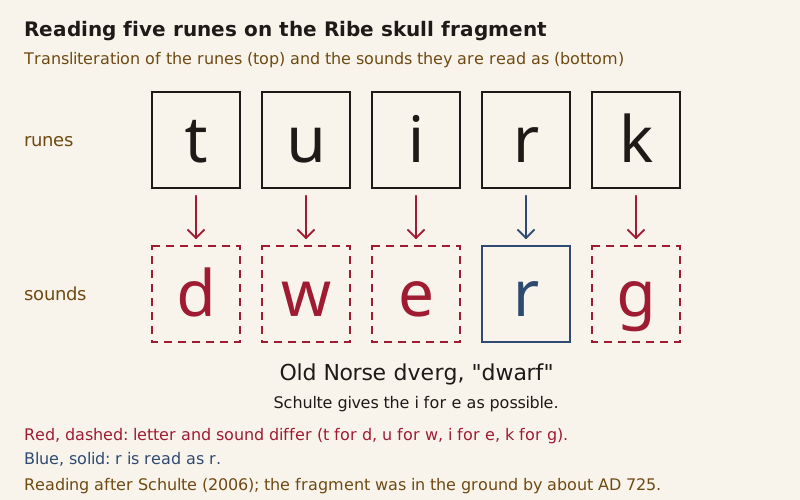
On the Ribe skull fragment, runes t, u, i, r, k are read as the Old Norse word for dwarf: t for d, u for w, k for g, and possibly i for e.
The 16-rune row is this site's second example of letter debt: irregularities a writing system runs up over time that readers still spend effort on. The cause is the mismatch described above, new sounds and fewer runes, and the cost is that work of reading. The spelling still does some work, though. A vowel changed by umlaut was usually written with the rune of the vowel it came from, which Schulte calls an "etymological notation principle," so the spelling keeps pointing back to the word's earlier vowel.
How do you tell the two rows apart?
Start by counting and by looking for the runes that the shorter row dropped.
| Feature | Elder Futhark | Younger Futhark |
|---|---|---|
| Runes in the row | 24 | 16 |
| Groups | three of eight, on two bracteates | three, of 6, 5 and 5 |
| Runes for g, w, ï, p, e, ŋ, d, o | present | none |
| k and g, t and d, p and b | separate runes | one rune for each pair |
| Last rune | o or d | ʀ, the old z rune |
| Dated example on this page | Kylver stone, AD 400–550 | Ribe skull fragment, by about AD 725 |
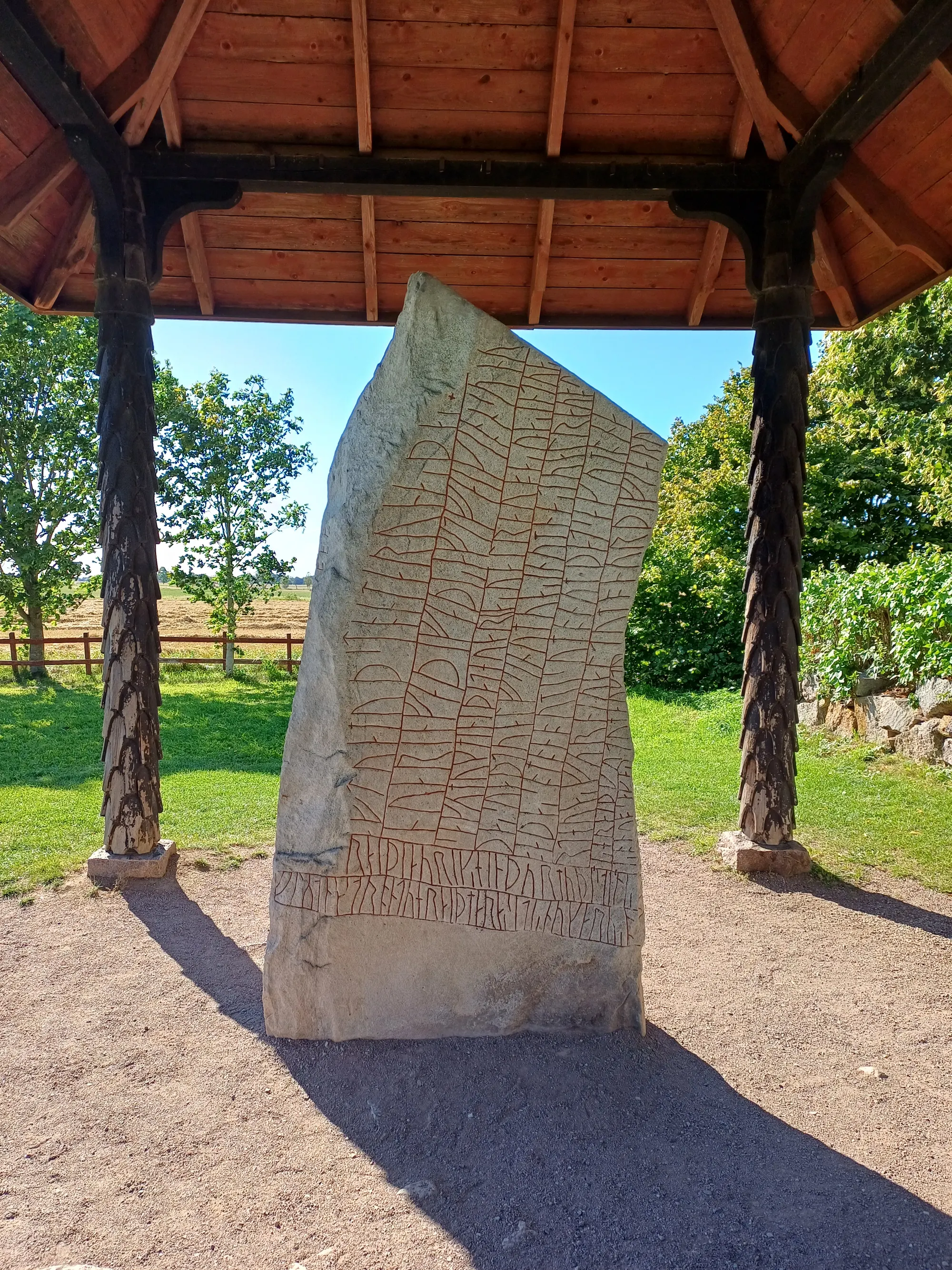
At least one inscription uses both rows. The Rök stone in Östergötland, Sweden, is written in the 16-rune row, but one coded passage swaps in runes from the older row. Liestøl argues that its carver knew at least 21 of the old runes at a time when the shorter row was already well established.
.jpg)
The Rök runestone beside the church at Rök, Östergötland, Sweden, under its shelter. Its plain text uses the 16-rune row. Photographed in 2024.
How did a rune end up in "Ye Olde"?
In English the third rune, þ, was called thorn. The 1911 Encyclopaedia Britannica says that Old English scribes at first wrote its sound as th or ð, but "at a later period the characters þ and ƿ were revived from the old Runic alphabet." It does not say which runic row. In England and Friesland, seven more runes were added to the row between the 5th and 9th centuries, according to the Unicode Standard.
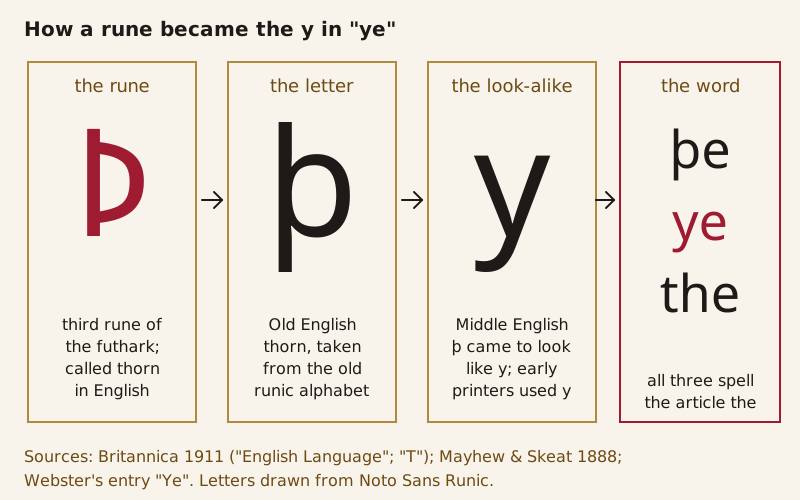
A rune, the Old English letter thorn, and the letter y that came to stand in for it. The box shows three spellings of one word, the article.
Later the letter changed shape: the same encyclopedia's article on the letter T says that in Middle English þ "was gradually assimilated in form to y, which is often found for it in early printing." The Middle English word for the was þe, A. L. Mayhew and Walter W. Skeat record, so with a y it became ye. An older edition of Webster's Unabridged Dictionary calls ye "an old method of printing the article the," with the y "used in place of the Anglo-Saxon thorn." English kept neither old letter, and today th spells two sounds, the one in thin and the one in this, the T article notes.
 Generated illustration
Early printing, the 1911 Britannica says, often used y in place of the letter þ, so the Middle English þe, "the," appeared as ye.
The same thorn opens þou, the Middle English spelling of thou. Thou vs You follows that word from there.
Sources
- 1
Statens historiska museer (Swedish History Museum), "Kylverstenen," object 267753_HST, runic inscription G 88, Sök i samlingarna catalogue record.
https://samlingar.shm.se/object/B41A7D55-F30E-4706-92AD-CFD16596ADA6 (catalogue record)
- 2
The Unicode Consortium, Unicode Character Database, version 18.0.0: UnicodeData.txt, Blocks.txt, Scripts.txt and DerivedAge.txt (2026).
https://www.unicode.org/Public/18.0.0/ucd/ (data files)
- 3
The Unicode Consortium, The Unicode Standard, Version 18.0.0 (South San Francisco: The Unicode Consortium, 2026), chapter 8, Europe-II: section 8.7, Runic, and the chapter introduction.
https://www.unicode.org/versions/Unicode18.0.0/core-spec/chapter-8/ (chapter introduction and section 8.7)
- 4
The Unicode Consortium, The Unicode Standard, Version 18.0.0 (2026), chapter 6, Writing Systems and Punctuation, Table 6-1, Typology of Scripts in the Unicode Standard.
https://www.unicode.org/versions/Unicode18.0.0/core-spec/chapter-6/ (Table 6-1)
- 5
Aslak Liestøl, "The Viking Runes: The Transition from the Older to the Younger Fuþark," Saga-Book of the Viking Society 20 (1978-81), 247-266.
https://vsnr.org/wp-content/uploads/2021/11/Saga-Book-XX.pdf (full text, pages 247-266)
- 6
Michael Schulte, "The transformation of the older fuþark: Number magic, runographic or linguistic principles?", Arkiv för nordisk filologi 121 (2006), 41-74.
https://journals.lub.lu.se/anf/article/view/11745 (full text)
- 7
R. I. Page, "The Icelandic Rune-Poem," Nottingham Medieval Studies 42 (1998); web edition, Viking Society for Northern Research.
http://vsnrweb-publications.org.uk/The%20Icelandic%20Rune-Poem.pdf (introduction and description of the two earliest manuscripts)
- 8
"English Language," Encyclopaedia Britannica, 11th ed., vol. 9 (1911), p. 590, signed J. A. H. M. and H. M. R. M.
https://en.wikisource.org/wiki/1911_Encyclop%C3%A6dia_Britannica/English_Language (p. 590)
- 9
"T," Encyclopaedia Britannica, 11th ed., vol. 26 (1911), p. 321, signed P. Gi.
https://en.wikisource.org/wiki/1911_Encyclop%C3%A6dia_Britannica/T (p. 321)
- 10
A. L. Mayhew and Walter W. Skeat, A Concise Dictionary of Middle English (Oxford: Clarendon Press, 1888), entries "Þe" and "Þou". Project Gutenberg eBook #10625.
https://www.gutenberg.org/ebooks/10625 (entries Þe and Þou)
- 11
Webster's Unabridged Dictionary, letters X, Y and Z (text with the 1913 supplement), entry "Ye". Project Gutenberg eBook #670.
https://www.gutenberg.org/ebooks/670 (entry Ye)
- 12
Lisbeth Imer, "How the Nazis abused the history of runes," ScienceNordic, 13 October 2018 (translated from the Danish version at ForskerZonen, Videnskab.dk).
https://www.sciencenordic.com/denmark-forskerzonen-history/how-the-nazis-abused-the-history-of-runes/1459227 (full text)
Download the data: the 24 runes and the 16-rune row (CSV) (Data: Unicode Character Database 18.0.0 (https://www.unicode.org/Public/18.0.0/ucd/), © Unicode, Inc., Unicode License v3 (https://www.unicode.org/license.txt), retrieved 2026-10-15)
Corrections
No corrections yet. Report an error through the corrections address in the page footer; every change is logged here as YYYY-MM-DD — what changed and why.
Decode next:
- Latin Alphabet: the runic row went from 24 to 16, and the Roman alphabet went the other way, from 21 letters to 26.
- Thou vs You: the Middle English þou begins with the same thorn, and thou was the familiar form, not the formal one.
Cite this page
Codes & Letters. “Elder Futhark: 24 Runes, but the Vikings Wrote With Only 16.” Codes & Letters. Published 2026-10-16. Last substantive revision 2026-10-16. https://codesandletters.com/writing-systems/elder-futhark/. Accessed [the date you read it].