Egyptian Hieroglyphs: Picture Signs That Spell Consonants
Codes & Letters
- Published
- Last substantive revision
Writing systemSpec card
- Name
- Egyptian hieroglyphsSource: Unicode Standard 18.0.0, section 11.4
- Type
- Logosyllabary in the Unicode Standard's Table 6-1: signs for words, for one to three consonants, and silent determinativesSource: Unicode Standard 18.0.0, Table 6-1 and section 11.4; Griffith 1911
- Direction of writing
- Right to left or left to right, in rows or columns; signs face the start of the line. Unicode encodes it left to rightSource: Griffith 1911, p. 64; Unicode Standard 18.0.0, section 11.4
- Period of use
- End of the 4th millennium BCE to the 4th century CE; an inscription dated 394 CE is thought to be among the latestSource: Unicode Standard 18.0.0, section 11.4
- Languages written
- EgyptianSource: Unicode Standard 18.0.0, section 11.4
- Status today
- Historical; out of use after the 4th century CESource: Unicode Standard 18.0.0, section 11.4
- Unicode blocks
- Egyptian Hieroglyphs U+13000–U+1342F; Egyptian Hieroglyph Format Controls U+13430–U+1345F; Egyptian Hieroglyphs Extended-A U+13460–U+143FF (5,105 code points)Source: Unicode 18.0.0 Blocks.txt and Scripts.txt; this page's count
egyptian-hieroglyphs-spec.csv the values on this card, as CSVData: Unicode Character Database 18.0.0 (https://www.unicode.org/Public/18.0.0/ucd/), © Unicode, Inc., Unicode License v3 (https://www.unicode.org/license.txt), retrieved 2026-10-15
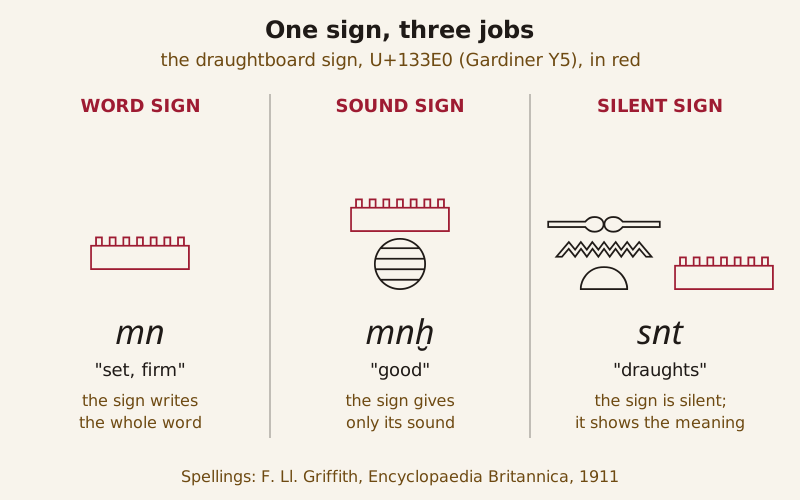
The draughtboard sign at work three ways: as a whole word, as a sound inside another word and as a silent determinative, following Griffith's 1911 examples.
In Egyptian hieroglyphs, a drawing of an owl spells the consonant m, and a drawing of a mouth spells r. The script looks like picture writing. But each sign had fixed jobs, and the signs that record sounds record consonants only. According to the Unicode Standard, hieroglyphs wrote the Egyptian language for more than 3,000 years, starting at the end of the fourth millennium BCE.
A sign can do one of three jobs. It can stand for a whole word or spell one, two or three consonants. Or it can sit silently after a word as a determinative, a sign that shows what kind of thing the word means. The draughtboard sign in the diagram above does all three.
What jobs can one hieroglyph do?
F. Ll. Griffith, who wrote the section on Egyptian language and writing for the 1911 Encyclopaedia Britannica, sorted the uses of a sign into three kinds. A sign could represent "a whole word or root," or "a sound as part of a word," or it could define the meaning of a word whose sound was already written. He called these word-signs, phonograms and determinatives.
His example is the draughtboard sign (U+133E0, Gardiner Y5). On its own it writes mn, "set" or "firm." Placed above the sign for ḫ, it supplies only the sound mn in mnḫ, "good." Written after the signs for s, n and t, it is not read at all: it shows that snt means "draughts" and not another word with the same consonants.
Modern terms differ. The Unicode Standard speaks of logograms that "could be read as a word or as a classifier," and the Unicode hieroglyph database, described in Unicode Standard Annex #57, says a classifier "is traditionally called a determinative." The Standard's section on writing systems adds that "the majority of the hieroglyphs are logographs," beside a subset that "functions as an alphabet."
Determinatives were limited at first. In the earliest inscriptions, Griffith wrote, their use was restricted to a few signs after proper names, yet after the Old Kingdom "few words beyond the particles were written without them." Certain generic ones were very common, he noted, marking broad categories such as motion, divinity or liquid.
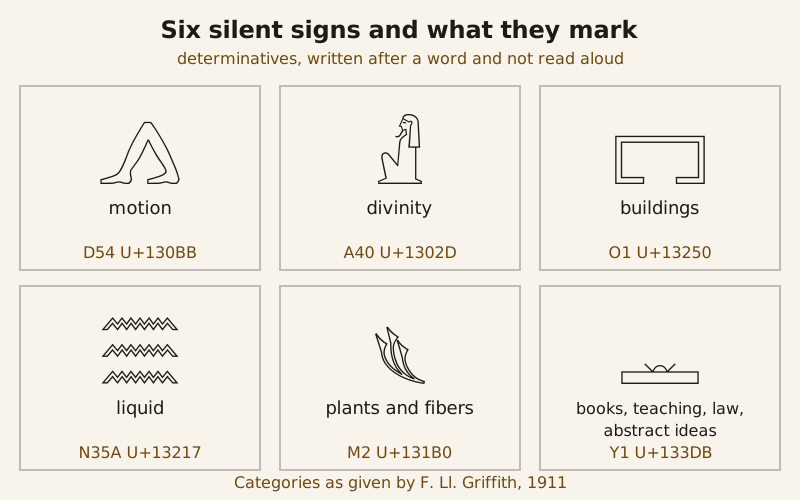
Six determinatives and the categories Griffith gave them in 1911: motion, divinity, buildings, liquid, plants and fibers, and books, teaching, law and abstract ideas.
Did hieroglyphs have an alphabet or vowels?
Hieroglyphs had a set of signs for single consonants and no signs for vowels. The Unicode Standard says the script "made use of 24 hieroglyphs for individual consonants." Griffith gave the same number for the Old Kingdom and added that extra signs for the same sounds later raised the count to 30. Other signs stand for two or three consonants; by Griffith's account, about 50 two-consonant signs were in common use.
Transliterations on this page, in italics, follow what the Unicode hieroglyph database calls the Gardiner 1957 convention. The 1911 Britannica writes some sounds differently, such as ỉ for the reed leaf that this page writes ꞽ.
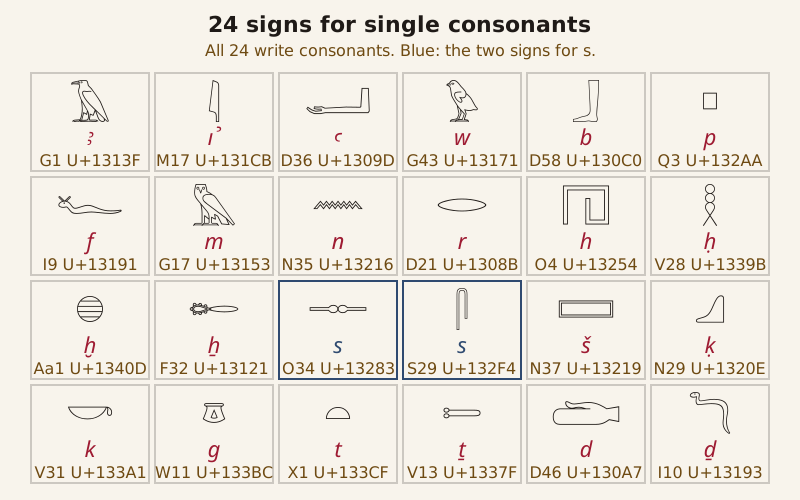
The 24 one-consonant signs, with transliteration, Gardiner number and code point. The two outlined in blue share one transliteration; in the Old Kingdom, Griffith notes, they stood for two different sounds.
Spelling a word purely with sound signs, or even with one-consonant signs only, "is not uncommon," Griffith wrote, though a determinative was generally added. He cites the verb ḫpr, "become," in two copies of one Pyramid Text: a single scarab in one copy, the signs for ḫ, p and r in the other. Still, he wrote, "no advance was ever made towards excluding the cumbersome word-signs." Unlike the letters of the Latin alphabet, the 24 never became a script of their own.
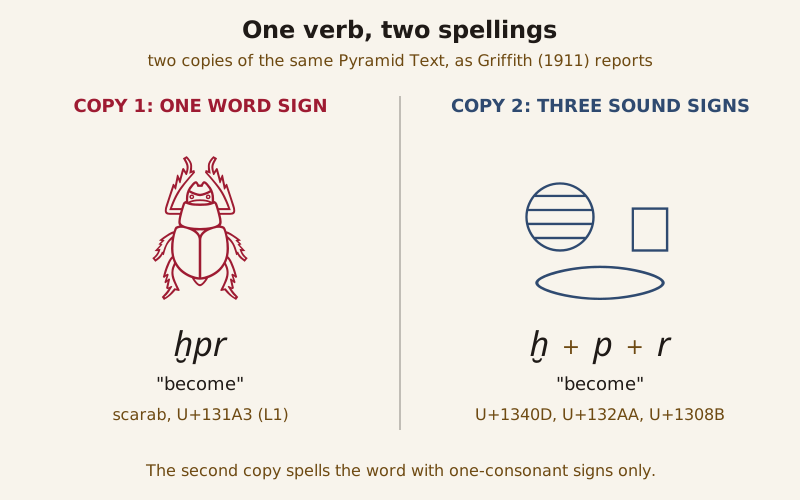
The same verb, "become," in two copies of one Pyramid Text: a single scarab sign in one copy and three one-consonant signs in the other, as Griffith reports.
The vowels are the bigger gap. "The writing expresses only consonants," in Griffith's words, so the sound of Egyptian words has to be recovered from later evidence. He called Coptic, the last stage of the language, written in Greek letters, the scholar's "mainstay" for that work, since it is "the only stage of the language in which the spelling gives a clear idea of the pronunciation."
Two practices came closer to writing vowels. In the Greco-Roman period, Griffith noted, "various imperfect attempts were made" to show the vowels of foreign names with the semi-vowels and the sign for ꜥ. Earlier, through the New Kingdom, foreign words were spelled in a "syllabic" style that paired consonants with semi-vowels. Whether that style recorded vowels was debated: W. Max Müller argued in 1893 that it was an attempt to show them, while Griffith judged in 1911 that if so, "it was carried out with very little system."
Which way do you read hieroglyphs?
Hieroglyphs can run right to left or left to right, in rows or in columns. Three steps find the start of a line:
- Find a face. Look for a person, an animal or a bird.
- Start on the side it faces. Griffith described the signs as "facing to the commencement of the line," and the Unicode Standard says one reads a line "facing into" the faces.
- Take stacked signs top first. Griffith prints snt with the signs for s, n and t stacked in that order from the top, and when Unicode encodes one sign above another, the upper sign comes first.
Griffith called right to left the normal direction for hieroglyphic, hieratic and demotic writing. Monumental inscriptions also ran left to right, often for symmetry: the texts on the two jambs of a doorway were "frequently turned in opposite directions."
Printers' type already ran left to right in 1911, Griffith noted, to fit Egyptian into European text. Unicode gives the signs a left-to-right direction "because most contemporary use" lays them out that way, and says the glyphs should be mirrored when a text is set right to left. The diagrams on this page follow that practice, so their animals face left.
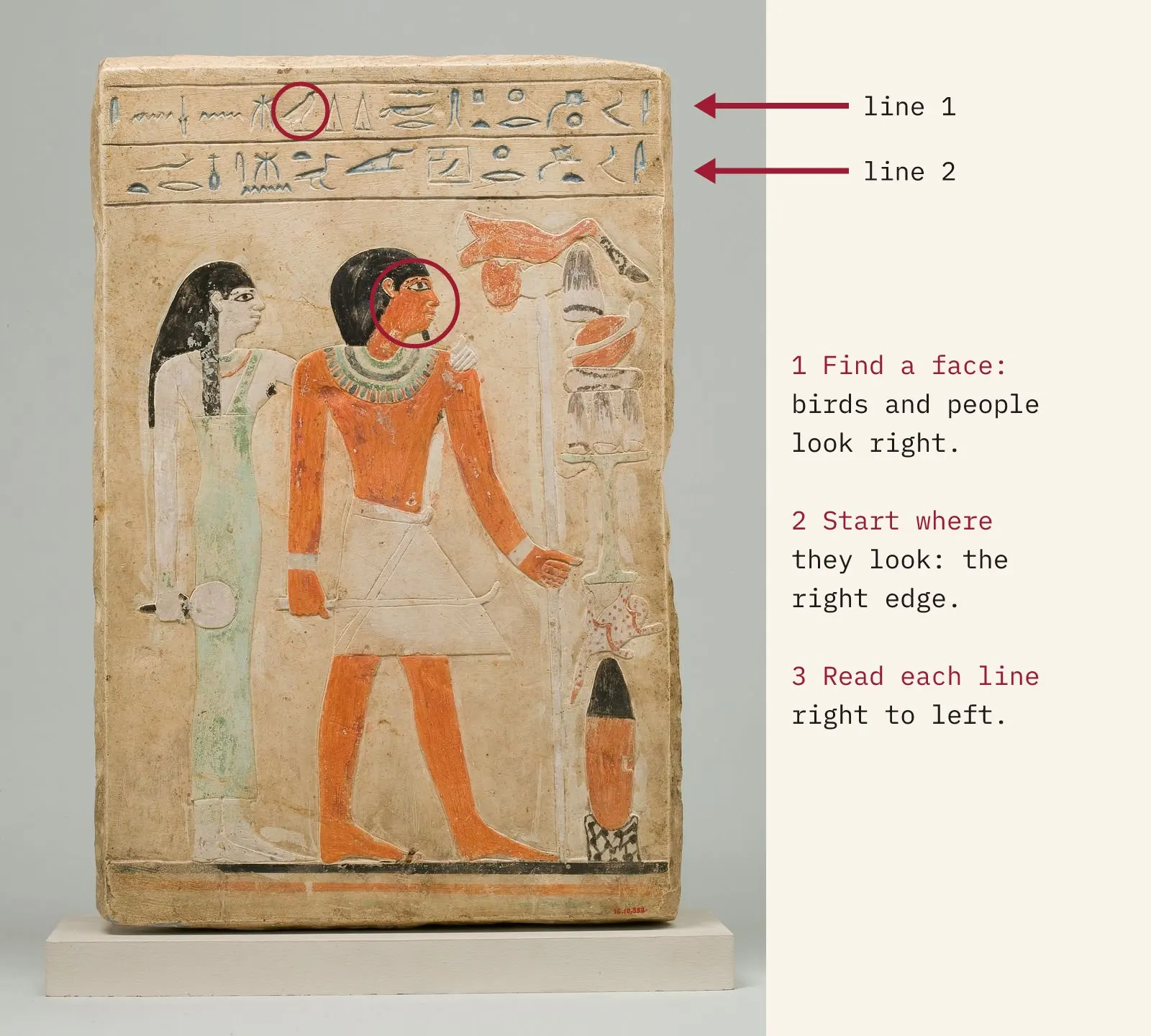
Image credit and license (full text)
"Reading the Stela of Dedu from right to left" by Codes & Letters, CC BY 4.0. Source: https://codesandletters.com/writing-systems/egyptian-hieroglyphs/. License: https://creativecommons.org/licenses/by/4.0/. Underlying image: "Stela of Dedu MET 16.10.333" by an unknown Egyptian artist; photograph by The Metropolitan Museum of Art — https://commons.wikimedia.org/wiki/File:Stela_of_Dedu_MET_16.10.333.jpg — CC0 1.0 (https://creativecommons.org/publicdomain/zero/1.0/); modifications: scaled to 1440 px high, panel added at the right, reading-direction arrows, two circles and notes added.
Stela of Dedu, Thebes, about 2000 to 1952 BCE. The birds and the people face right, so both lines of text start at the right edge and read leftward.
How many hieroglyphs are there?
The answer depends on what is counted. The Unicode Standard says 700 to 1,000 hieroglyphs were in regular use from the Old Kingdom through the New Kingdom, and that in the Greco-Roman period the variants, "as distinguished by some modern scholars," grew to about 10,000. Griffith knew of one native sign list, a fragmentary papyrus of Roman date, which "appears to have comprised about 460 signs."
Unicode 18.0.0 gives the script 5,105 code points, by this page's count from the Unicode data files. That is 1,072 signs in the Egyptian Hieroglyphs block, 3,995 in Egyptian Hieroglyphs Extended-A and 38 characters in a block of format controls, which arrange signs into groups and mark gaps or damage. The first 1,071 signs arrived in Unicode 5.2 in 2009. Extended-A followed in Unicode 16.0 in 2024.
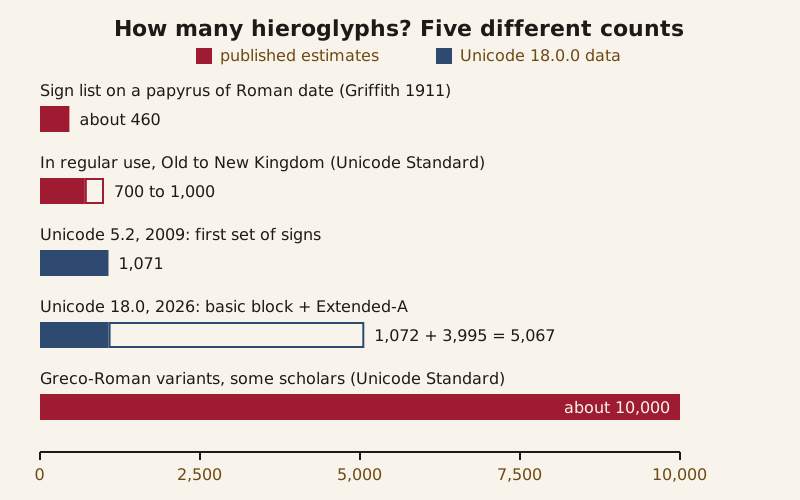
Five counts on one scale: a Roman-era sign list, signs in regular use, Unicode's first set, its two sign blocks today, and Greco-Roman variants.
The Standard says the first block is loosely called "the Gardiner set" and draws mainly on the sign list in Gardiner's Egyptian Grammar. Names in that block use standard catalog numbers based on Gardiner's list, so the owl, Gardiner's G17, is EGYPTIAN HIEROGLYPH G017. The Extended-A signs, "primarily from the Greco-Roman period," have names formed from the code point, such as EGYPTIAN HIEROGLYPH-13460.
By this page's count, the Unicode hieroglyph database identifies 2,947 of the Extended-A signs with an entry in the sign list Hieroglyphica (second edition, 2000). By the same count, the database identifies 2,056 of the Extended-A signs with a place in the 1983 type catalog of the Institut français d'archéologie orientale in Cairo.
In both blocks Unicode fixes each sign's name and code point, and a font supplies the drawing, as with emoji. The outlines on this page come from Noto Sans Egyptian Hieroglyphs 2.002, which covers the first block but none of Extended-A. Every Writing System on One Page sets the 5,105 beside the counts for other scripts.
What are hieratic and demotic?
Hieratic is a cursive form of hieroglyphic writing. Griffith explained that signs written with the reed pen had their outlines "more or less abbreviated," which in time produced hieratic and demotic. He wrote that hieratic is found "even in the Ist Dynasty," and in its most cursive form it "seems hardly to retain any definable trace of the original hieroglyphic pictures." The Unicode Standard treats hieratic as cursive forms of the encoded hieroglyphs, so it has no block of its own.
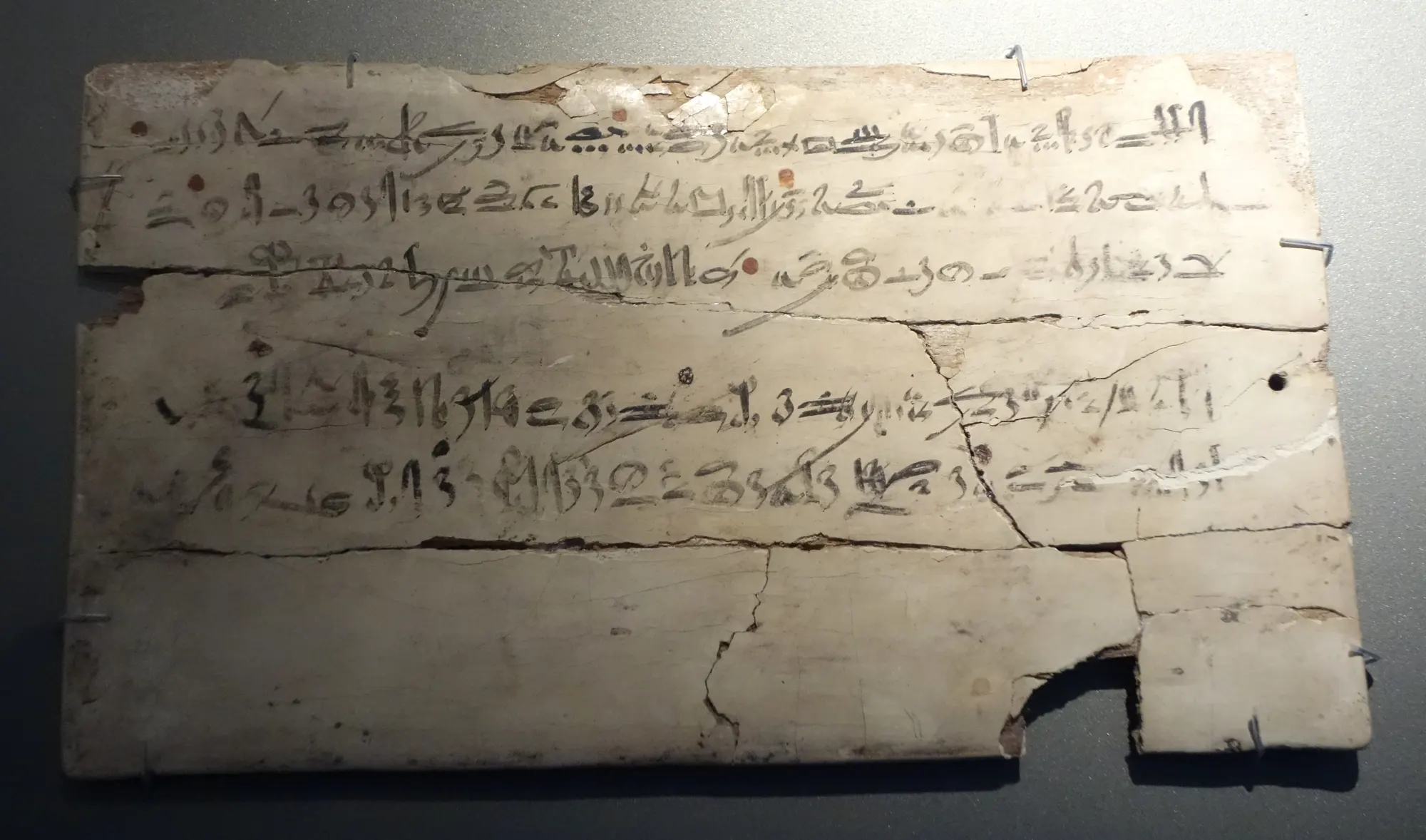

A scribe's exercise board with hieratic text, Dynasty 18, reign of Amunhotep I (about 1514 to 1493 BCE), in the Brooklyn Museum.
Demotic, the most cursive form, parted from hieratic around the 26th Dynasty, in Griffith's account. From then on hieratic was kept mostly for copying religious and other traditional texts, while demotic served business and even literature. Of later demotic he wrote that one of its most characteristic features is "the minuteness of the writing." Clement of Alexandria, Griffith reports, said Egyptian pupils learned demotic first, then hieratic, and hieroglyphs last.
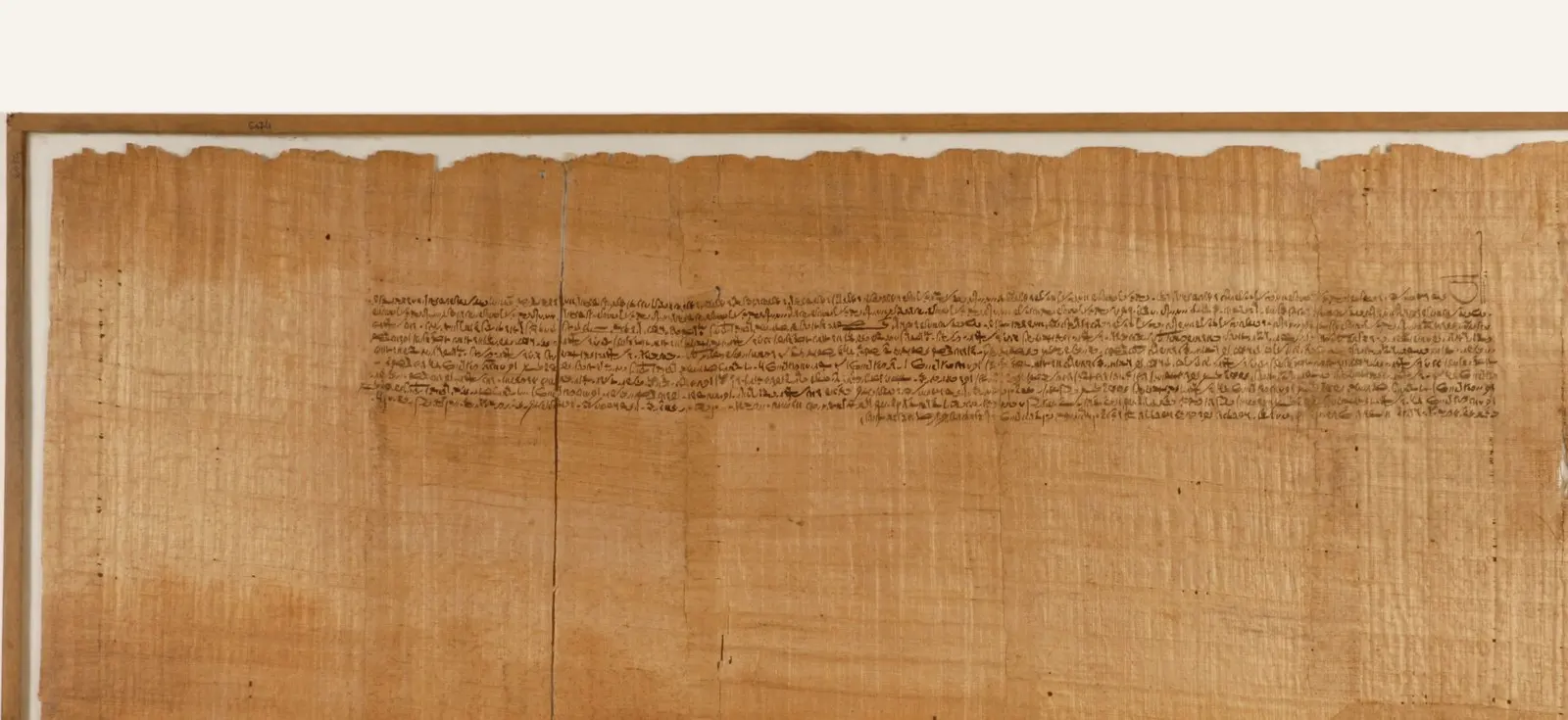

A demotic papyrus with two payment contracts, dated between 145 and 116 BCE, in the Museo Egizio, Turin (S. 6074).
The Elder Futhark is another set of 24 signs. Its runes were used on their own as an alphabet.
Sources
- 1
F. Ll. Griffith, "Egypt: Ancient Egypt, (D) Egyptian Language and Writing," Encyclopaedia Britannica, 11th ed., vol. 9 (1911), pp. 59–64.
https://en.wikisource.org/wiki/1911_Encyclop%C3%A6dia_Britannica/Egypt/2_Ancient_Egypt (pp. 59–64, with the printed page images)
- 2
Stela of Dedu, about 2000–1952 BC, limestone and paint, from Thebes; The Metropolitan Museum of Art, New York, 16.10.333. Object data and photograph via Wikimedia Commons, File:Stela of Dedu MET 16.10.333.jpg.
https://commons.wikimedia.org/wiki/File:Stela_of_Dedu_MET_16.10.333.jpg (file page with the museum's object record)
- 3
Scribe's Exercise Board with Hieratic Text, Egypt, New Kingdom, Dynasty 18, reign of Amunhotep I, about 1514–1493 BC, wood; Brooklyn Museum. Photograph by Daderot (2013), Wikimedia Commons.
- 4
Demotic papyrus containing two payment contracts, 145–116 BC; Museo Egizio, Turin, S. 6074. Image released by the Museo Egizio, Wikimedia Commons.
https://commons.wikimedia.org/wiki/File:Demotic_papyrus_containing_two_payment_contracts_-_Museo_Egizio_Turin_S_6074_p01.jpg (file page with the museum's object data)
- 5
The Unicode Consortium. The Unicode Standard, Version 18.0.0 (South San Francisco: The Unicode Consortium, 2026. ISBN 978-1-936213-36-8), core specification, section 6.1, section 8.7, "Runic," and section 11.4, "Egyptian Hieroglyphs."
https://www.unicode.org/versions/Unicode18.0.0/core-spec/chapter-11/ (section 11.4 with 11.4.1 and 11.4.2; section 6.1 with Table 6-1; section 8.7)
- 6
Michel Suignard, ed. Unicode Standard Annex #57, Unicode Egyptian Hieroglyph Database (Unikemet), revision 7 (The Unicode Consortium, 2026-09-02).
https://www.unicode.org/reports/tr57/tr57-7.html (sections 1 to 3 and the references)
- 7
The Unicode Consortium. Unicode Character Database, Version 18.0.0: UnicodeData.txt, Blocks.txt, Scripts.txt, DerivedAge.txt and Unikemet.txt (South San Francisco: The Unicode Consortium, 2026).
https://www.unicode.org/Public/18.0.0/ucd/ (data files)
- 8
The Unicode Consortium. Enumerated Versions of The Unicode Standard.
https://www.unicode.org/versions/enumeratedversions.html (version table)
Download the data: signs on this page (CSV) (Data: Unicode Character Database 18.0.0 (https://www.unicode.org/Public/18.0.0/ucd/), © Unicode, Inc., Unicode License v3 (https://www.unicode.org/license.txt), retrieved 2026-10-15; Unikemet.txt from the Unicode Character Database 18.0.0 (https://www.unicode.org/Public/18.0.0/ucd/Unikemet.txt), © Unicode, Inc., Unicode License v3 (https://www.unicode.org/license.txt), retrieved 2026-10-16) · hieroglyph counts (CSV) (Data: Unicode Character Database 18.0.0 (https://www.unicode.org/Public/18.0.0/ucd/), © Unicode, Inc., Unicode License v3 (https://www.unicode.org/license.txt), retrieved 2026-10-15; Unikemet.txt from the Unicode Character Database 18.0.0 (https://www.unicode.org/Public/18.0.0/ucd/Unikemet.txt), © Unicode, Inc., Unicode License v3 (https://www.unicode.org/license.txt), retrieved 2026-10-16)
Corrections
No corrections yet. Report an error through the corrections address in the page footer; every change is logged here as YYYY-MM-DD — what changed and why.
Decode next:
- Elder Futhark: 24 runes in three groups of eight, and the later row that kept only 16.
- Emoji: pictures that stayed pictures, where Unicode sets the name and number and each platform draws its own.
Cite this page
Codes & Letters. “Egyptian Hieroglyphs: Picture Signs That Spell Consonants.” Codes & Letters. Published 2026-10-16. Last substantive revision 2026-10-16. https://codesandletters.com/writing-systems/egyptian-hieroglyphs/. Accessed [the date you read it].