Every Writing System on One Page: Alphabets Are Outnumbered
Codes & Letters
- Published
- Last substantive revision
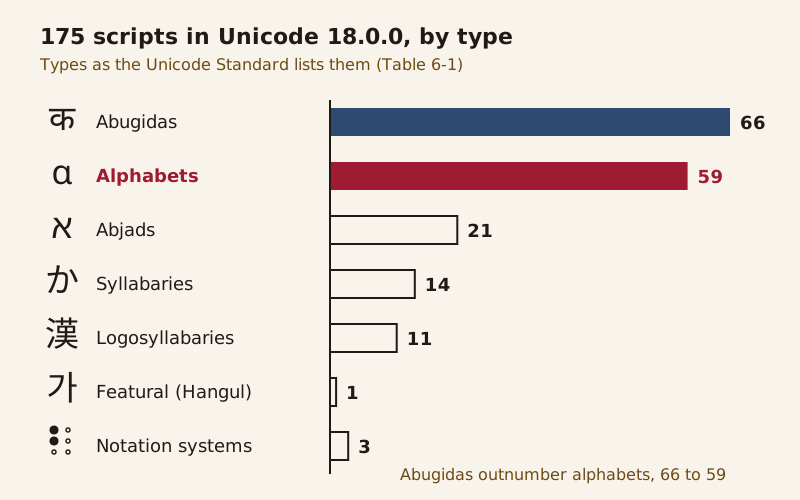
The 175 scripts of Unicode 18.0.0, counted by the type the Unicode Standard assigns each in its Table 6-1. Braille, Duployan and SignWriting sit outside the table as notation systems.
Unicode 18.0.0, released on September 16, 2026, gives 175 writing systems their own Script value, from Adlam to Zanabazar Square. Alphabets, the kind this sentence is written in, are not the largest group. The Unicode Standard sorts its scripts by type in Table 6-1, and on that list 66 are abugidas, scripts in which each consonant letter carries a built-in vowel, against 59 alphabets.
That 175 counts scripts the way Unicode defines them: every Script value in the Unicode Character Database file Scripts.txt, minus Common and Inherited, the two values that hold shared digits, punctuation, symbols and combining marks. It is not a count of every script ever written. Maya hieroglyphs, for one, appear on Unicode's roadmap as a proposal and have no Script value yet.
Two tables follow: 24 of the scripts with the earliest date the Unicode Standard gives, then all 175 with what the Unicode data files record about each.
What counts as a writing system here?
Scripts.txt gives every encoded character one Script value, and in version 18.0.0 the file uses 177 different values. Common holds 9,276 characters, among them the digits 0 to 9, most punctuation and thousands of symbols. Inherited holds 695, nearly all of them combining marks. This page omits both, which leaves 175.
The Standard itself uses "writing system" in two other senses. One is a type of script, such as an alphabet; the other is the way one language is written. Modern Japanese, the Standard's example, uses four scripts: Han, Hiragana, Katakana and Latin. So a single language can account for several of the 175.
Three of the 175 are what the Standard calls notational systems, not scripts for written languages. They are Braille, Duployan shorthand and Sutton SignWriting, which records sign languages. They appear on this page because the Unicode data lists them as scripts, not as a ruling by this site on whether they count as writing systems.
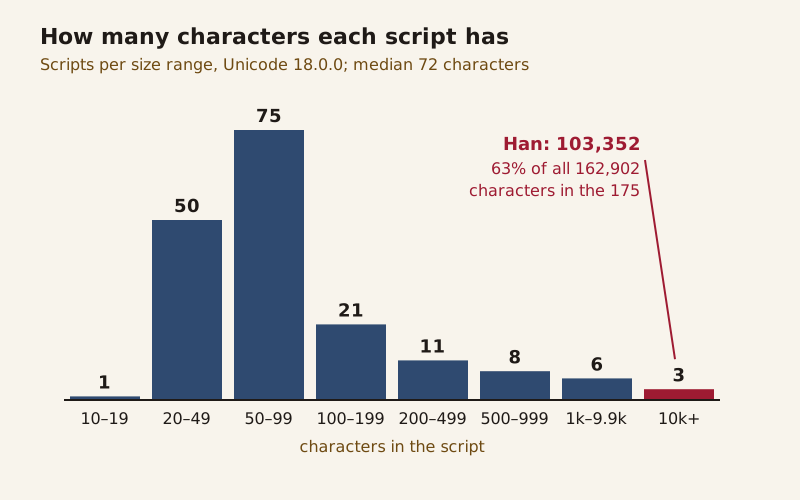
How many characters each script has in Unicode 18.0.0. Most scripts are small; Han is the outlier.
Most scripts are small. By this page's count, 126 of the 175 have fewer than 100 characters, and the median script has 72; Tagbanwa, with 18, is the smallest. Han alone has 103,352 characters, 63% of the 162,902 in all 175 scripts.
 Generated illustration
An empty type case whose compartments differ widely in size. Scripts differ too: 126 of the 175 have fewer than 100 characters, and Han alone has 103,352.
What is the difference between an alphabet, an abjad and an abugida?
The Unicode Standard sorts scripts with terms developed by Peter T. Daniels, whom it calls a leading expert on the writing systems of the world. Its definitions turn on vowels: an alphabet has letters for both consonants and vowels, with equal status. An abjad writes consonants and typically leaves short vowels out, or marks them optionally with points above and below the letters. In an abugida, each consonant letter carries an inherent vowel, frequently transcribed as a, and a written vowel sign overrides it.
Three more types complete the list. In a syllabary, each symbol typically stands for a consonant and a vowel together. The Standard calls Hangul a featural syllabary: each syllable block is built from parts for its sounds, and the shapes of those parts were devised to reflect how the sounds are made. In a logosyllabary such as Han, signs mainly write words or parts of words, and some are used for their sound.
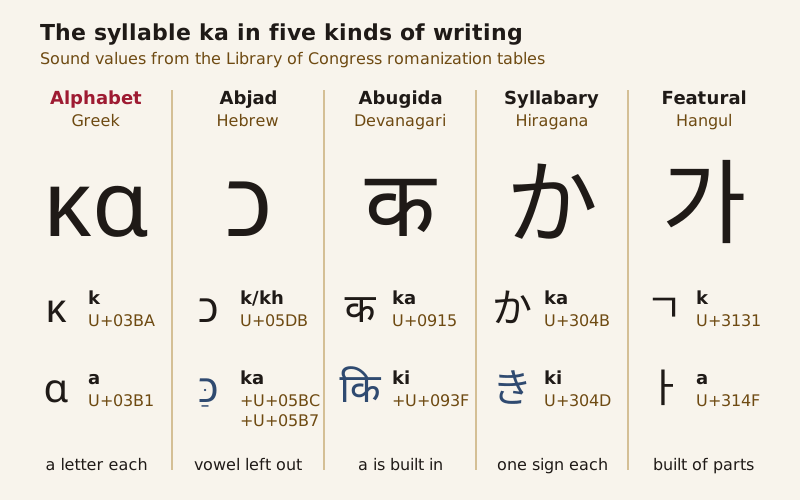
One syllable, five kinds of writing. Readings follow the Library of Congress romanization tables; glyphs are outlines from Noto fonts.
Take the syllable ka. Think of each script as a different key for writing it down. Greek spells it with two letters, kappa (U+03BA) and alpha (U+03B1).
Everyday Hebrew writes only the consonant, U+05DB HEBREW LETTER KAF. The Library of Congress table reads that letter as k or kh, depending on a dot that such text leaves out. It also notes that dictionaries are often needed to supply the vowels.
In Devanagari, U+0915 DEVANAGARI LETTER KA already reads ka. The Library of Congress table for Hindi says the vowel a is implicit after every consonant. The exceptions are a written vowel sign and the virama, a mark that cancels the vowel. Add U+093F DEVANAGARI VOWEL SIGN I and the same letter reads ki.
Hiragana has separate signs, U+304B for ka and U+304D for ki, and neither shape marks the k they share. Hangul writes the syllable as one character, U+AC00, which Unicode decomposes into a consonant part, U+1100, and a vowel part, U+1161. Unicode names that character HANGUL SYLLABLE GA, while the Library of Congress romanizes the same syllable ka. The diagram draws the two parts with the stand-alone letters U+3131 and U+314F.
How many scripts of each type are there?
Table 6-1 of the Unicode Standard 18.0.0 covers the 172 scripts for written languages. It lists 66 abugidas, 59 alphabets, 21 abjads, 14 syllabaries and 11 logosyllabaries, plus one featural syllabary, Hangul. All 66 abugidas sit in the Standard's chapters on South, Central and Southeast Asia, and the Standard explains that such regional labels normally name the region where a script originated. It also says Brahmi, attested from the third century BCE, grew regional varieties that became the modern Indian writing systems.
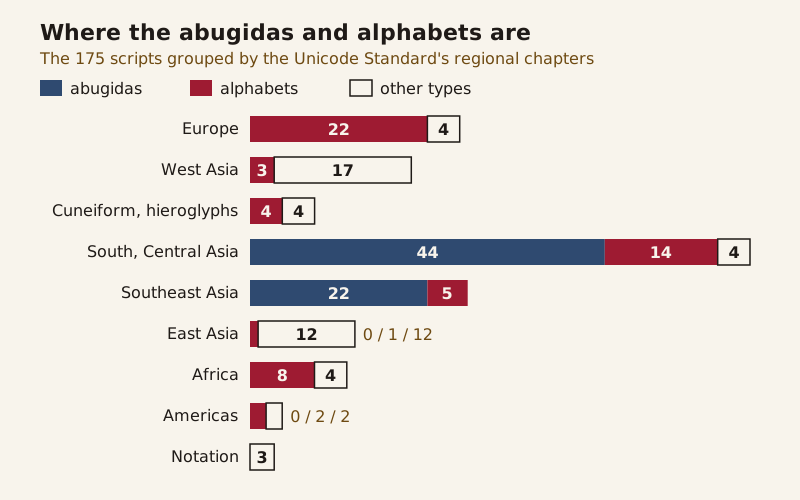
The 175 scripts grouped by the regional chapters of the Unicode Standard 18.0.0 and split by type. Every abugida falls in the South, Central and Southeast Asia chapters.
None of these types is a better or worse way to write. They are different ways of matching signs to sounds and words.
The Standard calls its table "an approximate guide, rather than a definitive classification." Ethiopic shows why: Table 6-1 lists it among the syllabaries, while the same chapter says it "is traditionally analyzed as an abugida." A script's type can also change with the language it writes: the Standard calls Arabic an abjad for Arabic and Persian but an alphabet for Kurdish and Uyghur.
Which writing systems are written right to left?
By this page's count of Unicode's bidirectional data, 37 of the 175 scripts in Unicode 18.0.0 have letters that run right to left by default, and 138 run left to right. The right-to-left group includes Arabic, Hebrew, Syriac and Thaana, and also N'Ko and Adlam, both devised in the 20th century. Many historic scripts are in it too, such as Phoenician and Imperial Aramaic. Kharoshthi, an abugida, is another: the Standard notes that unlike other Indic scripts, it is written right to left.
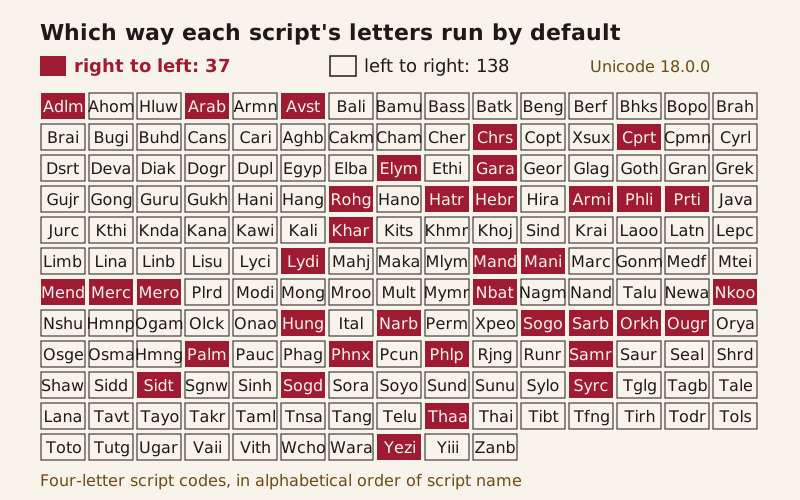
Default direction of each script's letters in Unicode 18.0.0, shown by four-letter code. Shaded cells run right to left.
Twenty of the 21 abjads run right to left. The exception is Multani, which the Standard describes as based on the Brahmi model but behaving like an abjad.
The default is a property of each character, not a record of every surviving text. The Standard notes that most Etruscan texts were written right to left, yet Old Italic is encoded left to right because many scholars prefer that presentation.
Some directions fall outside the left-or-right setting entirely. Mongolian is usually written in vertical columns from top to bottom, with the columns running left to right. East Asian scripts are often written vertically too. Early Greek used boustrophedon, in which lines alternate direction, and the Standard says it gives no direct support for such historical layouts.
Writing direction describes the page, not the sentence. The order of subject, verb and object is a separate question, taken up in Word Order.
When were these scripts first written?
The first table takes 24 scripts, spread across the types, whose descriptions in the Standard give an earliest date. The two oldest in it are cuneiform and Egyptian hieroglyphs. Cuneiform is first attested in the Uruk IV period, about 3500 to 3200 BCE, and the Standard says hieroglyphic writing appeared in Egypt at the end of the fourth millennium BCE. This page gives both dates as the Standard states them and does not rank the two.
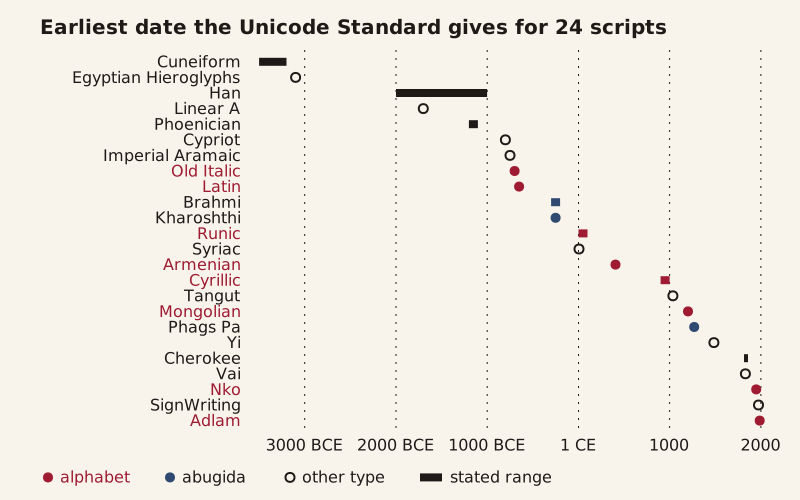
Earliest dates given in the Unicode Standard 18.0.0 for 24 scripts. Bars mark a stated range, such as a century.
The dates come from a character encoding standard. This site treats it as a starting point rather than the final word on ancient history. The Standard says the Latin alphabet came from an Etruscan model around the mid-seventh century BCE or a bit earlier, and that runes were in use from the first century CE. At the young end, it dates N'Ko to 1949, Sutton SignWriting to 1974 and Adlam to the late 1980s.
In the table, Type follows Table 6-1; SignWriting sits outside that table as one of the Standard's notational systems. The date paraphrases the section linked in the last column, and identifier status is explained in the next section.
| Script | Type (Table 6-1) | Earliest date the Standard gives | Identifier status | Section |
|---|---|---|---|---|
| Cuneiform | logosyllabary | first attested c. 3500–3200 BCE | excluded | §11.1 |
| Egyptian Hieroglyphs | logosyllabary | appeared at the end of the 4th millennium BCE | excluded | §11.4 |
| Han | logosyllabary | developed in the 2nd millennium BCE | recommended | ch. 18 |
| Linear A | logosyllabary | used from c. 1700 BCE | excluded | §8.1 |
| Phoenician | abjad | evolved from about the 12th century BCE | excluded | §10.3 |
| Cypriot | syllabary | used from about 800 BCE | excluded | §8.3 |
| Imperial Aramaic | abjad | a distinct script by the mid-8th century BCE | excluded | §10.4 |
| Old Italic | alphabet | earliest Etruscan inscriptions c. 700 BCE | excluded | §8.6 |
| Latin | alphabet | taken from an Etruscan model by about 650 BCE | recommended | §8.6 |
| Brahmi | abugida | attested from the 3rd century BCE | excluded | §14.1 |
| Kharoshthi | abugida | first appears c. 250 BCE | excluded | §14.2 |
| Runic | alphabet | in use from the 1st century CE | excluded | §8.7 |
| Syriac | abjad | earliest datable writing 6 CE | limited use | §9.3 |
| Armenian | alphabet | devised about 406 CE | recommended | §7.6 |
| Cyrillic | alphabet | earliest attestations in the 10th century CE | recommended | §7.4 |
| Tangut | logosyllabary | created about 1036 CE | excluded | §18.11 |
| Mongolian | alphabet | created around the start of the 13th century | excluded | §13.5 |
| Phags Pa | abugida | promulgated in 1269 | excluded | §14.4 |
| Yi | syllabary | earliest surviving example 1485 | limited use | §18.7 |
| Cherokee | syllabary | devised 1815–1821 | limited use | §20.1 |
| Vai | syllabary | developed in the early 1830s | limited use | §19.5 |
| Nko | alphabet | devised in 1949 | limited use | §19.4 |
| SignWriting | notation system | developed in 1974 | excluded | §21.7 |
| Adlam | alphabet | devised in the late 1980s | limited use | §19.9 |
Which scripts are still in everyday use?
Unicode does not count readers. Its rules for identifiers, such as names in program code and hashtags, do sort scripts into three groups, largely by how widely each is used today. UAX #31, revision 45, recommends 28 scripts that are in widespread modern customary use or used by large regional communities, lists 35 as limited use and suggests excluding 111. The excluded group holds historic and obsolete scripts, scripts used mostly in worship and scripts of very small communities, plus some with unresolved technical issues.
Those lists cover 174 of the 175 scripts. Braille is on none of them: the annex sets it aside as a special case that consists only of symbols.
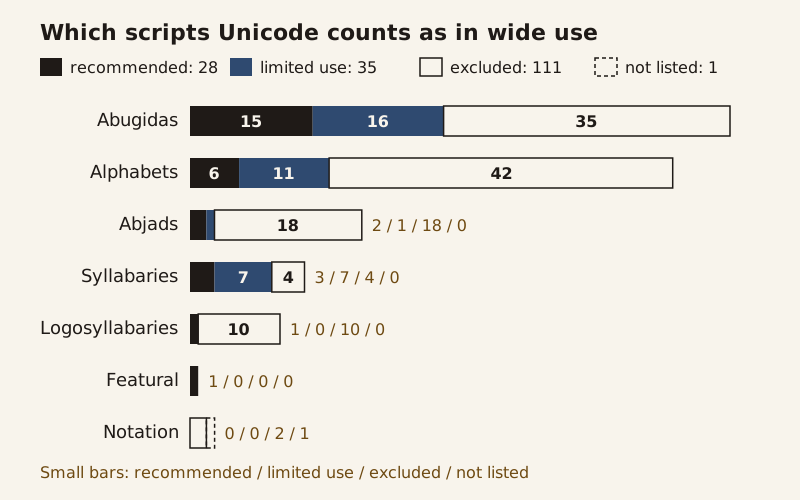
Unicode identifier status of the 175 scripts, split by type. Recommended scripts are in widespread modern use or used by large communities; Braille is on none of the lists.
The 28 recommended scripts lean the same way as the full list. Fifteen are abugidas, from Bengali to Tibetan. Six are alphabets: Latin, Greek, Cyrillic, Armenian, Georgian and Thaana. The rest are two abjads (Arabic, Hebrew), three syllabaries (Hiragana, Katakana, Ethiopic), Han and Hangul.
Excluded does not mean dead. Coptic is on the excluded list. The Standard says the Coptic language died out in the fourteenth century, but Coptic Christians maintain it as a liturgical language. UAX #31 also notes significant revival efforts for limited-use scripts such as Balinese, Cham, Ol Chiki and Vai, where large communities may speak the language even though the script is not in widespread use.
When did Unicode add each script?
Counted by each script's earliest character in DerivedAge.txt, Unicode 1.1, released in 1993, already had 24 of today's 175 scripts. By this count, 100 of the 175 arrived in version 5.2, from 2009, or later. The biggest single jump came in version 7.0 in 2014, which added 23, among them Linear A, Manichaean and Duployan. Version 18.0 added three: Jurchen, Proto-Cuneiform and Seal.
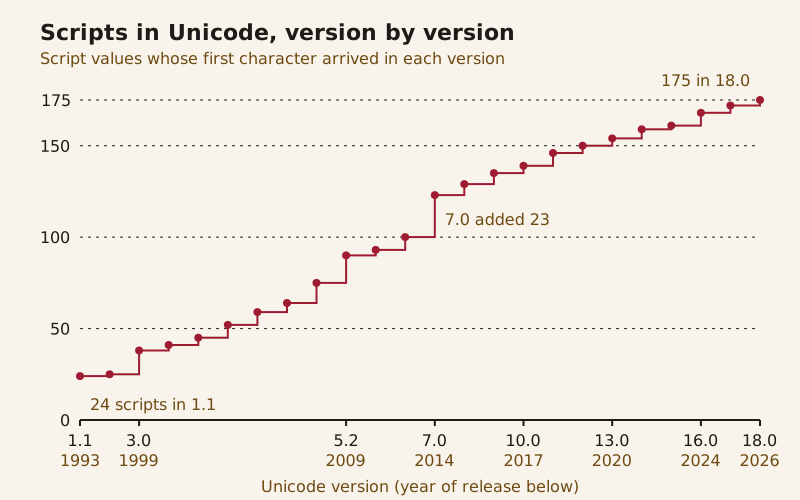
Scripts in Unicode, version by version, counted from each script's earliest character.
Dating a script by its earliest character can mislead. Coptic shows 1.1 because 14 Coptic characters sat in the Greek and Coptic block from the start, while the separate Coptic block dates from 4.1. DerivedAge.txt also tracks ages only from version 1.1, so a 1.1 in the table means a script was in Unicode by 1993, not that it was first added that year.
In the table below, Script is the name the Unicode data uses, with spaces between words: Old_Italic appears as Old Italic. Code is the four-letter ISO 15924 code that Unicode lists for it. Characters counts code points with that Script value. The code-point column gives the lowest and highest code point, with the number of separate ranges in parentheses; the CSV download lists every range.
| Script | Code | First in Unicode | Characters | Code points (lowest–highest, ranges) | Default direction | Identifier status |
|---|---|---|---|---|---|---|
| Adlam | Adlm | 9.0 | 88 | U+1E900–U+1E95F (3) | right to left | limited use |
| Ahom | Ahom | 8.0 | 65 | U+11700–U+11746 (3) | left to right | excluded |
| Anatolian Hieroglyphs | Hluw | 8.0 | 583 | U+14400–U+14646 (1) | left to right | excluded |
| Arabic | Arab | 1.1 | 1,452 | U+0600–U+1EEF1 (56) | right to left | recommended |
| Armenian | Armn | 1.1 | 99 | U+0531–U+FB17 (3) | left to right | recommended |
| Avestan | Avst | 5.2 | 61 | U+10B00–U+10B3F (2) | right to left | excluded |
| Balinese | Bali | 5.0 | 127 | U+1B00–U+1B7F (2) | left to right | limited use |
| Bamum | Bamu | 5.2 | 657 | U+A6A0–U+16A38 (2) | left to right | limited use |
| Bassa Vah | Bass | 7.0 | 36 | U+16AD0–U+16AF5 (2) | left to right | excluded |
| Batak | Batk | 6.0 | 56 | U+1BC0–U+1BFF (2) | left to right | limited use |
| Bengali | Beng | 1.1 | 98 | U+0980–U+11DF1 (15) | left to right | recommended |
| Beria Erfe | Berf | 17.0 | 50 | U+16EA0–U+16ED3 (2) | left to right | excluded |
| Bhaiksuki | Bhks | 9.0 | 97 | U+11C00–U+11C6C (4) | left to right | excluded |
| Bopomofo | Bopo | 1.1 | 77 | U+02EA–U+31BF (3) | left to right | limited use |
| Brahmi | Brah | 6.0 | 115 | U+11000–U+1107F (3) | left to right | excluded |
| Braille | Brai | 3.0 | 256 | U+2800–U+28FF (1) | left to right | not listed |
| Buginese | Bugi | 4.1 | 30 | U+1A00–U+1A1F (2) | left to right | excluded |
| Buhid | Buhd | 3.2 | 20 | U+1740–U+1753 (1) | left to right | excluded |
| Canadian Aboriginal | Cans | 3.0 | 726 | U+1400–U+11ABF (3) | left to right | limited use |
| Carian | Cari | 5.1 | 49 | U+102A0–U+102D0 (1) | left to right | excluded |
| Caucasian Albanian | Aghb | 7.0 | 53 | U+10530–U+1056F (2) | left to right | excluded |
| Chakma | Cakm | 6.1 | 71 | U+11100–U+11147 (2) | left to right | limited use |
| Cham | Cham | 5.1 | 83 | U+AA00–U+AA5F (4) | left to right | limited use |
| Cherokee | Cher | 3.0 | 172 | U+13A0–U+ABBF (3) | left to right | limited use |
| Chorasmian | Chrs | 13.0 | 28 | U+10FB0–U+10FCB (1) | right to left | excluded |
| Coptic | Copt | 1.1 | 137 | U+03E2–U+2CFF (3) | left to right | excluded |
| Cuneiform | Xsux | 5.0 | 1,393 | U+12000–U+12686 (4) | left to right | excluded |
| Cypriot | Cprt | 4.0 | 55 | U+10800–U+1083F (6) | right to left | excluded |
| Cypro Minoan | Cpmn | 14.0 | 99 | U+12F90–U+12FF2 (1) | left to right | excluded |
| Cyrillic | Cyrl | 1.1 | 508 | U+0400–U+1E08F (10) | left to right | recommended |
| Deseret | Dsrt | 3.1 | 80 | U+10400–U+1044F (1) | left to right | excluded |
| Devanagari | Deva | 1.1 | 165 | U+0900–U+11B0A (5) | left to right | recommended |
| Dives Akuru | Diak | 13.0 | 72 | U+11900–U+11959 (8) | left to right | excluded |
| Dogra | Dogr | 11.0 | 60 | U+11800–U+1183B (1) | left to right | excluded |
| Duployan | Dupl | 7.0 | 143 | U+1BC00–U+1BC9F (5) | left to right | excluded |
| Egyptian Hieroglyphs | Egyp | 5.2 | 5,105 | U+13000–U+143FA (2) | left to right | excluded |
| Elbasan | Elba | 7.0 | 40 | U+10500–U+10527 (1) | left to right | excluded |
| Elymaic | Elym | 12.0 | 23 | U+10FE0–U+10FF6 (1) | right to left | excluded |
| Ethiopic | Ethi | 3.0 | 523 | U+1200–U+1E7FE (36) | left to right | recommended |
| Garay | Gara | 16.0 | 69 | U+10D40–U+10D8F (3) | right to left | excluded |
| Georgian | Geor | 1.1 | 173 | U+10A0–U+2D2D (10) | left to right | recommended |
| Glagolitic | Glag | 4.1 | 134 | U+2C00–U+1E02A (6) | left to right | excluded |
| Gothic | Goth | 3.1 | 27 | U+10330–U+1034A (1) | left to right | excluded |
| Grantha | Gran | 7.0 | 85 | U+11300–U+11374 (15) | left to right | excluded |
| Greek | Grek | 1.1 | 520 | U+0370–U+1DFF4 (37) | left to right | recommended |
| Gujarati | Gujr | 1.1 | 91 | U+0A81–U+0AFF (14) | left to right | recommended |
| Gunjala Gondi | Gong | 11.0 | 63 | U+11D60–U+11DA9 (6) | left to right | excluded |
| Gurmukhi | Guru | 1.1 | 80 | U+0A01–U+0A76 (16) | left to right | recommended |
| Gurung Khema | Gukh | 16.0 | 58 | U+16100–U+16139 (1) | left to right | excluded |
| Han | Hani | 1.1 | 103,352 | U+2E80–U+33479 (21) | left to right | recommended |
| Hangul | Hang | 1.1 | 11,739 | U+1100–U+FFDC (14) | left to right | recommended |
| Hanifi Rohingya | Rohg | 11.0 | 50 | U+10D00–U+10D39 (2) | right to left | limited use |
| Hanunoo | Hano | 3.2 | 21 | U+1720–U+1734 (1) | left to right | excluded |
| Hatran | Hatr | 8.0 | 26 | U+108E0–U+108FF (3) | right to left | excluded |
| Hebrew | Hebr | 1.1 | 136 | U+0591–U+FB4F (9) | right to left | recommended |
| Hiragana | Hira | 1.1 | 382 | U+3041–U+1F200 (7) | left to right | recommended |
| Imperial Aramaic | Armi | 5.2 | 31 | U+10840–U+1085F (2) | right to left | excluded |
| Inscriptional Pahlavi | Phli | 5.2 | 27 | U+10B60–U+10B7F (2) | right to left | excluded |
| Inscriptional Parthian | Prti | 5.2 | 30 | U+10B40–U+10B5F (2) | right to left | excluded |
| Javanese | Java | 5.2 | 90 | U+A980–U+A9DF (3) | left to right | limited use |
| Jurchen | Jurc | 18.0 | 965 | U+18E00–U+191D2 (2) | left to right | excluded |
| Kaithi | Kthi | 5.2 | 68 | U+11080–U+110CD (2) | left to right | excluded |
| Kannada | Knda | 1.1 | 92 | U+0C80–U+0CF3 (13) | left to right | recommended |
| Katakana | Kana | 1.1 | 327 | U+30A1–U+1B168 (15) | left to right | recommended |
| Kawi | Kawi | 15.0 | 87 | U+11F00–U+11F5A (3) | left to right | excluded |
| Kayah Li | Kali | 5.1 | 47 | U+A900–U+A92F (2) | left to right | limited use |
| Kharoshthi | Khar | 4.1 | 68 | U+10A00–U+10A58 (8) | right to left | excluded |
| Khitan Small Script | Kits | 13.0 | 477 | U+16FE4–U+18CFF (3) | left to right | excluded |
| Khmer | Khmr | 3.0 | 146 | U+1780–U+19FF (4) | left to right | recommended |
| Khojki | Khoj | 7.0 | 65 | U+11200–U+11241 (2) | left to right | excluded |
| Khudawadi | Sind | 7.0 | 69 | U+112B0–U+112F9 (2) | left to right | excluded |
| Kirat Rai | Krai | 16.0 | 58 | U+16D40–U+16D79 (1) | left to right | excluded |
| Lao | Laoo | 1.1 | 83 | U+0E81–U+0EDF (11) | left to right | recommended |
| Latin | Latn | 1.1 | 1,653 | U+0041–U+1DFFF (40) | left to right | recommended |
| Lepcha | Lepc | 5.1 | 74 | U+1C00–U+1C4F (3) | left to right | limited use |
| Limbu | Limb | 4.0 | 68 | U+1900–U+194F (5) | left to right | limited use |
| Linear A | Lina | 7.0 | 341 | U+10600–U+10767 (3) | left to right | excluded |
| Linear B | Linb | 4.0 | 211 | U+10000–U+100FA (7) | left to right | excluded |
| Lisu | Lisu | 5.2 | 49 | U+A4D0–U+11FB0 (2) | left to right | limited use |
| Lycian | Lyci | 5.1 | 29 | U+10280–U+1029C (1) | left to right | excluded |
| Lydian | Lydi | 5.1 | 27 | U+10920–U+1093F (2) | right to left | excluded |
| Mahajani | Mahj | 7.0 | 39 | U+11150–U+11176 (1) | left to right | excluded |
| Makasar | Maka | 11.0 | 25 | U+11EE0–U+11EF8 (1) | left to right | excluded |
| Malayalam | Mlym | 1.1 | 118 | U+0D00–U+0D7F (7) | left to right | recommended |
| Mandaic | Mand | 6.0 | 29 | U+0840–U+085E (2) | right to left | limited use |
| Manichaean | Mani | 7.0 | 51 | U+10AC0–U+10AF6 (2) | right to left | excluded |
| Marchen | Marc | 9.0 | 68 | U+11C70–U+11CB6 (3) | left to right | excluded |
| Masaram Gondi | Gonm | 10.0 | 75 | U+11D00–U+11D59 (7) | left to right | excluded |
| Medefaidrin | Medf | 11.0 | 91 | U+16E40–U+16E9A (1) | left to right | excluded |
| Meetei Mayek | Mtei | 5.2 | 79 | U+AAE0–U+ABF9 (3) | left to right | limited use |
| Mende Kikakui | Mend | 7.0 | 213 | U+1E800–U+1E8D6 (2) | right to left | excluded |
| Meroitic Cursive | Merc | 6.1 | 90 | U+109A0–U+109FF (3) | right to left | excluded |
| Meroitic Hieroglyphs | Mero | 6.1 | 32 | U+10980–U+1099F (1) | right to left | excluded |
| Miao | Plrd | 6.1 | 149 | U+16F00–U+16F9F (3) | left to right | limited use |
| Modi | Modi | 7.0 | 79 | U+11600–U+11659 (2) | left to right | excluded |
| Mongolian | Mong | 3.0 | 168 | U+1800–U+1166C (6) | left to right | excluded |
| Mro | Mroo | 7.0 | 43 | U+16A40–U+16A6F (3) | left to right | excluded |
| Multani | Mult | 8.0 | 38 | U+11280–U+112A9 (5) | left to right | excluded |
| Myanmar | Mymr | 3.0 | 243 | U+1000–U+116E3 (4) | left to right | recommended |
| Nabataean | Nbat | 7.0 | 40 | U+10880–U+108AF (2) | right to left | excluded |
| Nag Mundari | Nagm | 15.0 | 42 | U+1E4D0–U+1E4F9 (1) | left to right | excluded |
| Nandinagari | Nand | 12.0 | 65 | U+119A0–U+119E4 (3) | left to right | excluded |
| New Tai Lue | Talu | 4.1 | 83 | U+1980–U+19DF (4) | left to right | limited use |
| Newa | Newa | 9.0 | 97 | U+11400–U+11461 (2) | left to right | limited use |
| Nko | Nkoo | 5.0 | 62 | U+07C0–U+07FF (2) | right to left | limited use |
| Nushu | Nshu | 10.0 | 397 | U+16FE1–U+1B2FB (2) | left to right | excluded |
| Nyiakeng Puachue Hmong | Hmnp | 12.0 | 71 | U+1E100–U+1E14F (4) | left to right | limited use |
| Ogham | Ogam | 3.0 | 29 | U+1680–U+169C (1) | left to right | excluded |
| Ol Chiki | Olck | 5.1 | 48 | U+1C50–U+1C7F (1) | left to right | limited use |
| Ol Onal | Onao | 16.0 | 44 | U+1E5D0–U+1E5FF (2) | left to right | excluded |
| Old Hungarian | Hung | 8.0 | 108 | U+10C80–U+10CFF (3) | right to left | excluded |
| Old Italic | Ital | 3.1 | 39 | U+10300–U+1032F (2) | left to right | excluded |
| Old North Arabian | Narb | 7.0 | 32 | U+10A80–U+10A9F (1) | right to left | excluded |
| Old Permic | Perm | 7.0 | 43 | U+10350–U+1037A (1) | left to right | excluded |
| Old Persian | Xpeo | 4.1 | 50 | U+103A0–U+103D5 (2) | left to right | excluded |
| Old Sogdian | Sogo | 11.0 | 40 | U+10F00–U+10F27 (1) | right to left | excluded |
| Old South Arabian | Sarb | 5.2 | 32 | U+10A60–U+10A7F (1) | right to left | excluded |
| Old Turkic | Orkh | 5.2 | 73 | U+10C00–U+10C48 (1) | right to left | excluded |
| Old Uyghur | Ougr | 14.0 | 26 | U+10F70–U+10F89 (1) | right to left | excluded |
| Oriya | Orya | 1.1 | 93 | U+0B01–U+0B77 (14) | left to right | recommended |
| Osage | Osge | 9.0 | 72 | U+104B0–U+104FB (2) | left to right | limited use |
| Osmanya | Osma | 4.0 | 40 | U+10480–U+104A9 (2) | left to right | excluded |
| Pahawh Hmong | Hmng | 7.0 | 127 | U+16B00–U+16B8F (5) | left to right | excluded |
| Palmyrene | Palm | 7.0 | 32 | U+10860–U+1087F (1) | right to left | excluded |
| Pau Cin Hau | Pauc | 7.0 | 57 | U+11AC0–U+11AF8 (1) | left to right | excluded |
| Phags Pa | Phag | 5.0 | 56 | U+A840–U+A877 (1) | left to right | excluded |
| Phoenician | Phnx | 5.0 | 29 | U+10900–U+1091F (2) | right to left | excluded |
| Proto Cuneiform | Pcun | 18.0 | 164 | U+125A8–U+1264B (1) | left to right | excluded |
| Psalter Pahlavi | Phlp | 7.0 | 29 | U+10B80–U+10BAF (3) | right to left | excluded |
| Rejang | Rjng | 5.1 | 37 | U+A930–U+A95F (2) | left to right | excluded |
| Runic | Runr | 3.0 | 86 | U+16A0–U+16F8 (2) | left to right | excluded |
| Samaritan | Samr | 5.2 | 61 | U+0800–U+083E (2) | right to left | excluded |
| Saurashtra | Saur | 5.1 | 82 | U+A880–U+A8D9 (2) | left to right | limited use |
| Seal | Seal | 18.0 | 11,328 | U+3D000–U+3FC3F (1) | left to right | excluded |
| Sharada | Shrd | 6.1 | 104 | U+11180–U+11B67 (2) | left to right | excluded |
| Shavian | Shaw | 4.0 | 48 | U+10450–U+1047F (1) | left to right | excluded |
| Siddham | Sidd | 7.0 | 92 | U+11580–U+115DD (2) | left to right | excluded |
| Sidetic | Sidt | 17.0 | 26 | U+10940–U+10959 (1) | right to left | excluded |
| SignWriting | Sgnw | 8.0 | 672 | U+1D800–U+1DAAF (3) | left to right | excluded |
| Sinhala | Sinh | 3.0 | 111 | U+0D81–U+111F4 (13) | left to right | recommended |
| Sogdian | Sogd | 11.0 | 42 | U+10F30–U+10F59 (1) | right to left | excluded |
| Sora Sompeng | Sora | 6.1 | 35 | U+110D0–U+110F9 (2) | left to right | excluded |
| Soyombo | Soyo | 10.0 | 83 | U+11A50–U+11AA2 (1) | left to right | excluded |
| Sundanese | Sund | 5.1 | 72 | U+1B80–U+1CC7 (2) | left to right | limited use |
| Sunuwar | Sunu | 16.0 | 44 | U+11BC0–U+11BF9 (2) | left to right | excluded |
| Syloti Nagri | Sylo | 4.1 | 45 | U+A800–U+A82C (1) | left to right | limited use |
| Syriac | Syrc | 3.0 | 88 | U+0700–U+086A (4) | right to left | limited use |
| Tagalog | Tglg | 3.2 | 23 | U+1700–U+171F (2) | left to right | excluded |
| Tagbanwa | Tagb | 3.2 | 18 | U+1760–U+1773 (3) | left to right | excluded |
| Tai Le | Tale | 4.0 | 35 | U+1950–U+1974 (2) | left to right | limited use |
| Tai Tham | Lana | 5.2 | 127 | U+1A20–U+1AAD (5) | left to right | limited use |
| Tai Viet | Tavt | 5.2 | 72 | U+AA80–U+AADF (2) | left to right | limited use |
| Tai Yo | Tayo | 17.0 | 55 | U+1E6C0–U+1E6FF (3) | left to right | excluded |
| Takri | Takr | 6.1 | 68 | U+11680–U+116C9 (2) | left to right | excluded |
| Tamil | Taml | 1.1 | 123 | U+0B82–U+11FFF (18) | left to right | recommended |
| Tangsa | Tnsa | 14.0 | 89 | U+16A70–U+16AC9 (2) | left to right | excluded |
| Tangut | Tang | 9.0 | 7,061 | U+16FE0–U+18DF2 (4) | left to right | excluded |
| Telugu | Telu | 1.1 | 101 | U+0C00–U+0C7F (13) | left to right | recommended |
| Thaana | Thaa | 3.0 | 50 | U+0780–U+07B1 (1) | right to left | recommended |
| Thai | Thai | 1.1 | 86 | U+0E01–U+0E5B (2) | left to right | recommended |
| Tibetan | Tibt | 2.0 | 207 | U+0F00–U+0FDA (7) | left to right | recommended |
| Tifinagh | Tfng | 4.1 | 59 | U+2D30–U+2D7F (3) | left to right | limited use |
| Tirhuta | Tirh | 7.0 | 82 | U+11480–U+114D9 (2) | left to right | excluded |
| Todhri | Todr | 16.0 | 52 | U+105C0–U+105F3 (1) | left to right | excluded |
| Tolong Siki | Tols | 17.0 | 54 | U+11DB0–U+11DE9 (2) | left to right | excluded |
| Toto | Toto | 14.0 | 31 | U+1E290–U+1E2AE (1) | left to right | excluded |
| Tulu Tigalari | Tutg | 16.0 | 80 | U+11380–U+113E2 (11) | left to right | excluded |
| Ugaritic | Ugar | 4.0 | 31 | U+10380–U+1039F (2) | left to right | excluded |
| Vai | Vaii | 5.1 | 300 | U+A500–U+A62B (1) | left to right | limited use |
| Vithkuqi | Vith | 14.0 | 70 | U+10570–U+105BC (8) | left to right | excluded |
| Wancho | Wcho | 12.0 | 59 | U+1E2C0–U+1E2FF (2) | left to right | limited use |
| Warang Citi | Wara | 7.0 | 84 | U+118A0–U+118FF (2) | left to right | excluded |
| Yezidi | Yezi | 13.0 | 47 | U+10E80–U+10EB1 (3) | right to left | excluded |
| Yi | Yiii | 3.0 | 1,220 | U+A000–U+A4C6 (2) | left to right | limited use |
| Zanabazar Square | Zanb | 10.0 | 72 | U+11A00–U+11A47 (1) | left to right | excluded |
To see one of the oldest entries sign by sign, go next to Egyptian hieroglyphs. For the same Unicode machinery applied to pictures rather than sounds, try emoji.
Sources
- 1
The Unicode Consortium. Unicode Character Database, Version 18.0.0: Scripts.txt, PropertyValueAliases.txt, DerivedAge.txt, UnicodeData.txt and extracted/DerivedBidiClass.txt (South San Francisco: The Unicode Consortium, 2026).
https://www.unicode.org/Public/18.0.0/ucd/ (data files)
- 2
The Unicode Consortium. Unicode Technical Standard #39, Unicode Security Mechanisms, Version 18.0.0, data file IdentifierType.txt (2026).
https://www.unicode.org/Public/18.0.0/security/ (data file IdentifierType.txt)
- 3
The Unicode Consortium. The Unicode Standard, Version 18.0.0 (South San Francisco: The Unicode Consortium, 2026. ISBN 978-1-936213-36-8), core specification.
https://www.unicode.org/versions/Unicode18.0.0/core-spec/ (table of contents; sections 2.10, 6.1 with Table 6-1, 7.3 and 14.2; the chapter 21 introduction and section 21.1; and the script sections linked in the first table)
- 4
Mark Davis and Robin Leroy, eds. Unicode Standard Annex #31, Unicode Identifiers and Syntax, revision 45 (The Unicode Consortium, 2026-09-01).
https://www.unicode.org/reports/tr31/tr31-45.html (summary; section 2.4 with Tables 4, 5 and 7 and the special cases that follow them)
- 5
The Unicode Consortium. "Unicode 18.0.0" (release summary, 2026-09-16).
https://www.unicode.org/versions/Unicode18.0.0/ (section A, Summary)
- 6
The Unicode Consortium. "Enumerated Versions of The Unicode Standard."
https://www.unicode.org/versions/enumeratedversions.html (Year column of the version table)
- 7
Script Encoding Working Group. "Roadmap to the SMP," Roadmaps to Unicode (The Unicode Consortium).
https://www.unicode.org/roadmaps/smp/ (Plane 1 map and presentation conventions)
- 8
Library of Congress. "Greek," ALA-LC Romanization Tables (July 2010).
https://www.loc.gov/catdir/cpso/romanization/greek.pdf (full table)
- 9
Library of Congress. "Hebrew and Yiddish," ALA-LC Romanization Tables.
https://www.loc.gov/catdir/cpso/romanization/hebrew.pdf (full table and rules of application)
- 10
Library of Congress. "Hindi Romanization Table," 2026 version, ALA-LC Romanization Tables.
https://www.loc.gov/catdir/cpso/romanization/hindi-2026.pdf (full table and notes 1–2)
- 11
Library of Congress. "Japanese Romanization Table," 2022 version, ALA-LC Romanization Tables.
https://www.loc.gov/catdir/cpso/romanization/japanese.pdf (Romanized/Kana Equivalent Charts, chart A)
- 12
Library of Congress. "Korean Romanization and Word Division," Korean Romanization Table (2009 version, minor updates July 2025), ALA-LC Romanization Tables.
https://www.loc.gov/catdir/cpso/romanization/korean.pdf (rules 1–5 and examples)
Download the data: All 175 scripts in Unicode 18.0.0 (CSV) (Data: Unicode Character Database 18.0.0 (https://www.unicode.org/Public/18.0.0/ucd/), © Unicode, Inc., Unicode License v3 (https://www.unicode.org/license.txt), retrieved 2026-10-15; UTS #39 Unicode Security Mechanisms data 18.0.0, IdentifierType.txt (https://www.unicode.org/Public/18.0.0/security/), © Unicode, Inc., Unicode License v3 (https://www.unicode.org/license.txt), retrieved 2026-10-15)
Corrections
No corrections yet. Report an error through the corrections address in the page footer; every change is logged here as YYYY-MM-DD — what changed and why.
Decode next:
- Egyptian Hieroglyphs: picture signs that can stand for a word, for consonants or for a word's category, from one of the two oldest dates in the table above.
- Emoji: the same Unicode system of names and code points, applied to pictures instead of letters.
Cite this page
Codes & Letters. “Every Writing System on One Page: Alphabets Are Outnumbered.” Codes & Letters. Published 2026-10-16. Last substantive revision 2026-10-16. https://codesandletters.com/writing-systems/all/. Accessed [the date you read it].