Evidentiality: When Grammar Marks How You Know
Codes & Letters
- Published
- Last substantive revision
Grammar featureSpec card
- Feature
- Evidentiality: grammatical marking of the speaker's source of information (seen, sensed, inferred or reported)Source: WALS chapters 77-78 (Ferdinand de Haan, 2013)
- Typology database feature ID
- WALS 77A, 78A; Grambank GB322, GB323Source: WALS Online v2020.6; Grambank v1.0.3
- Main values and distribution
- 77A, 418 languages: no grammatical evidentials 181 (43.3%), indirect only 166 (39.7%), direct and indirect 71 (17.0%); 78A most common coding: verbal affix or clitic 131Source: WALS 77A, 78A (v2020.6), this page's count
- Example languages
- Direct and indirect: Turkish, Bulgarian, Georgian; Indirect only: Dutch, Lezgian, Japanese; None: English, Mandarin, SpanishSource: WALS 77A (v2020.6)
evidentiality-spec.csv the values on this card, as CSVData: WALS Online v2020.6, ed. Matthew S. Dryer and Martin Haspelmath (https://doi.org/10.5281/zenodo.23010827), CC BY 4.0, retrieved 2026-10-16; Grambank v1.0.3, Hedvig Skirgård et al. (https://doi.org/10.5281/zenodo.7844558), CC BY 4.0, retrieved 2026-10-16
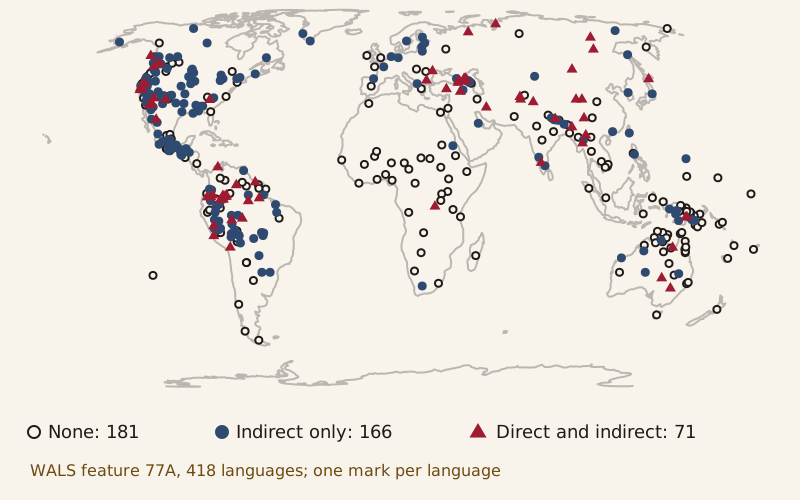
The 418 languages in WALS feature 77A. Hollow circles have no grammatical evidentials, blue dots have indirect evidentials only, and red triangles have both direct and indirect ones.
In Turkish, "Ahmet gel-di" and "Ahmet gel-miş" can both be translated "Ahmet came." The World Atlas of Language Structures (WALS) marks the first as witnessed by the speaker and the second as unwitnessed. That is evidentiality: grammar that records how the speaker knows. In the atlas's words, markers of evidentiality "express the evidence a speaker has for his/her statement."
By this page's count of the WALS v2020.6 data, 237 of the 418 languages in its evidentiality sample have grammatical evidentials (56.7%). English is not one of them. It reports a source with separate words, such as reportedly, which WALS leaves out of the count.
Seen, heard or inferred: which sources can a grammar mark?
WALS chapter 77, by Ferdinand de Haan, splits evidence into two kinds. Direct evidentials mark "some sort of sensory evidence," usually sight. Indirect evidentials are used when the speaker "was not a witness to the event but learned of it after the fact," by inference or by being told. The chapter's examples cover five kinds of source:
- Seen: Fasu, spoken in Papua New Guinea, wraps the verb in a visual marker, a-…-re: a-pe-re is translated "[I see] it coming."
- Heard: a Koasati ending says that the charring of meat was "perceived by hearing": "It sounds like the meat is charring."
- Other senses: Tuyuca, in Colombia and Brazil, has a non-visual marker used both for sounds and for the other senses.
- Inferred: in Khalkha, the marker biz gives "He must have come."
- Reported: Lezgian -lda gives "They say that there will be a meeting today."
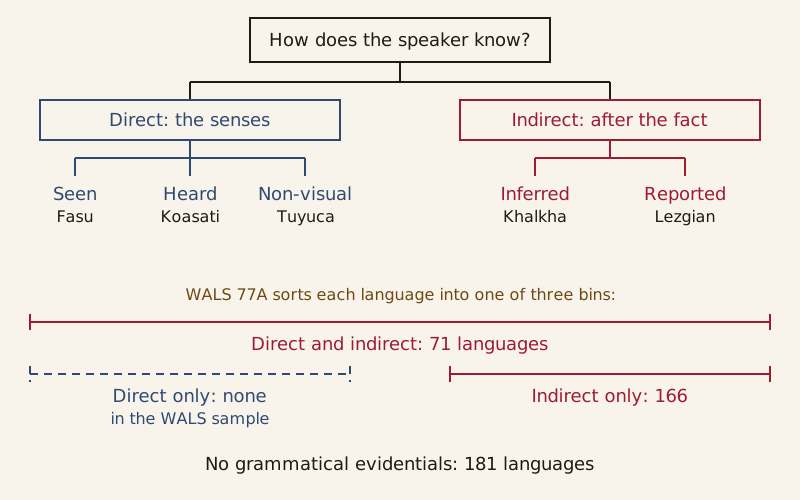
The kinds of source in WALS chapter 77, with one example language each, and the three bins of WALS feature 77A. No language in the WALS sample has direct evidentials alone.
The atlas does not count how many of these one language can mark; its map has three bins. De Haan writes that "in the majority of cases" there is "one general direct evidential." Indirect evidence, too, is "more often than not" grouped under one marker. He places the largest systems of North America in California, "especially the Pomoan languages," and the Southwest, and those of South America in the Vaupés River region of western Brazil and nearby areas.
The databases disagree on one pattern. WALS finds no language in its sample with direct evidentials but no indirect ones. Grambank v1.0.3 codes 29 languages that way, Korean among them. Each gets a yes on GB322, "Is there grammatical marking of direct evidence (perceived with the senses)?" and a no on GB323, "Is there grammatical marking of indirect evidence (hearsay, inference, etc.)?"
 Generated illustration
Seen or told: direct evidentials mark sensory evidence, usually sight; indirect evidentials mark what a speaker learned after the fact, by inference or by being told.
Which languages have grammatical evidentials?
On the map at the top of this page, each mark is one language, placed at the coordinates WALS gives and drawn over Natural Earth coastlines. Evidentials are most common in the Americas: 100 of the 134 North American languages in the sample have them, and 53 of 79 in South America. In Africa only 3 of 35 do: Afrikaans, Lega and Beja. De Haan calls this "the almost complete absence of evidentials in Africa."
In Eurasia, 62 of 95 languages have evidentials. WALS codes Turkish, Bulgarian and Georgian with both direct and indirect evidentials, and Japanese and Lezgian with indirect ones only. De Haan writes that evidentiality "would appear to be more of an areal feature than a genetic feature." He adds that its presence in Bulgarian, Macedonian and Albanian "may be due to Turkish influence."
A count by genus gives a lower share. When each of the 240 genera in the sample gets one vote, split among its languages, 48.3% of the votes go to evidentials, by this page's count. WALS defines a genus as a group of languages "whose relatedness is fairly obvious without systematic comparative analysis."
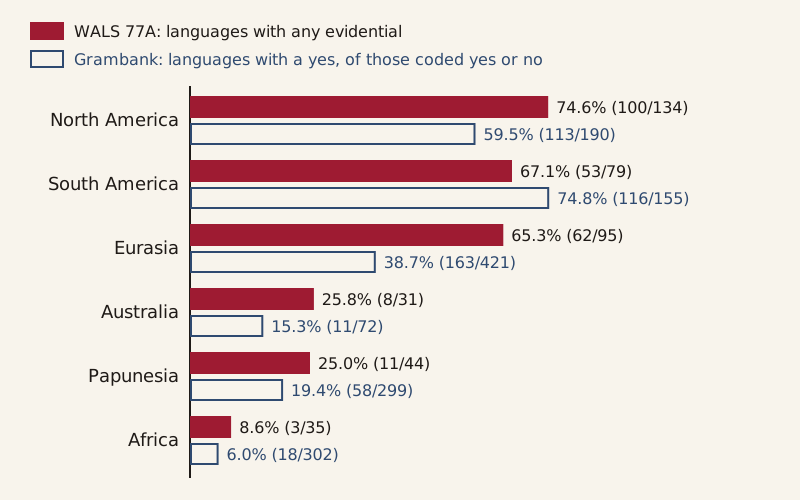
Share with grammatical evidentials in six world regions: WALS languages, and Grambank languages coded yes or no. Both databases put Africa lowest.
Grambank, a separate database with a different sample, gives a lower figure still. This page counts a yes on GB322 or GB323 as present and a no on both as absent. On that rule, Grambank settles the question for 1,439 languages. Evidentials are present in 479 of them (33.3%).
A language counts as in both databases only when it is in Grambank and its Glottolog code matches. Of the 218 such languages that both databases settle, they agree on 174 (79.8%).
How do languages mark evidentiality?
WALS feature 78A records the form a marker takes. Among the 237 languages with evidentials, 131 attach it to the verb as an affix or clitic (55.3%). Another 65 use a separate particle (27.4%). In 24 it is part of the tense system (10.1%), 10 mix methods (4.2%) and 7 use a modal morpheme, such as a modal verb (3.0%).
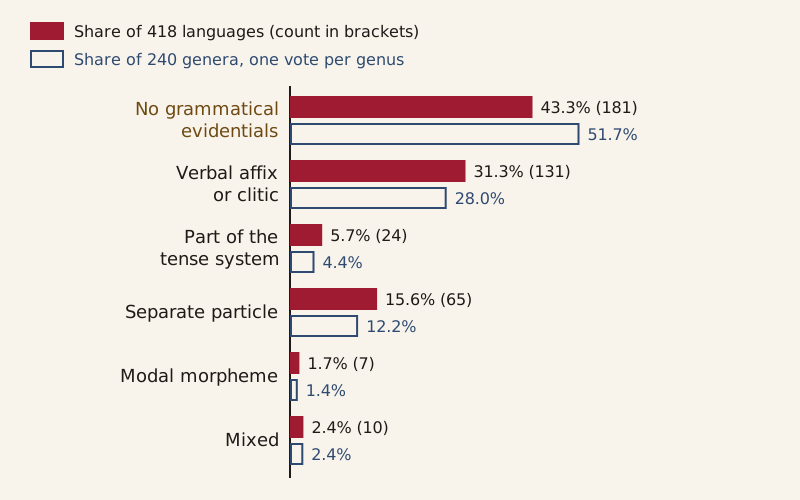
How 418 languages code evidentials in WALS 78A, as a share of languages and of 240 genera. Among languages with evidentials, a verbal affix or clitic is the most common form.
De Haan reads these forms as traces of where each marker came from. Where evidentiality is part of the verbal system, he writes, the markers "were originally tense morphemes." Dutch shows the modal route. Its moeten "must" can mark indirect evidence, so "Het moet een goede film zijn" is translated "It seems to be a good movie."
He also writes that a language with evidential particles "will only use them for indirect evidentiality." He names Apalai and Lega as the only possible exceptions in the sample; the v2020.6 data has three languages with both direct and indirect evidentials coded by a separate particle: Apalaí, Lega and Squamish. This page follows the data and reports the chapter's list beside it.
What does the Turkish ending -miş mark?
Turkish has two past tenses that, in de Haan's words, "can be used for evidential distinctions." WALS, citing Aksu-Koç and Slobin (1986), glosses -di as a direct past and -miş as an indirect one. The atlas then translates the -miş sentence two ways.
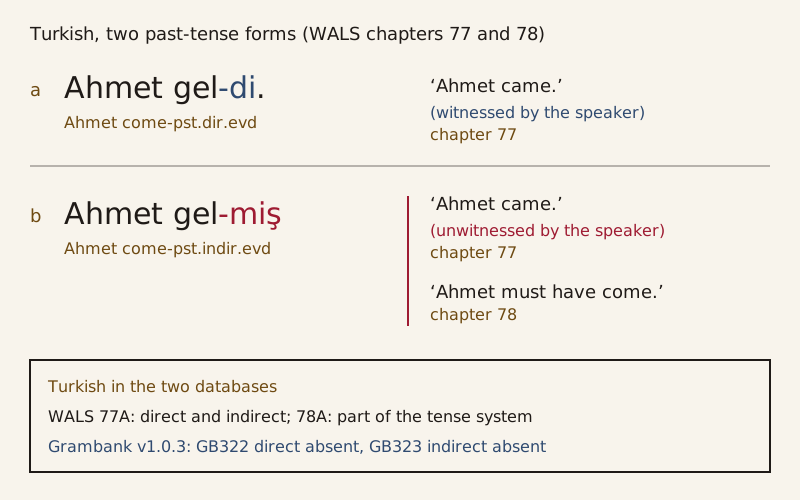
The Turkish pair from WALS chapters 77 and 78, the two translations the atlas gives for gel-miş, and the codes WALS and Grambank assign to Turkish.
Chapter 77 gives "Ahmet came." with the note "(unwitnessed by the speaker)." Chapter 78 gives "Ahmet must have come," the "must have come" wording that chapter 77 uses for the Khalkha inference marker. Many languages draw this witnessed and unwitnessed line in the past tense, de Haan writes, among them Georgian, many Turkic languages, Komi-Zyrian, Haida and Ika.
Grambank v1.0.3 codes Turkish differently: no on GB322 and no on GB323, citing Jaklin Kornfilt's 1997 grammar. The tests differ. While Grambank asks for markers "dedicated to expressing" the speaker's evidence, WALS has a value for evidentials that are "part of the tense system," and that is where it puts Turkish. Neither entry for Turkish carries a comment that explains the difference.
Turkish also has values on the WALS features behind this site's other grammar pages. It is SOV for word order, has no grammatical gender and has a polite form of "you" (Thou vs You).
Does English have evidentiality?
Not in its grammar, by both databases. WALS codes English as having no grammatical evidentials, and de Haan notes that the European languages with indirect evidentials are "mostly Germanic (though not English)." Grambank v1.0.3, citing Huddleston and Pullum's 2002 grammar, also codes English no on both questions.
English must is the near miss. Its Dutch cognate moeten can mark evidence, but English must "does not have an evidential sense," de Haan writes. It keeps a reading that WALS files under epistemic modality, which marks "the speaker's degree of confidence in the statement."
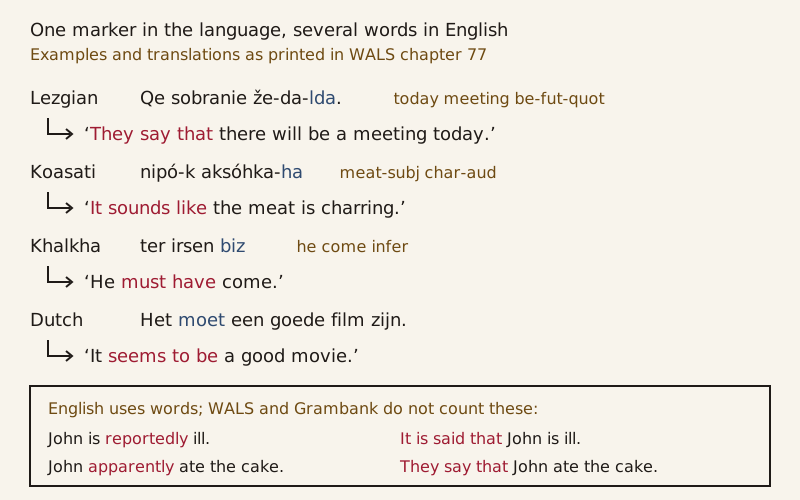
Four evidential markers and their English translations in WALS chapter 77. Below, English sentences that WALS and Grambank leave out, because the source is given by separate words.
In place of grammar, English names a source with separate words: WALS's examples of what it leaves out are reportedly, as in "John is reportedly ill," and "It is said that John is ill." Grambank adds apparently and sentences such as "They say that John ate the cake" and "I saw that John had eaten the cake." When the atlas translates a single evidential ending, it reaches for the same kind of words. Lezgian -lda becomes "They say that."
A grammar with evidentials does not outrank one without them: this site's position is that no language is primitive.
English writing tracks hearsay with verbs such as says. The Caesar Cipher page leans on them in a box headed "Retelling vs. the text," which sets an encyclopedia's retelling beside the Latin of Suetonius.
Sources
- 1
Ferdinand de Haan. 2013. Semantic Distinctions of Evidentiality. In: Dryer, Matthew S. & Haspelmath, Martin (eds.) WALS Online (v2020.6) [Data set]. Zenodo. https://doi.org/10.5281/zenodo.23010827 (Available online at https://wals.info/chapter/77, Accessed on 2026-10-16.)
https://wals.info/chapter/77 (full text)
- 2
Ferdinand de Haan. 2013. Coding of Evidentiality. In: Dryer, Matthew S. & Haspelmath, Martin (eds.) WALS Online (v2020.6) [Data set]. Zenodo. https://doi.org/10.5281/zenodo.23010827 (Available online at https://wals.info/chapter/78, Accessed on 2026-10-16.)
https://wals.info/chapter/78 (full text)
- 3
Dryer, Matthew S. & Haspelmath, Martin (eds.) 2013. WALS Online (v2020.6) [Data set]. Zenodo. https://doi.org/10.5281/zenodo.23010827 (Available online at https://wals.info, Accessed on 2026-10-16.)
https://doi.org/10.5281/zenodo.23010827 (data tables for features 77A and 78A, with Turkish values for 30A, 45A and 81A)
- 4
Matthew S. Dryer. 2013. Genealogical Language List. In: Dryer, Matthew S. & Haspelmath, Martin (eds.) WALS Online (v2020.6) [Data set]. Zenodo. https://doi.org/10.5281/zenodo.23010827 (Available online at https://wals.info/languoid/genealogy, Accessed on 2026-10-16.)
https://wals.info/languoid/genealogy (introduction (definition of genus))
- 5
Skirgård, Hedvig et al. 2023. Grambank v1.0.3 [Data set]. Zenodo. https://doi.org/10.5281/zenodo.7844558
https://doi.org/10.5281/zenodo.7844558 (data tables and the feature descriptions for GB322 and GB323)
- 6
Natural Earth. 1:110m Physical Vectors: Coastline, version 4.1.0. Public domain. https://www.naturalearthdata.com/
https://naciscdn.org/naturalearth/110m/physical/ne_110m_coastline.zip (data file (version 4.1.0))
Download the data: 418 languages with WALS and Grambank codes (CSV) (Data: WALS Online v2020.6, ed. Matthew S. Dryer and Martin Haspelmath (https://doi.org/10.5281/zenodo.23010827), CC BY 4.0, retrieved 2026-10-16; Grambank v1.0.3, Hedvig Skirgård et al. (https://doi.org/10.5281/zenodo.7844558), CC BY 4.0, retrieved 2026-10-16) · counts by language, genus and region (CSV) (Data: WALS Online v2020.6, ed. Matthew S. Dryer and Martin Haspelmath (https://doi.org/10.5281/zenodo.23010827), CC BY 4.0, retrieved 2026-10-16; Grambank v1.0.3, Hedvig Skirgård et al. (https://doi.org/10.5281/zenodo.7844558), CC BY 4.0, retrieved 2026-10-16) · WALS against Grambank (CSV) (Data: WALS Online v2020.6, ed. Matthew S. Dryer and Martin Haspelmath (https://doi.org/10.5281/zenodo.23010827), CC BY 4.0, retrieved 2026-10-16; Grambank v1.0.3, Hedvig Skirgård et al. (https://doi.org/10.5281/zenodo.7844558), CC BY 4.0, retrieved 2026-10-16)
Corrections
No corrections yet. Report an error through the corrections address in the page footer; every change is logged here as YYYY-MM-DD — what changed and why.
Decode next:
- Grammatical Gender: the WALS count of noun classes that other words must agree with, from none to five or more, across 257 languages.
- Caesar Cipher: the shift of three in Suetonius's account, and a 10,000-message test of two ways to break it.
Cite this page
Codes & Letters. “Evidentiality: When Grammar Marks How You Know.” Codes & Letters. Published 2026-10-16. Last substantive revision 2026-10-16. https://codesandletters.com/grammar/evidentiality/. Accessed [the date you read it].