Male and Female Symbols: Linnaeus Took Them From the Planets
Codes & Letters
- Published
- Last substantive revision
SymbolSpec card
- Symbol
- Male sign ♂ (U+2642) and female sign ♀ (U+2640)Source: Unicode Character Database 18.0.0
- System
- Astronomical signs of Mars and Venus, used in alchemy for iron and copper; in botany and then zoology for male and femaleSource: Stearn, Taxon 11 (1962): 109–113
- Year issued
- 1751, the first use for male and female in biology that Stearn records (Plantae hybridae)Source: Stearn, Taxon 11 (1962): 110; Amoenitates academicae 3 (1756): 33
- Design background
- Origin of the shapes disputed: Mars's shield and spear and Venus's looking-glass (Scaliger's reading), or shortened Greek names Thouros and Phosphoros (Salmasius, 1629), favored by Stearn (1962) and BeckmannSource: Stearn, Taxon 11 (1962): 112–113; Beckmann, History of Inventions, vol. 2 (1846): 23–31
- Image rights
- Glyphs drawn from Noto Sans Symbols 2.003, Noto Sans Symbols 2 2.008 and Noto Sans 2.015 (SIL Open Font License 1.1); book pages and the 1515 photograph are public domain, via Wikimedia CommonsSource: this page's image credits
male-and-female-symbols-spec.csv the values on this card, as CSVData: Unicode Character Database 18.0.0 (https://www.unicode.org/Public/18.0.0/ucd/), © Unicode, Inc., Unicode License v3 (https://www.unicode.org/license.txt), retrieved 2026-10-15 and 2026-10-16
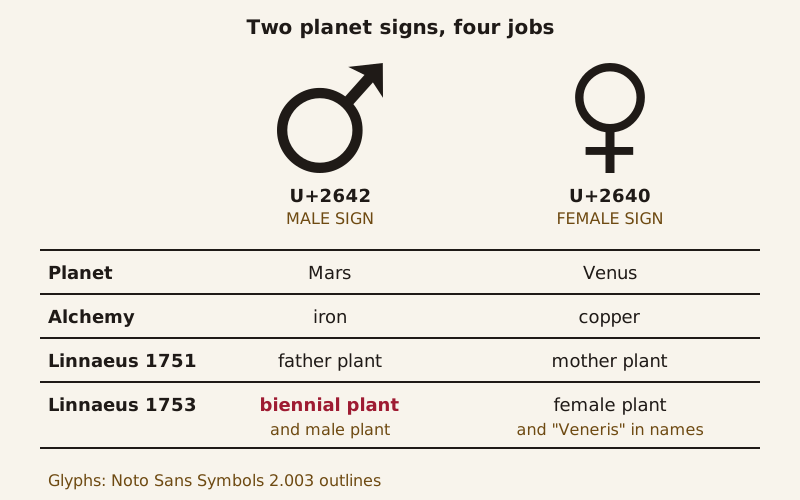
The male sign ♂ (U+2642) and female sign ♀ (U+2640), drawn from Noto Sans Symbols, and the jobs each held by 1753, from planet and metal to plants in Linnaeus's books.
In volume 1 of Linnaeus's Species Plantarum (1753), ♂ (U+2642) marks 65 plant entries. None of them is male. In that volume the Mars sign means a plant that lives for two years, by this page's count of the Project Gutenberg transcription.
The male and female signs began as the astronomical symbols of Mars and Venus. Alchemists used them for iron and copper. The Swedish naturalist Carl Linnaeus (1707–78) carried them into biology: a dissertation presented under him at Uppsala in 1751, Plantae hybridae, marked a hybrid's mother plant ♀ (U+2640) and its father plant ♂. William T. Stearn, writing in the plant taxonomy journal Taxon in 1962, called this the signs' first biological use.
Where did ♂ and ♀ come from before biology?
Long before botany, ♂ (U+2642) and ♀ (U+2640) stood for two planets. Astrology and the old crafts of metalworking paired each planet with a metal. Stearn, quoting E. J. Holmyard's Alchemy (1957), lists the pairs: the Sun with gold, Mars with iron, Venus with copper, and so on through the seven. Medieval European alchemists then wrote the planet's sign as shorthand for its metal, so ♂ could mean iron and ♀ copper.
In print, the signs also marked the planets themselves. In a 1515 Venice edition of the astrologer Abu Ma'shar's De magnis coniunctionibus, the woodcut of Mars carries ♂ and the woodcut of Venus carries ♀.
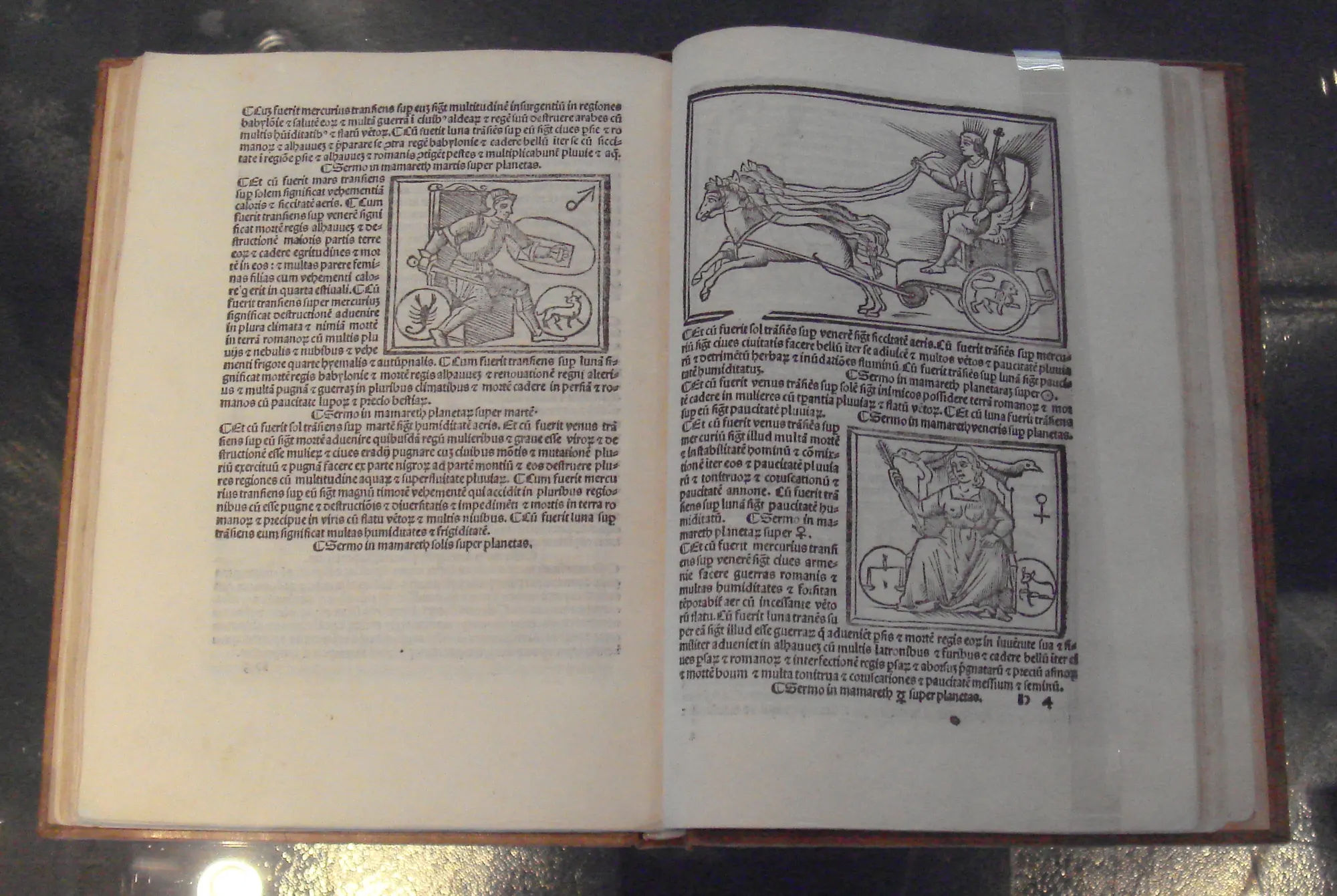
Image credit and license (full text)
"Translation of Albumasar Venice 1515 De Magnis Coniunctionibus" by PHGCOM — Public domain (photograph released into the public domain by its author, PHGCOM (Commons PD-self); the book shown, Abu Ma'shar's De magnis coniunctionibus printed in Venice in 1515 with unsigned woodcuts, is public domain in the US as a work published before 1931 and in the EU, where anonymous works are protected for 70 years after publication) — https://commons.wikimedia.org/wiki/File:Translation_of_Albumasar_Venice_1515_De_Magnis_Coniunctionibus.jpg
Abu Ma'shar's De magnis coniunctionibus, printed in Venice in 1515: the woodcut of Mars on the left page carries ♂, and the woodcut of Venus on the right page carries ♀.
Linnaeus met the signs in that older sense. His earliest surviving manuscript, written in 1725 when he was 18, copies the planet signs for the metals from the Pharmacopoea Leovardensis, first published in 1687. His Systema Naturae of 1735 still used them for metals, Stearn writes. Only later did they become botanical shorthand.
Is ♀ really Venus's hand mirror?
That is one of two explanations scholars have offered, and Stearn in 1962 and Beckmann before him both favored the other. In the first reading, which Stearn attributes to Scaliger, ♂ (U+2642) shows the shield and spear of Mars and ♀ (U+2640) the looking-glass of Venus. Stearn judged in 1962 that "probably none now accepts" it. Johann Beckmann, a one-time student of Linnaeus, also described this picture reading in his History of Inventions, then set it aside.
The second reading goes back to the French scholar Claude de Saumaise (Salmasius, 1588–1653), cited by both Stearn and Beckmann for his Plinianae exercitationes. In this account the signs began as shortened Greek names of the planets, which Stearn spells Thouros for Mars and Phosphoros for Venus. Beckmann calls the supposed looking-glass "nothing else than the initial letter, a little distorted" of the Greek name. Stearn wrote that "All the evidence favours" this account.
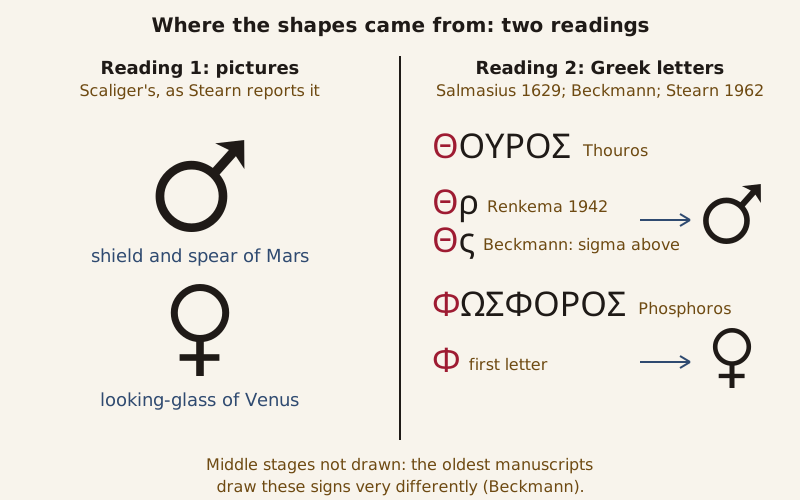
Two readings of the same shapes: pictures of Mars's gear and Venus's mirror, or worn-down Greek letters. The middle stages are not drawn, because old manuscripts draw them differently.
The Greek-letter reading still has gaps. Even its supporters derive the Mars sign from different letters. Beckmann describes theta with a final sigma set above it, while the table Stearn prints after H. W. Renkema (1942) uses theta and rho. Beckmann also warned that the oldest manuscripts differ very much in how they draw these signs.
This site treats the Greek-letter reading as the better-supported one, not as settled fact. The peace symbol also has two origin stories, but both come from the man who designed it.
Who first used ♂ and ♀ for male and female?
The earliest use Stearn records is in Plantae hybridae, presented by Johannes Haartman with Linnaeus presiding, at Uppsala on November 23, 1751. The text was reprinted in volume 3 of Linnaeus's Amoenitates academicae (1756). Page 33 of that reprint sets out the code: "MATREM signo ♀, PATREM ♂". That is, the mother is marked with the sign ♀ (U+2640), the father with ♂ (U+2642).
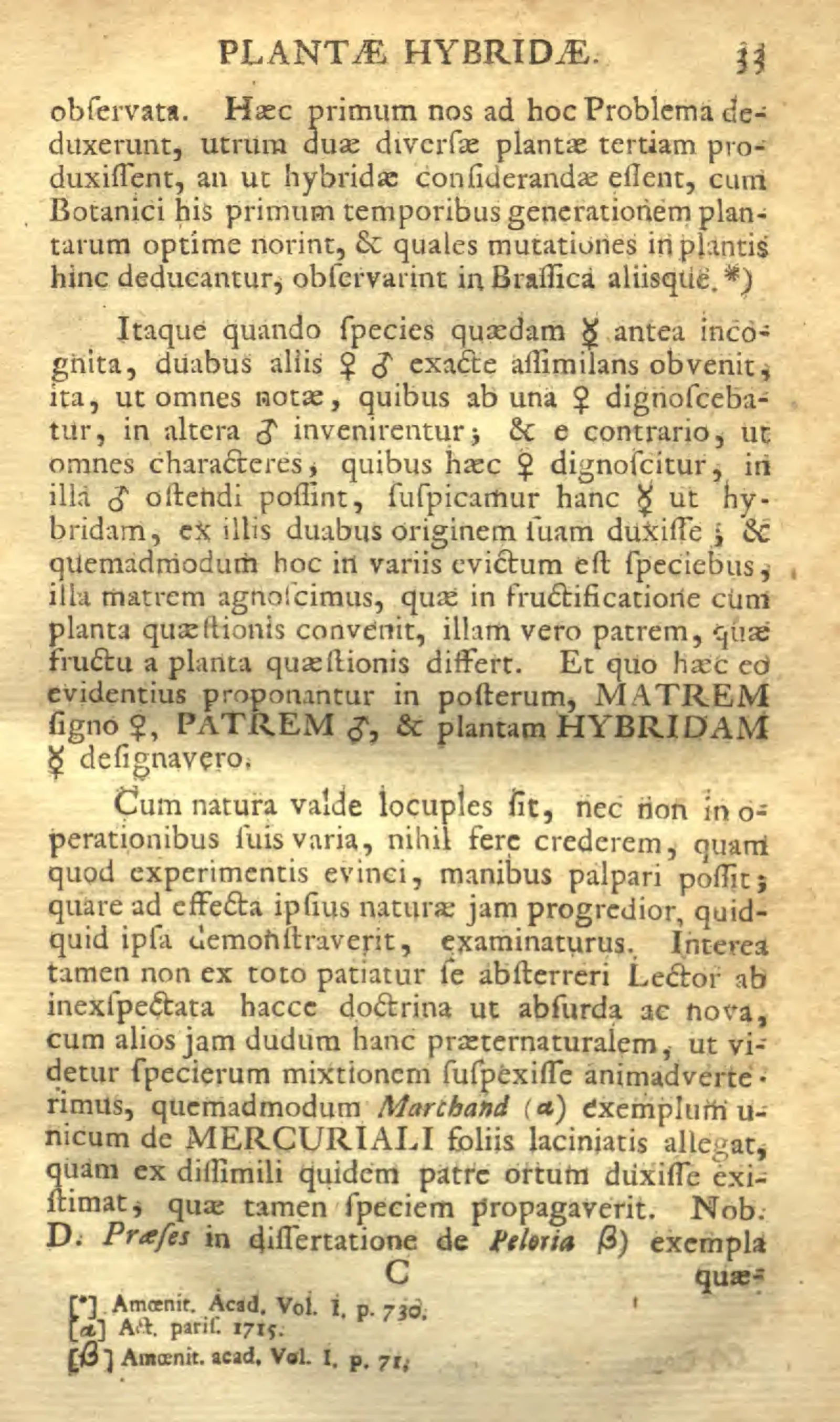
Image credit and license (full text)
"Caroli Linnaei ... Amoenitates academicae, seu, Dissertationes variae physicae, medicae, botanicae ?antehac seorsim editae ? nunc collectae et auctae ? cum tabulis aeneis. (IA mobot31753000806395)" by Carl Linnaeus and Johannes Haartman — Public domain (dissertation of 1751 reprinted in Stockholm in 1756; Carl Linnaeus died in 1778, and the respondent Johannes Haartman, an adult by 1751, died long before 1956; public domain in the US (published 1756) and the EU (authors dead more than 70 years); a faithful scan of a flat page adds no new rights (US Bridgeman principle, EU DSM Directive Art. 14); Commons tag PD-US-expired) — https://commons.wikimedia.org/wiki/File:Caroli_Linnaei_..._Amoenitates_academicae,_seu,_Dissertationes_variae_physicae,_medicae,_botanicae_%3Fantehac_seorsim_editae_%3F_nunc_collectae_et_auctae_%3F_cum_tabulis_aeneis._(IA_mobot31753000806395).pdf; modifications: one page taken from the scanned volume: PDF page 36 (printed page 33), at the native resolution of the scan (1604 x 2715 px, color); no cropPlantae hybridae (1751), reprinted in Amoenitates academicae, volume 3 (1756), page 33. The capitals MATREM and PATREM give the code: the mother marked ♀, the father ♂.
Two pages later the code is put to work. Veronica spuria, which arose in the Uppsala academic garden in 1750, is given Veronica maritima ♀ as its mother and Verbena officinalis ♂ as its father.
Stearn reported that no evidence had been found of these signs being used for sex before Linnaeus. A supposed ancient case appears in Lancelot Hogben's Science for the Citizen (1938): a "female sign" on a tablet from Susa. It did not survive a look at the original. A. R. Millard of the British Museum reported in 1962 that the mark was "simply a circular depression in the clay."
Linnaeus kept ♂ and ♀ for male and female in later books. In his Mantissa Plantarum (1767) and Mantissa Plantarum altera (1771), Stearn writes, he "regularly used" them for male and female flowers. Stearn credits their convenience for their spread into zoology as well as botany.
Why does ♂ also mean biennial?
In Species Plantarum, Linnaeus's 1753 survey of the plant kingdom as then known, the planet signs mostly tell how long a plant lives. The preface gives the key: "Fruticantes ♄, Perennes ♃, Biennes ♂, Annuas ☉ notavi". Woody plants get ♄ (U+2644, Saturn), perennials ♃ (U+2643, Jupiter), biennials ♂ (U+2642, Mars) and annuals ☉ (U+2609, the Sun).
Volume 1 uses that key hundreds of times. Outside the key itself, this page's count of the Project Gutenberg transcription finds ♃ 885 times, ♄ 770 and ☉ 412. The Mars sign ♂ appears 65 times, every time at the end of the Habitat line that gives the plant's native range, where the other lifespan signs usually stand too. The Venus sign ♀ (U+2640) appears five times, always standing for Veneris, "of Venus," inside a plant name such as Campanula Speculum ♀, from Speculum Veneris, Venus's looking-glass.
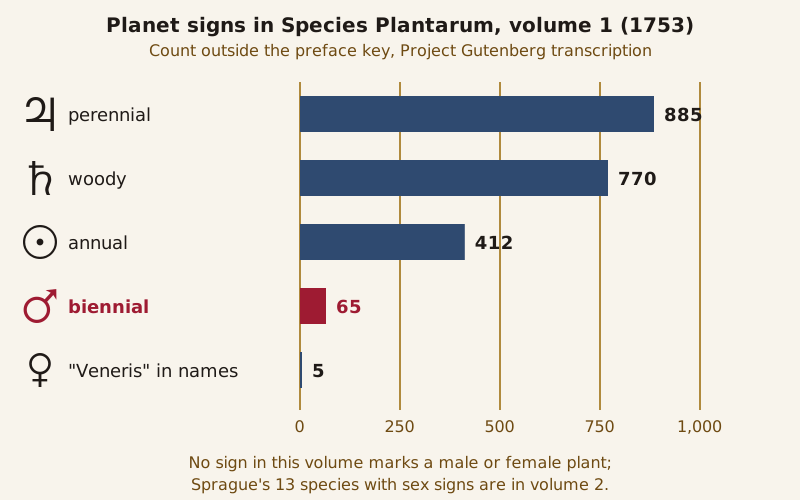
Planet signs in volume 1 of Species Plantarum outside the preface key, by this page's count of the Project Gutenberg transcription. Every ♂ marks a biennial; no sign marks a plant's sex.
Signs for sex are rare in the book. T. A. Sprague, whom Stearn quotes, listed them under 13 species, from spinach (Spinacia oleracea) and hemp (Cannabis sativa) to the fig (Ficus carica). All 13 are in volume 2, though the list may not be complete: page 1027 also has a ♂ under Antidesma, which is not on it. On the hemp entry, the name Cannabis mas, "male hemp," cited from an earlier book, carries ♀.
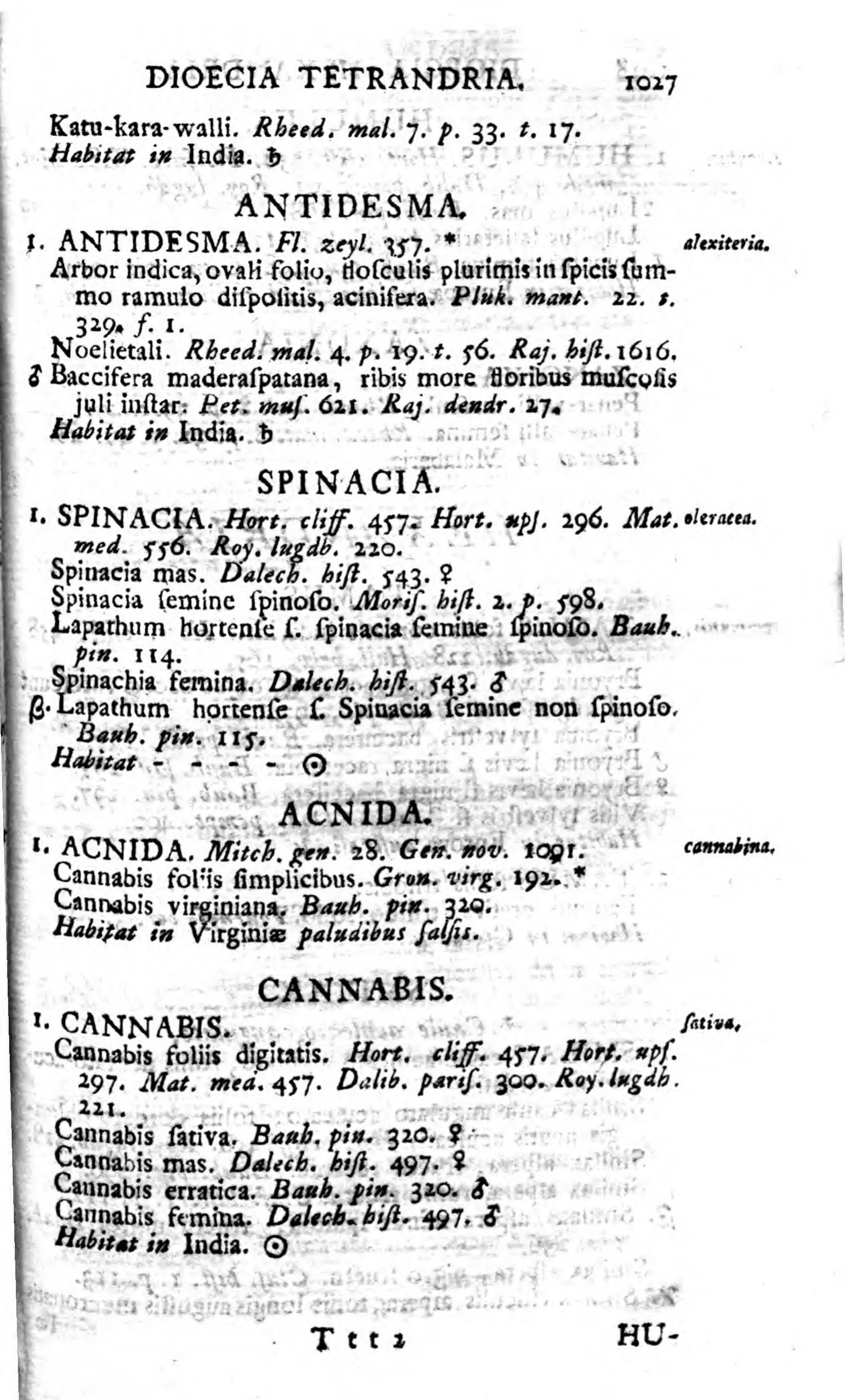
Image credit and license (full text)
"Caroli Linnaei ... Species plantarum ?exhibentes plantas rite cognitas, ad genera relatas, cum differentiis specificis, nominibus trivialibus, synonymis selectis, locis natalibus (IA mobot31753000802832)" by Carl Linnaeus — Public domain (printed in Stockholm in 1753; Carl Linnaeus died in 1778; public domain in the US (published 1753) and the EU (author dead more than 70 years); a faithful scan of a flat page adds no new rights (US Bridgeman principle, EU DSM Directive Art. 14); Commons tag PD-US-expired) — https://commons.wikimedia.org/wiki/File:Caroli_Linnaei_..._Species_plantarum_%3Fexhibentes_plantas_rite_cognitas,_ad_genera_relatas,_cum_differentiis_specificis,_nominibus_trivialibus,_synonymis_selectis,_locis_natalibus_(IA_mobot31753000802832).pdf; modifications: one page taken from the scanned volume: PDF page 469 (printed page 1027), at the native resolution of the scan (1651 x 2734 px, grayscale); no cropSpecies Plantarum, volume 2 (1753), page 1027. Under spinach and hemp, ♀ and ♂ mark female and male plants, and ☉ after Habitat marks an annual.
Sprague found it "not obvious" why Linnaeus gave the Mars sign two senses. He suggested that when Linnaeus began the manuscript in 1746 he "did not anticipate having to use signs for sex". That is a guess, not a record.
What are U+2640 and U+2642 in Unicode?
Unicode encodes ♀ as U+2640 FEMALE SIGN and ♂ as U+2642 MALE SIGN, both in the Miscellaneous Symbols block (2600–26FF) and both with the age 1.1 in the Unicode 18.0.0 data. That puts them in Unicode 1.1 (1993). The age data starts at that version, so it cannot show whether they were already in Unicode 1.0.
The Unicode names list still carries the older meanings. It glosses U+2640 as "= Venus" and "= alchemical symbol for copper," and U+2642 as "= Mars" and "= alchemical symbol for iron."
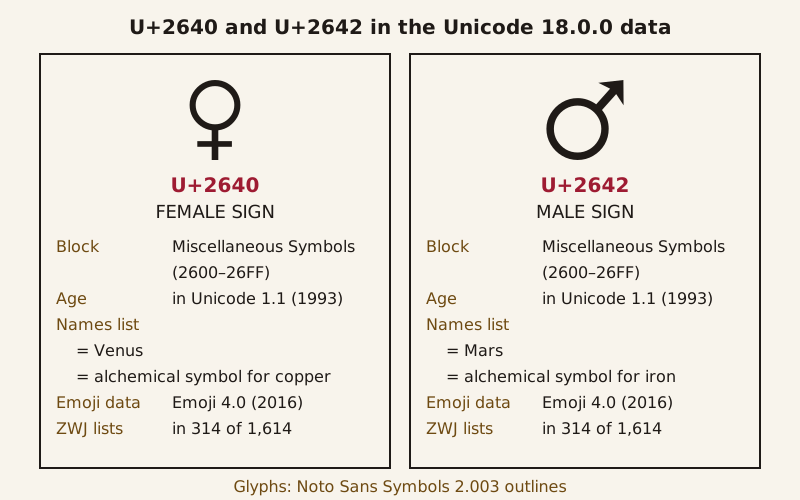
U+2640 and U+2642 in the Unicode 18.0.0 data: block, age, the names list glosses, the Emoji 4.0 listing, and their share of the recommended emoji sequences.
Both signs were added to Unicode's emoji data in Emoji 4.0 (2016). In Unicode 18.0's list of recommended emoji sequences joined by a zero-width joiner, each appears in 314 of 1,614, and each of those sequences is a female (♀) or male (♂) form, such as "woman police officer" or "merman." Emoji covers how Unicode fixes a name and a number but leaves the picture to each font.
A circle with an arrow says nothing about sex on its own. This site holds that symbols like these are learned, not intuitive, the same point Road Signs makes with the red warning triangle.
In grammar, gender is a class of nouns that other words agree with, and not every gender system is based on sex. Grammatical Gender counts those classes language by language.
Sources
- 1
Carl Linnaeus (praeses) and Johannes Haartman (respondent), Plantae hybridae (Uppsala, November 23, 1751), reprinted in Carl Linnaeus, Amoenitates academicae, vol. 3 (Stockholm: Laurentius Salvius, 1756), pp. 28–62. Missouri Botanical Garden copy, scan on Wikimedia Commons.
https://commons.wikimedia.org/wiki/File:Caroli_Linnaei_..._Amoenitates_academicae,_seu,_Dissertationes_variae_physicae,_medicae,_botanicae_%3Fantehac_seorsim_editae_%3F_nunc_collectae_et_auctae_%3F_cum_tabulis_aeneis._(IA_mobot31753000806395).pdf (title page and pp. 28, 33–35)
- 2
Carl Linnaeus, Species Plantarum, vol. 1 (Stockholm: Laurentius Salvius, 1753), Project Gutenberg eBooks #20771 (Sections I–III, with the preface Lectori aequo), #27049 (Sections IV–V), #30104 (Sections VI–X) and #31010 (Sections XI–XIII).
https://www.gutenberg.org/ebooks/20771 (full text)
- 3
Carl Linnaeus, Species Plantarum, vol. 2 (Stockholm: Laurentius Salvius, 1753), p. 1027. Missouri Botanical Garden copy, scan on Wikimedia Commons.
https://commons.wikimedia.org/wiki/File:Caroli_Linnaei_..._Species_plantarum_%3Fexhibentes_plantas_rite_cognitas,_ad_genera_relatas,_cum_differentiis_specificis,_nominibus_trivialibus,_synonymis_selectis,_locis_natalibus_(IA_mobot31753000802832).pdf (p. 1027, and the pages for the 13 species Sprague lists)
- 4
PHGCOM, photograph (2009) of Abu Ma'shar, De magnis coniunctionibus (Venice, 1515), open at the chapters on Mars and Venus, Wikimedia Commons.
https://commons.wikimedia.org/wiki/File:Translation_of_Albumasar_Venice_1515_De_Magnis_Coniunctionibus.jpg (file record and photograph)
- 5
William T. Stearn, "The Origin of the Male and Female Symbols of Biology," Taxon 11, no. 4 (May 1962): 109–113, https://doi.org/10.2307/1217734.
https://iapt-taxon.org/historic/Congress/IBC_1964/male_fem.pdf (full text)
- 6
Johann Beckmann, A History of Inventions, Discoveries, and Origins, trans. William Johnston, 4th ed., rev. William Francis and J. W. Griffith (London: Henry G. Bohn, 1846), vol. 2, "Chemical Names of Metals," pp. 23–31. Project Gutenberg eBook #48152.
https://www.gutenberg.org/ebooks/48152 (chapter "Chemical Names of Metals")
- 7
Unicode Consortium, Unicode Character Database 18.0.0: UnicodeData.txt, Blocks.txt, DerivedAge.txt and NamesList.txt.
https://www.unicode.org/Public/18.0.0/ucd/ (entries for U+2609, U+2640 and U+2642–U+2644, and the notes at the head of DerivedAge.txt)
- 8
Mark Davis and Ned Holbrook, eds., Unicode Technical Standard #51, "Unicode Emoji," version 18.0, revision 31 (2026-08-28), Emoji Versions table, with the data files emoji-data.txt and emoji-zwj-sequences.txt 18.0.
https://www.unicode.org/reports/tr51/ (Emoji Versions table; entries for U+2640 and U+2642 in the data files)
Download the data: planet signs in Species Plantarum, volume 1 (CSV) (Data: Unicode Character Database 18.0.0 (https://www.unicode.org/Public/18.0.0/ucd/), © Unicode, Inc., Unicode License v3 (https://www.unicode.org/license.txt), retrieved 2026-10-15 and 2026-10-16) · Unicode data for U+2640 and U+2642 (CSV) (Data: Unicode Character Database 18.0.0 (https://www.unicode.org/Public/18.0.0/ucd/), © Unicode, Inc., Unicode License v3 (https://www.unicode.org/license.txt), retrieved 2026-10-15 and 2026-10-16; Unicode emoji data 18.0 (https://www.unicode.org/Public/18.0.0/emoji/), © Unicode, Inc., Unicode License v3 (https://www.unicode.org/license.txt), retrieved 2026-10-16)
Corrections
No corrections yet. Report an error through the corrections address in the page footer; every change is logged here as YYYY-MM-DD — what changed and why.
Decode next:
- Grammatical Gender: the grammar kind of gender, where other words in a sentence change to agree with a noun, counted across the languages in WALS.
- Emoji: the same Unicode machinery, where a code point fixes a name and a number but each font draws its own picture.
Cite this page
Codes & Letters. “Male and Female Symbols: Linnaeus Took Them From the Planets.” Codes & Letters. Published 2026-10-16. Last substantive revision 2026-10-16. https://codesandletters.com/symbols/male-and-female-symbols/. Accessed [the date you read it].