Peace Symbol: Semaphore N and D, by Its Designer's Account
Codes & Letters
- Published
- Last substantive revision
SymbolSpec card
- Symbol
- Peace symbol, also called the CND symbol (in Britain it stands for nuclear disarmament); Unicode U+262E PEACE SYMBOLSource: CND, History of the Symbol; Unicode 18.0.0 UnicodeData.txt
- System
- Emblem of the Campaign for Nuclear Disarmament (CND); flag semaphore N and D, by the designer's accountSource: CND, History of the Symbol
- Year issued
- 1958Source: CND, History of the Symbol; German Patent and Trade Mark Office
- Design background
- Drawn by Gerald Holtom (1914–1985) for the 1958 march from London to Aldermaston; he also described it as a figure in despair with hands held out and downSource: CND; German Patent and Trade Mark Office
- Image rights
- Treated as public domain in the US as simple geometry (Wikimedia Commons PD-shape); CND says it has "quite deliberately never been copyrighted" and is free for allSource: Wikimedia Commons; CND, History of the Symbol
peace-symbol-spec.csv the values on this card, as CSV
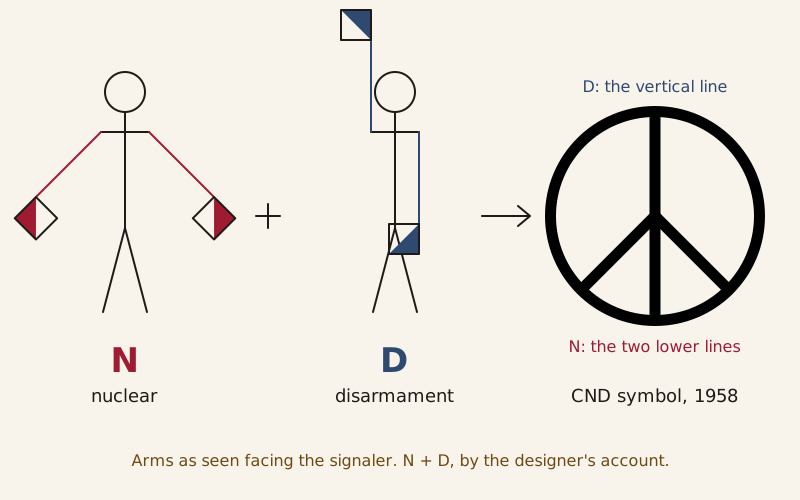
Image credit and license (full text)
"Semaphore N and D beside the peace symbol" by Codes & Letters, CC BY 4.0. Source: https://codesandletters.com/symbols/peace-symbol/. License: https://creativecommons.org/licenses/by/4.0/. Underlying image: "Peace symbol" by Gerald Holtom (symbol) and Crotalus horridus (SVG file) — Public domain (simple geometric shape, not protected in the US (Commons PD-shape: "This image of simple geometry is ineligible for copyright"); CND states the symbol has "quite deliberately never been copyrighted" and is free for all, https://cnduk.org/the-symbol/) — https://commons.wikimedia.org/wiki/File:Peace_symbol.svg; modifications: Commons drawing embedded unchanged, scaled proportionally and placed beside two semaphore figures, labels added outside the drawing.
Semaphore N and D, drawn facing the signaler, beside the CND symbol of 1958. By Gerald Holtom's account, the circle holds those two letters.
Hold two flags down and out at 45 degrees and you are signaling N in flag semaphore. Overlay D, one flag straight up and one straight down, inside a circle. That is the peace symbol. By the account of its designer, Gerald Holtom, the circle holds a code: N and D, for "nuclear disarmament."
Holtom drew it in 1958 for what the Campaign for Nuclear Disarmament (CND) calls the first major anti-nuclear march, from London to the weapons site at Aldermaston. He also gave a second, more personal explanation: a drawing of himself in despair. Both stories come from the designer, as reported by CND and by Germany's patent and trade mark office. This page sets them side by side.
How do semaphore N and D make the peace symbol?
Flag semaphore spells out words with two hand-held flags. Each letter is a fixed pair of arm positions. In the charts used for this page, every arm points in one of eight directions, 45 degrees apart. A US Navy chart printed in All Hands magazine in June 1956 and a British manual from 1918, Signalling, show N and D the same way.
N holds both arms down and out at 45 degrees, like an upside-down V. D holds one arm straight up and the other straight down, a single vertical line through the signaler. Put the four arm directions together and they match the lines inside the circle: one from top to bottom, two slanting down from the center. A program draws the diagrams here from those angles and checks that N plus D gives exactly those strokes.
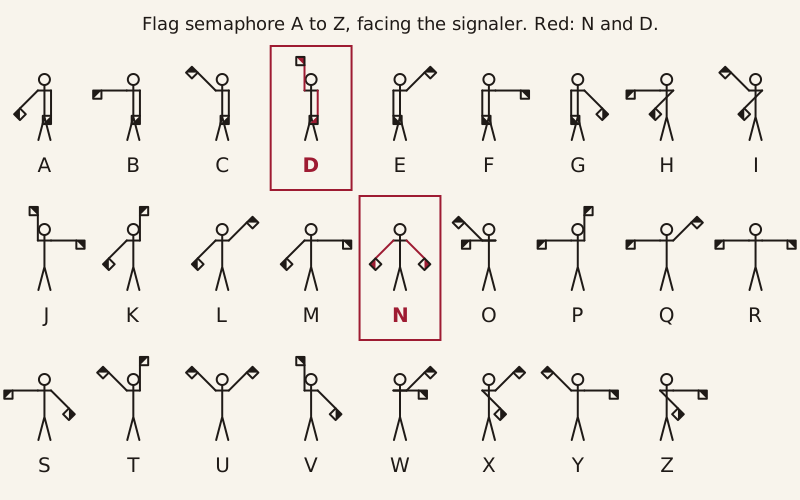
Flag semaphore from A to Z, drawn from the arm angles that two public-domain charts agree on, with N and D in red. Every figure faces the viewer.
Nothing in the finished circle spells out N or D. The reading has to be supplied. That fits this site's position that good symbols are learned rather than intuitive, the case the Road Signs page makes about warning triangles.
What was Holtom's second explanation?
CND describes Holtom as a professional designer and artist who had been a conscientious objector in the Second World War, working on a farm in Norfolk. The DPMA, Germany's patent and trade mark office, gives his dates as 1914 to 1985. He later described the design in more personal terms in a letter to Hugh Brock, editor of Peace News. CND quotes the letter on its history page without giving a date:
"I was in despair. Deep despair. I drew myself: the representative of an individual in despair, with hands palm outstretched outwards and downwards in the manner of Goya's peasant before the firing squad."
In his words, he then formalized the drawing into a line and put a circle around it. The two accounts describe the same lower strokes: as flags they are N, and as arms they are a person with hands held out and down. The DPMA likewise says that Holtom put more than one version of his inspiration into circulation, the semaphore letters on one hand and a stylized person with arms hanging helplessly on the other.
The quoted letter names no painting. Wikipedia's articles on the painting and on peace symbols both link Holtom's symbol to Goya's The Third of May 1808, which Wikidata dates to 1814 and places in the Prado in Madrid. In that painting, the lit man in the white shirt faces the soldiers with his arms raised and spread wide. Holtom's words put the hands outward and downward.
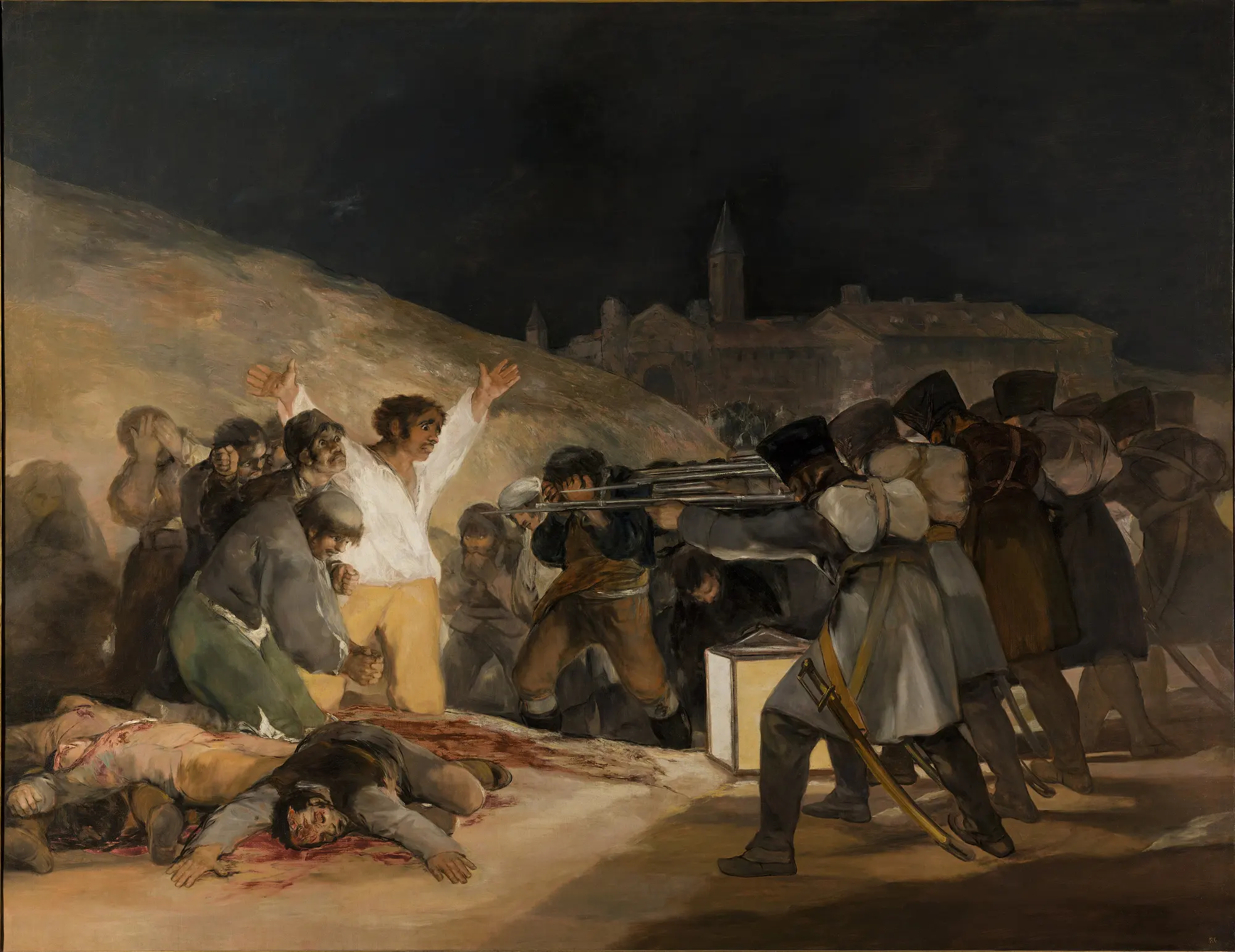
Image credit and license (full text)
"El Tres de Mayo, by Francisco de Goya, from Prado in Google Earth" by Francisco de Goya — Public domain (painting of 1814 by Francisco de Goya, who died in 1828: public domain in Spain and the rest of the EU, where terms run for the life of the author plus 70 or 80 years, and in the US as a work published before 1931 (Commons PD-old-auto-expired, deathyear 1828); a faithful photographic reproduction of a two-dimensional work adds no new rights in the US (Bridgeman principle) or the EU (DSM Directive Article 14); Commons PD-Art) — https://commons.wikimedia.org/wiki/File:El_Tres_de_Mayo,_by_Francisco_de_Goya,_from_Prado_in_Google_Earth.jpg
Goya's The Third of May 1808, completed in 1814 and held by the Prado. The man in the white shirt raises his arms; Holtom's letter describes hands held out and down.
At first, CND says, Holtom considered a Christian cross inside a circle as the motif for the march, but priests he approached were not happy about using the cross on a protest march. Christian CND later used the symbol with the central stroke extended upward to form the upright of a cross, CND adds.
How did a march sign become a general peace sign?
Holtom showed his sketches at the Peace News office in North London and to the Direct Action Committee Against Nuclear War, one of the groups that later formed CND. The symbol was chosen for the march. The DPMA dates the design to 21 February 1958.
The symbol first appeared in public on that march, over the Easter weekend of 1958, on five hundred cardboard "lollipops" on sticks. Half were black on white, for Good Friday and Saturday, and half white on green, for Easter Sunday and Monday: "from Winter to Spring, from Death to Life," as quoted on CND's history page.
An earlier CND text, kept on the site Docs Populi, says the symbol "almost at once crossed the Atlantic." Bayard Rustin, a close associate of Martin Luther King who had come over for the first Aldermaston march, took it back to the United States, where it was used on civil rights marches and later on demonstrations against the Vietnam War. The same text says it appeared on walls in Prague when Soviet tanks invaded in 1968.
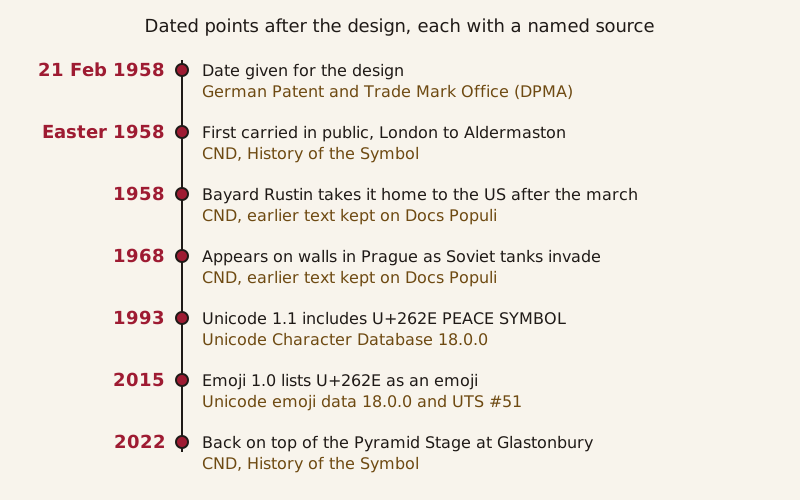
Dated points after the design, each tied to a named source: CND, Germany's patent and trade mark office, and Unicode data. Claims without a date are left off.
That earlier text says the sign became known "first in the US and then round the world as the peace symbol." CND's current page says that in Britain it stands for nuclear disarmament, while "in the rest of the world it is known more broadly as the peace symbol." Neither text names a single year for the change. In 2022, CND notes, the symbol was back on top of the Pyramid Stage at the Glastonbury Festival.
CND records claims that the sign has "older, occult or anti-Christian associations," and an official attempt to ban it in South Africa under apartheid. Groups in the United States, it says, tied it to Satan or to Communism. CND replies that Holtom described its origins in letters and interviews.
Is there a peace symbol in Unicode?
Yes. The Unicode Character Database lists U+262E PEACE SYMBOL in the Miscellaneous Symbols block, U+2600 to U+26FF, and gives it the age 1.1, the version released in 1993. The database tracks ages only from version 1.1, so it does not say whether the character was already in Unicode 1.0 of 1991. Unicode's emoji data labels the same code point E1.0, for Emoji 1.0, which the emoji standard UTS #51 dates to June 9, 2015.
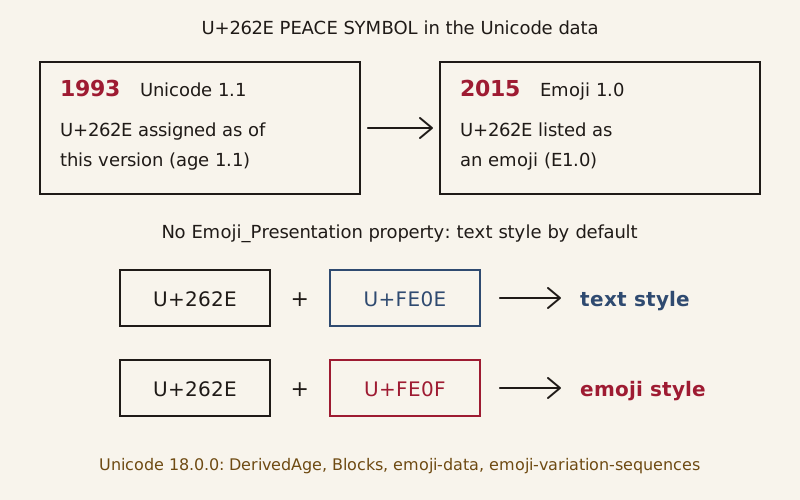
U+262E in the Unicode 18.0.0 data files: in Unicode 1.1 (1993), listed as an emoji in 2015, and set to text style by default unless a selector asks for emoji style.
U+262E does not have the Emoji_Presentation property, so UTS #51 counts it as a default text presentation character. Following it with U+FE0F, the emoji presentation selector, asks for the emoji style, and U+FE0E asks for the text style. The Emoji page explains how a code point gets its picture.
Is the peace symbol copyrighted?
By CND's account, no. Its history page says the symbol "has quite deliberately never been copyrighted. No one has to pay or to seek permission before they use it." CND adds that it cannot stop commercial, advertising or fashion uses and asks commercial users for a donation instead.
The DPMA tells the same story from the designer's side: Holtom deliberately chose not to have his design protected, so that anyone could use it. Wikimedia Commons, which hosts the drawing used in the diagram at the top of this page, files it as public domain with the note "This image of simple geometry is ineligible for copyright and therefore in the public domain." Those are the statements of CND, the German office and Commons, reported here as history rather than as legal advice.
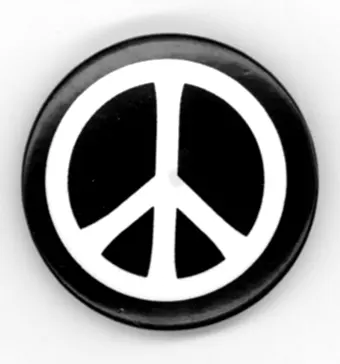

A CND button badge, photographed in 2010 and released into the public domain by its photographer. CND says anyone may use the symbol without paying or asking.
The first badges, CND says, were made by a member of its Kensington group from white clay, with the symbol painted black. They came with a note saying that fired pottery badges would be among the few human artifacts to survive a nuclear war.
Flags are only one way to send N and D: Recommendation ITU-R M.1677-1 lists them in International Morse code as dash-dot and dash-dot-dot. Morse Code is where those dots and dashes get timed.
Sources
- 1
Campaign for Nuclear Disarmament (CND), "History of the Symbol," cnduk.org, published 2018-02-13, updated 2023-02-06.
https://cnduk.org/the-symbol/ (full text)
- 2
Deutsches Patent- und Markenamt (German Patent and Trade Mark Office), "Peace-Zeichen" (in German), dpma.de, page dated 2026-01-15.
https://www.dpma.de/dpma/veroeffentlichungen/hintergrund/dasallalles/peace/index.html (full text, in German)
- 3
US Navy, "International Alphabet Flags, Phonetic Alphabet, Morse Code and Semaphore Alphabet," All Hands, June 1956, pp. 32–33, scan on Wikimedia Commons.
https://commons.wikimedia.org/wiki/File:International_Alphabet_Flags,_Phonetic_Alphabet,_Morse_Code_and_Semaphore_Alphabet_1956.png (semaphore chart, A to Z)
- 4
An Officer of the Regular Army, Signalling, ed. Capt. E. J. Solano (London: John Murray, 1918), semaphore alphabet plate, scan on Wikimedia Commons.
https://commons.wikimedia.org/wiki/File:Semaphore_alphabet_(Signalling,_1918).jpg (semaphore alphabet plate)
- 5
ITU Radiocommunication Sector, Recommendation ITU-R M.1677-1, "International Morse code" (10/2009), section 1.1.1.
https://www.itu.int/rec/R-REC-M.1677-1-200910-I/en (section 1.1.1)
- 6
Unicode Consortium, Unicode Character Database 18.0.0: UnicodeData.txt, DerivedAge.txt and Blocks.txt.
https://www.unicode.org/Public/18.0.0/ucd/ (entries for U+262E, and the notes at the head of DerivedAge.txt)
- 7
Unicode Consortium, "Enumerated Versions of The Unicode Standard."
https://www.unicode.org/versions/enumeratedversions.html (version table)
- 8
Mark Davis and Ned Holbrook, eds., Unicode Technical Standard #51, "Unicode Emoji," version 18.0, revision 31 (2026-08-28), sections 1.4.2, 1.4.3 and 1.5.2, with the data files emoji-data.txt and emoji-variation-sequences.txt 18.0.0.
https://www.unicode.org/reports/tr51/tr51-31.html (sections 1.4.2, 1.4.3 and 1.5.2, and the data file entries for U+262E)
- 9
"Peace Symbol History," Docs Populi (page updated 2021-04-23), reproducing an earlier text from the CND website.
https://docspopuli.org/articles/PeaceSymbolArticle.html (full text)
- 10
Wikimedia Commons, "File:Peace symbol.svg," file page and license section (PD-shape).
https://commons.wikimedia.org/wiki/File:Peace_symbol.svg (file page and license section)
- 11
Wikidata, "The Third of May 1808" (Q1091086).
https://www.wikidata.org/wiki/Q1091086 (date, collection and inventory statements)
- 12
Wikipedia, "The Third of May 1808," revision 1364376467 of 2026-07-16.
https://en.wikipedia.org/w/index.php?title=The_Third_of_May_1808&oldid=1364376467 (lead and the section on the composition)
- 13
Wikipedia, "Peace symbols," revision 1380090833 of 2026-10-13.
https://en.wikipedia.org/w/index.php?title=Peace_symbols&oldid=1380090833 (lead section)

.jpg)
Download the data: semaphore arm angles, A to Z (CSV)
Corrections
No corrections yet. Report an error through the corrections address in the page footer; every change is logged here as YYYY-MM-DD — what changed and why.
Decode next:
- Morse Code: N and D again, this time as dash-dot and dash-dot-dot, and why a common O takes as long to send as a rare Z.
- Male and Female Symbols: two more signs with competing origin stories, set side by side and checked against the sources.
Cite this page
Codes & Letters. “Peace Symbol: Semaphore N and D, by Its Designer's Account.” Codes & Letters. Published 2026-10-16. Last substantive revision 2026-10-16. https://codesandletters.com/symbols/peace-symbol/. Accessed [the date you read it].