Morse Code: Why the Common O Takes as Long as a Rare Z
Codes & Letters
- Published
- Last substantive revision
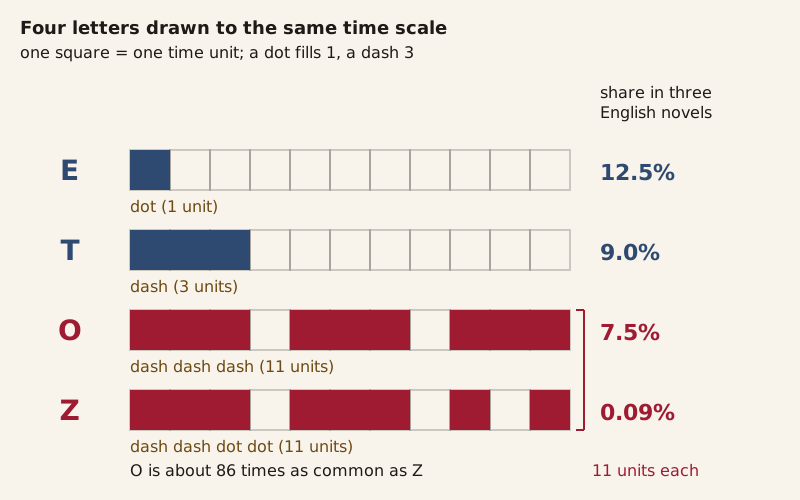
E, T, O and Z on one time scale, with codes checked against ITU-R M.1677-1. O is the fourth most common letter in three English novels, Z the rarest; both take 11 units.
In International Morse code, the letter O is three dashes and Z is dash, dash, dot, dot. Both take 11 time units to send. Yet O turns up about 86 times as often as Z in the three English novels counted on the letter frequency page. The full chart, with timing strips and five signals to decode, is in the next section.
The timing comes from Recommendation ITU-R M.1677-1 (2009) of the International Telecommunication Union. A dot lasts 1 unit and a dash 3, with gaps of 1 unit inside a letter, 3 between letters and 7 between words. The two commonest letters, E and T, do get short codes, 1 and 3 units long. O breaks that pattern more than any other letter: it is the fourth most common, yet one of eight letters that take 11 units or more.
The chart and the timings
Each cell gives a letter or figure, its code and its length in time units, from the start of the first mark to the end of the last. A program checked every code against the table in ITU-R M.1677-1, and every length was counted with the rule above.
| Letter | Code | Units | Letter | Code | Units | Letter | Code | Units |
|---|---|---|---|---|---|---|---|---|
| A | ·− | 5 | M | −− | 7 | Y | −·−− | 13 |
| B | −··· | 9 | N | −· | 5 | Z | −−·· | 11 |
| C | −·−· | 11 | O | −−− | 11 | 1 | ·−−−− | 17 |
| D | −·· | 7 | P | ·−−· | 11 | 2 | ··−−− | 15 |
| E | · | 1 | Q | −−·− | 13 | 3 | ···−− | 13 |
| F | ··−· | 9 | R | ·−· | 7 | 4 | ····− | 11 |
| G | −−· | 9 | S | ··· | 5 | 5 | ····· | 9 |
| H | ···· | 7 | T | − | 3 | 6 | −···· | 11 |
| I | ·· | 3 | U | ··− | 7 | 7 | −−··· | 13 |
| J | ·−−− | 13 | V | ···− | 9 | 8 | −−−·· | 15 |
| K | −·− | 9 | W | ·−− | 9 | 9 | −−−−· | 17 |
| L | ·−·· | 9 | X | −··− | 11 | 0 | −−−−− | 19 |
To read a timing strip, work from left to right:
- Measure each mark. A mark 1 unit long is a dot, and a mark 3 units long is a dash.
- Measure each gap. A 1-unit gap stays inside the letter, a 3-unit gap starts a new letter and a 7-unit gap starts a new word.
- Look up each group of marks in the chart.
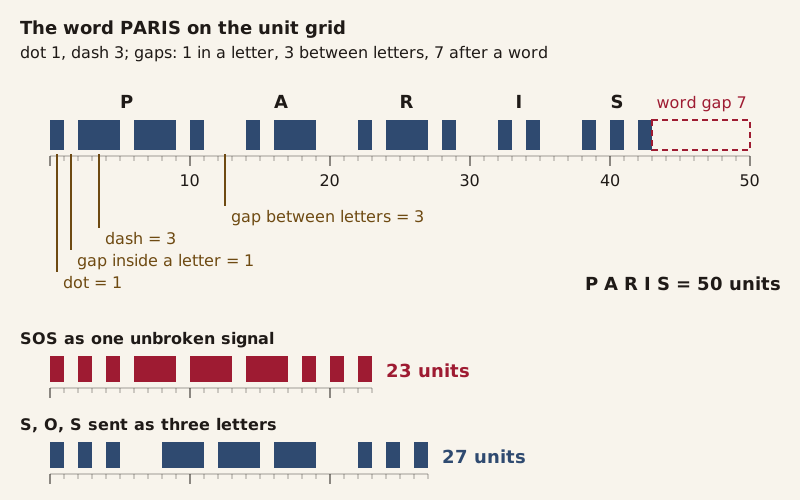
The word PARIS, the usual yardstick for speed, fills 50 units including the gap after it. SOS takes 23 units as one unbroken signal, 27 as three separate letters.
Speed is counted in words per minute. The Wikipedia article on Morse code calls PARIS the usual standard word for that count, and by this page's count PARIS fills exactly 50 units, including the 7-unit gap after it. At 20 words per minute, one unit therefore lasts 60,000 ms ÷ (20 × 50) = 60 milliseconds.
As of the 2025 edition of the US Code of Federal Regulations, the Federal Communications Commission's Radiotelegraph Operator License requires sending by hand and receiving by ear in international Morse code at 20 words per minute, plus a test at 16 code groups per minute. The ITU's 2009 recommendation says the code "continues to be used in some radiocommunication services including the amateur and amateur-satellite services, and to a diminishing extent in the mobile and fixed services."
SOS is sent as one unbroken signal: three dots, three dashes and three dots, with no letter gaps. That takes 23 units, against 27 for S, O and S sent as separate letters, by this page's count. The Wikipedia article on SOS says the service regulations of the 1906 International Radiotelegraph Convention wrote the distress signal in dots and dashes rather than letters, and that SOS remained the maritime radio distress signal until 1999.
Each strip in the next figure is a short message in International Morse code. Decode them with the chart and the three steps. The answers follow the figure.
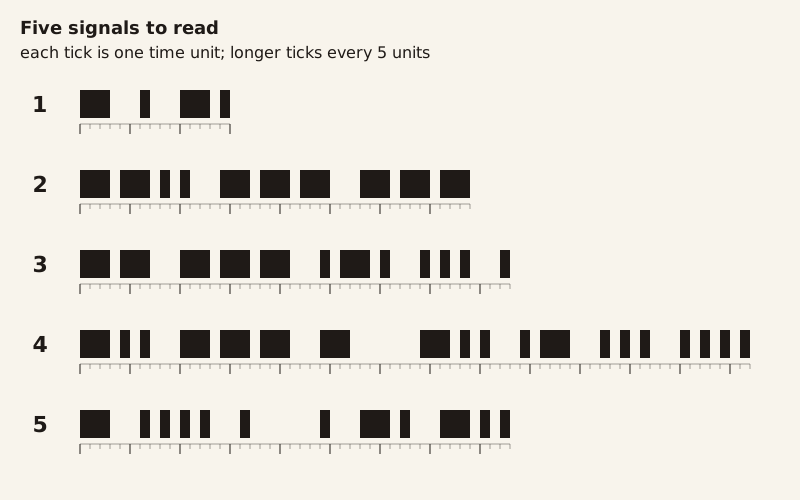
Five short messages in International Morse code, drawn to one time scale. Strips 4 and 5 hold two words each.
Answers
- TEN, 15 units: T
−, E·, N−·. - ZOO, 39 units: the Z
−−··takes exactly as long as each O−−−. - MORSE, 43 units: M
−−, O−−−, R·−·, S···, E·. - DOT DASH, 67 units: the 7-unit gap after the T marks the second word.
- THE END, 43 units: H is four dots and E is one, so the word gap comes right after a single dot.
Do common letters get the shortest codes?
Mostly. Weighting each letter by its count in the three novels, an International Morse letter averages 6.07 units, not counting the 3-unit gap that follows it. The same 26 codes handed out at random would be expected to average 8.23 units, and handed out shortest-first to the commonest letters, 5.69. By this page's calculation, the real assignment covers about 85% of the distance from the random average to the best one.
O is the biggest exception. It is the fourth most common letter, at 7.5% of all letters, and the only one of the ten most common with a code longer than 7 units. In the best order it would get 5 units, as N does.
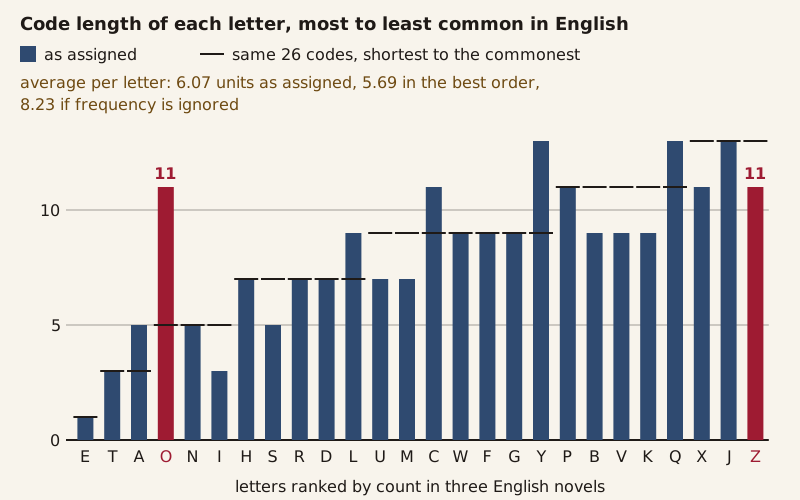
Each bar is a letter's Morse code length; each line is the length it would get if the same 26 codes went shortest-first to the commonest letters. O sits furthest above its line.
The comparison uses the same English counts as the Vigenère cipher page, which tests each column of a ciphertext against them.
Who matched code lengths to letter counts is disputed. J. Munro's Heroes of the Telegraph, whose text runs to events of 1891, says Alfred Vail went to the office of the local newspaper and "found the result he wanted in the type-cases of the compositors."
In 1914 Morse's son, Edward Lind Morse, reproduced what he called calculations in Morse's handwriting of "quantities of type found in the type-cases of a printing-office." He argued that Morse alone devised the alphabet, while allowing that the two men may have worked together on its final form, though "there is no written proof of this." Vail's own 1845 book says the alphabet "was originated on board the packet Sully, by Prof. Morse."
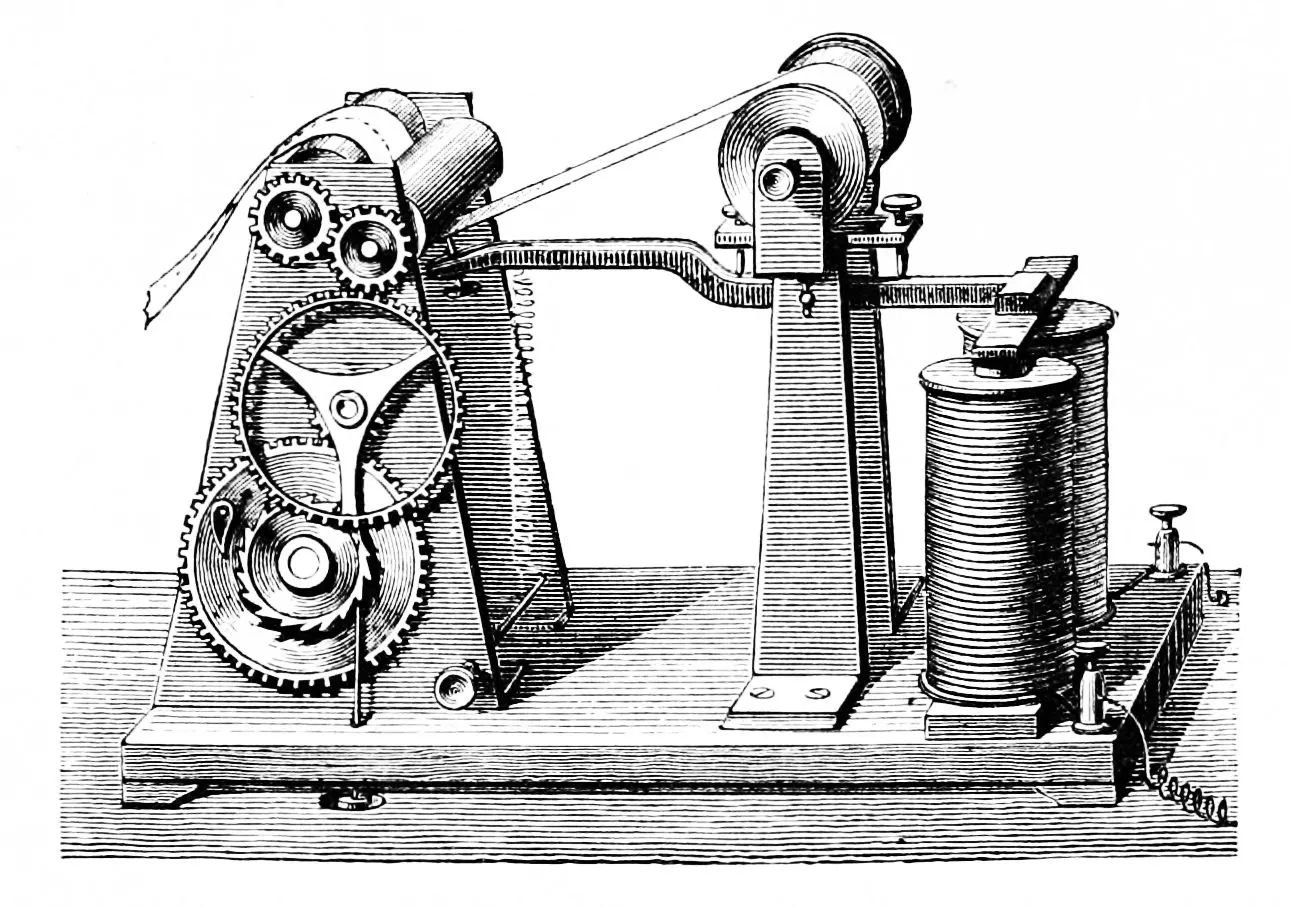
Image credit and license (full text)
"PSM V03 D423 Morse telegraph" by unknown author, fig. 9 of "Electric Telegraphs" by A. P. Deschanel, Popular Science Monthly, vol. 3 (1873) — Public domain (figure 9, "Morse's Telegraph", of the article "Electric Telegraphs" by A. P. Deschanel, Popular Science Monthly, vol. 3, p. 409, August 1873, abridged from Deschanel's Natural Philosophy, Part III; the source names no engraver or draughtsman; public domain in the US as a work published in 1873, before 1931; in the EU the 70-year term from publication for an anonymous work ended at the end of 1943, and if the figure is credited to the article's author, Augustin Privat-Deschanel (1821-1883), his life plus 70 years ended at the end of 1953; an engraver whose work was printed in 1873 would still be protected only after dying in 1956 or later, at about 98 or older, or, for the French 30-year extension, dying for France in 1939-1945 at about 81 or older, which is not a realistic case; a faithful scan of a two-dimensional printed page adds no new rights in the US (Bridgeman principle) or the EU (DSM Directive Article 14); Commons PD-old) — https://commons.wikimedia.org/wiki/File:PSM_V03_D423_Morse_telegraph.jpg
Morse's receiving instrument in its simplest form, as printed in 1873. An electromagnet moves a lever that marks a strip of paper drawn past it by a pair of rollers.
How do American and International Morse code differ?
The 1911 Encyclopaedia Britannica printed both codes on one page. Its article on the telegraph says the code "introduced by Morse is still employed in the United States and Canada, and the international code in vogue in Europe differs only slightly from it." Set side by side in this page's program, 15 of the 26 letters share the same pattern of dots and dashes, and 11 do not: C, F, J, L, O, P, Q, R, X, Y and Z.
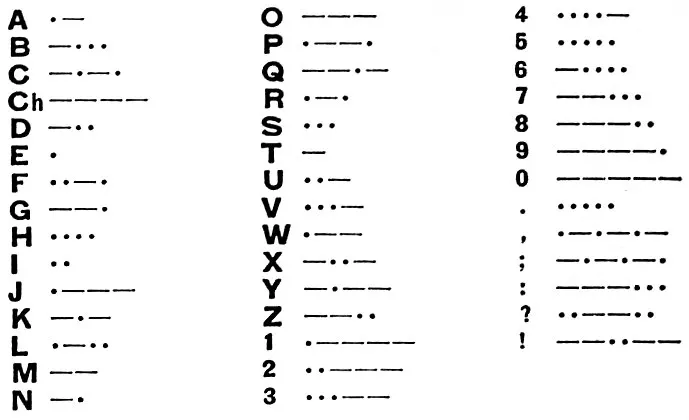
Image credit and license (full text)
"EB1911 Telegraph - Morse alphabets - international code" by Harry Robert Kempe (section author), Encyclopaedia Britannica, 11th ed. (1911) — Public domain (figure 14 (top) of the article Telegraph, Encyclopaedia Britannica, 11th ed., vol. 26, p. 516, published 1911, in the section signed H. R. K., Harry Robert Kempe (1852-1935); public domain in the US as a work published in 1911, before 1931; in the EU the term of the section author's life plus 70 years ended at the end of 2005, and the 70-year term from publication that applies if the figure is treated as an anonymous contribution ended at the end of 1981; a faithful scan of a two-dimensional printed page adds no new rights in the US (Bridgeman principle) or the EU (DSM Directive Article 14); Commons PD-Britannica) — https://commons.wikimedia.org/wiki/File:EB1911_Telegraph_-_Morse_alphabets_-_international_code.jpg
The international code as printed in 1911. Its 26 letters and 10 figures match the current ITU table; its full stop and comma do not.
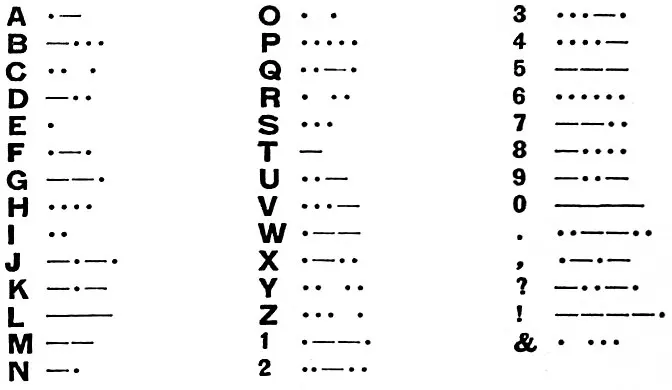
Image credit and license (full text)
"EB1911 Telegraph - Morse alphabets - American code" by Harry Robert Kempe (section author), Encyclopaedia Britannica, 11th ed. (1911) — Public domain (figure 14 (bottom) of the article Telegraph, Encyclopaedia Britannica, 11th ed., vol. 26, p. 516, published 1911, in the section signed H. R. K., Harry Robert Kempe (1852-1935); public domain in the US as a work published in 1911, before 1931; in the EU the term of the section author's life plus 70 years ended at the end of 2005, and the 70-year term from publication that applies if the figure is treated as an anonymous contribution ended at the end of 1981; a faithful scan of a two-dimensional printed page adds no new rights in the US (Bridgeman principle) or the EU (DSM Directive Article 14); Commons PD-Britannica) — https://commons.wikimedia.org/wiki/File:EB1911_Telegraph_-_Morse_alphabets_-_American_code.jpg
The American code from the same 1911 page. C, O, R, Y and Z have an extra space between marks, and L is one long dash.
The American code used spacing that the international one drops. C, O, R, Y and Z each contain an extra space between marks, so the American O is just two dots with a gap between them. L is a single long dash. Vail's 1845 description times a dash at "about the time required to make two dots" and L at about four.
According to the Wikipedia article on Morse code, Friedrich Gerke's 1848 revision, adopted in Germany and Austria in 1851, did away with the spaced letters and the dashes of different lengths. The same article says the international code of 1865 took its O from a code by Steinheil, and it calls the long code for "the frequently used vowel O" the "only real defect" of Gerke's revision.
Neither version hides anything. Unlike a Caesar cipher, Morse code has no key, so anyone with the chart can read it.
Flag semaphore is another way to signal letters, and by its designer's account the peace symbol combines semaphore N and D, which Morse sends as dash-dot and dash-dot-dot.
Sources
- 1
Recommendation ITU-R M.1677-1 (10/2009), International Morse code. Geneva: ITU, 2009.
https://www.itu.int/rec/R-REC-M.1677-1-200910-I/en (full text)
- 2
Alfred Vail, The American Electro Magnetic Telegraph: With the Reports of Congress, and a Description of All Telegraphs Known, Employing Electricity or Galvanism (Philadelphia: Lea & Blanchard, 1845); Project Gutenberg eBook #61533.
https://www.gutenberg.org/ebooks/61533 (the section on the telegraphic alphabet)
- 3
Harry Robert Kempe, "Telegraph" (section signed H. R. K.), Encyclopaedia Britannica, 11th ed., vol. 26 (1911), with Fig. 14, "Morse Alphabets," p. 516; Wikisource transcription.
https://en.wikisource.org/wiki/1911_Encyclop%C3%A6dia_Britannica/Telegraph (the paragraph on Morse's code and Fig. 14)
- 4
Edward Lind Morse, ed., Samuel F. B. Morse: His Letters and Journals, vol. 2 (1914), chapter XXIII; Project Gutenberg eBook #11018.
https://www.gutenberg.org/ebooks/11018 (chapter XXIII)
- 5
J. Munro, Heroes of the Telegraph, chapter III, "Samuel Morse"; Project Gutenberg eBook #979 (the text mentions events of 1891).
https://www.gutenberg.org/ebooks/979 (chapter III)
- 6
Code of Federal Regulations, Title 47, Part 13, sections 13.201 and 13.203 (10-1-25 edition), U.S. Government Publishing Office, govinfo.
https://www.govinfo.gov/content/pkg/CFR-2025-title47-vol1/pdf/CFR-2025-title47-vol1-sec13-203.pdf (sections 13.201(b) and 13.203(b))
- 7
Campaign for Nuclear Disarmament (CND), "History of the Symbol," cnduk.org, published 2018-02-13, updated 2023-02-06.
https://cnduk.org/the-symbol/ (the section "What does it mean?")
- 8
Austen, Jane. Pride and Prejudice. Project Gutenberg eBook #1342, https://www.gutenberg.org/ebooks/1342 (text file retrieved via the gutenberg.pglaf.org mirror, 2026-10-16).
https://www.gutenberg.org/ebooks/1342 (full text, as cut on the Letter Frequency page)
- 9
Dickens, Charles. A Tale of Two Cities. Project Gutenberg eBook #98, https://www.gutenberg.org/ebooks/98 (text file retrieved via the gutenberg.pglaf.org mirror, 2026-10-16).
https://www.gutenberg.org/ebooks/98 (full text, as cut on the Letter Frequency page)
- 10
Melville, Herman. Moby-Dick; or, The Whale. Project Gutenberg eBook #2701, https://www.gutenberg.org/ebooks/2701 (text file retrieved via the gutenberg.pglaf.org mirror, 2026-10-16).
https://www.gutenberg.org/ebooks/2701 (full text, as cut on the Letter Frequency page)
- 11
Wikipedia, "Morse code," revision of 2026-10-12.
https://en.wikipedia.org/w/index.php?title=Morse_code&oldid=1379801618 (full article)
- 12
Wikipedia, "SOS," revision of 2026-09-22.
https://en.wikipedia.org/w/index.php?title=SOS&oldid=1376184324 (full article)
Download the data: Morse code chart, A to Z and 0 to 9 (CSV) · English letter counts and code lengths (CSV) · average code length per letter (CSV) · American and International codes compared (CSV)
Corrections
No corrections yet. Report an error through the corrections address in the page footer; every change is logged here as YYYY-MM-DD — what changed and why.
Decode next:
- Peace Symbol: N and D in flag semaphore, drawn inside a circle, and the designer's own two accounts of what the strokes mean.
- Letter Frequency: the English counts behind the O-and-Z comparison, with German and French counts beside them and how much they shift from book to book.
Cite this page
Codes & Letters. “Morse Code: Why the Common O Takes as Long as a Rare Z.” Codes & Letters. Published 2026-10-16. Last substantive revision 2026-10-16. https://codesandletters.com/ciphers/morse-code/. Accessed [the date you read it].