Letter Frequency: E Is Commoner in German Than in English
Codes & Letters
- Published
- Last substantive revision
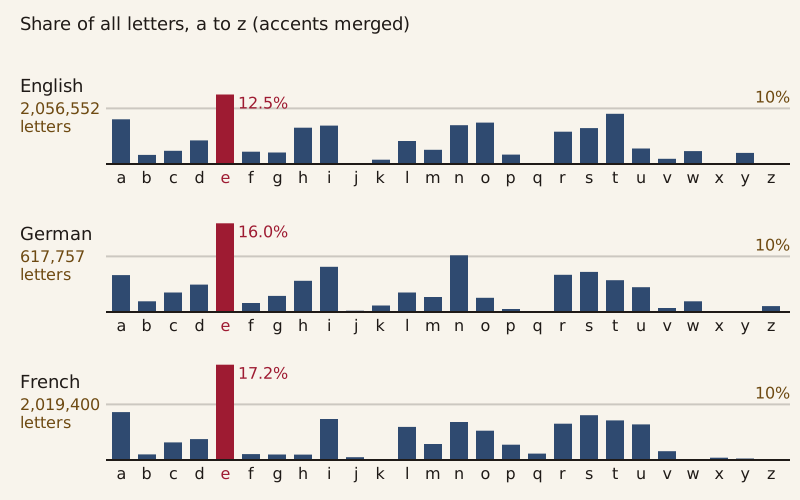
Letter shares in three novels per language, accents merged into a to z. The e bar is tallest in all three and grows from English to German to French.
In three English novels counted letter by letter, e makes up 12.5% of all letters, about one in eight. Run the same count on three German novels and e climbs to 16.0%, close to one letter in six. Three French novels give 17.2%, a little more than one in six.
These are this page's own counts from nine public-domain books, three per language, with capitals folded into lower case and accents merged into their base letters. German and French also get a second count in which ä, ß, é and the other accented letters keep rows of their own, and the counts behind every number below can be downloaded as CSV.
What does the letter frequency table look like in English, German and French?
Each column gives a letter's share of all the letters in that language's three books, accents merged into A to Z.
| Letter | English | German | French |
|---|---|---|---|
| a | 8.04% | 6.64% | 8.62% |
| b | 1.65% | 1.93% | 1.00% |
| c | 2.38% | 3.52% | 3.17% |
| d | 4.25% | 4.93% | 3.75% |
| e | 12.52% | 15.97% | 17.15% |
| f | 2.22% | 1.62% | 1.06% |
| g | 2.07% | 2.90% | 1.00% |
| h | 6.53% | 5.61% | 0.97% |
| i | 6.91% | 8.13% | 7.38% |
| j | 0.12% | 0.24% | 0.50% |
| k | 0.77% | 1.17% | 0.01% |
| l | 4.14% | 3.51% | 5.95% |
| m | 2.56% | 2.70% | 2.88% |
| n | 6.98% | 10.21% | 6.84% |
| o | 7.46% | 2.55% | 5.27% |
| p | 1.69% | 0.54% | 2.75% |
| q | 0.14% | 0.01% | 1.15% |
| r | 5.81% | 6.69% | 6.54% |
| s | 6.47% | 7.22% | 8.06% |
| t | 9.03% | 5.72% | 7.13% |
| u | 2.79% | 4.46% | 6.40% |
| v | 0.94% | 0.71% | 1.59% |
| w | 2.33% | 1.93% | 0.01% |
| x | 0.13% | 0.01% | 0.41% |
| y | 2.00% | 0.01% | 0.28% |
| z | 0.09% | 1.07% | 0.15% |
The letter e leads all three columns. After it the languages part ways: t is second in English at 9.03%, n in German at 10.21% and a in French at 8.62%. The rare end differs too: x, y and q each stay under 0.02% of the German letters, and w and k each stay under 0.02% of the French ones.
A handful of letters carries most of the text. The six most frequent English letters, e, t, a, o, n and i, account for 50.9% of everything counted, and the top six reach 54.9% in German and 55.2% in French. The five vowel letters a, e, i, o and u take 37.7% of the English and German letters but 44.8% of the French ones.
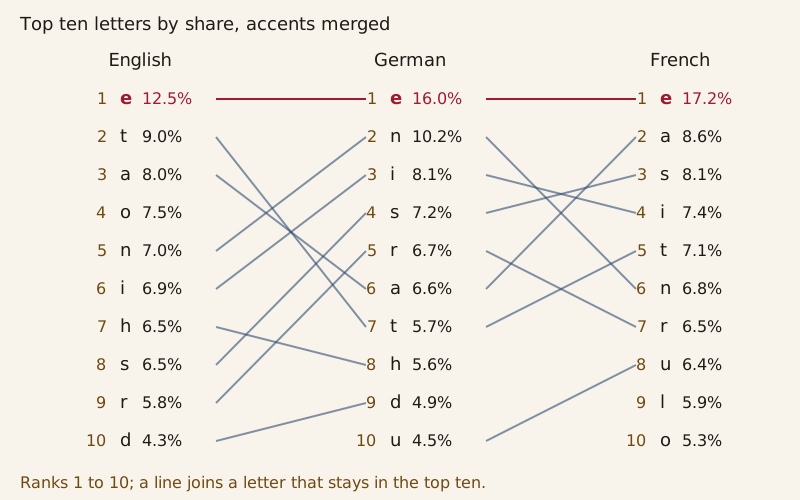
The ten most common letters in each language, accents merged. A line joins a letter that also ranks in the top ten of the next column.
Why the alphabet has these 26 letters, in this order, is a separate story, traced on the Latin alphabet page.
How were the letters counted?
The counts come from nine Project Gutenberg text files, three novels per language.
| Book | Author | Language | Letters counted (merged) |
|---|---|---|---|
| Pride and Prejudice (#1342) | Jane Austen (1775–1817) | English | 537,128 |
| A Tale of Two Cities (#98) | Charles Dickens (1812–1870) | English | 583,755 |
| Moby-Dick; or, The Whale (#2701) | Herman Melville (1819–1891) | English | 935,669 |
| Effi Briest (#5323) | Theodor Fontane (1819–1898) | German | 471,192 |
| Die Verwandlung (#22367) | Franz Kafka (1883–1924) | German | 99,001 |
| Immensee (#6651) | Theodor Storm (1817–1888) | German | 47,564 |
| Vingt mille lieues sous les mers (#5097) | Jules Verne (1828–1905) | French | 686,451 |
| Madame Bovary (#14155) | Gustave Flaubert (1821–1880) | French | 533,715 |
| Notre-Dame de Paris (#19657) | Victor Hugo (1802–1885) | French | 799,234 |
Each count starts at the first chapter and stops at the last line of the story. Project Gutenberg's header and license, title pages, tables of contents, dedications, prefaces, notes printed after the story, footnotes set in brackets and illustration labels are left out, and so are the Etymology and Extracts that open Moby-Dick. The CSV of the nine books lists the exact lines kept from each file.
Capitals count as lower case, and digits, spaces and punctuation are ignored. In the merged count, a letter with an accent or umlaut counts as the letter its Unicode decomposition starts with, so ä counts as a and é as e. The letter ß counts as ss, as Unicode's full case folding writes it; the Unicode Standard 18.0.0 still recommends "SS" as its uppercase for most casing operations. The letters æ and œ count as two letters each, which is this page's own rule.
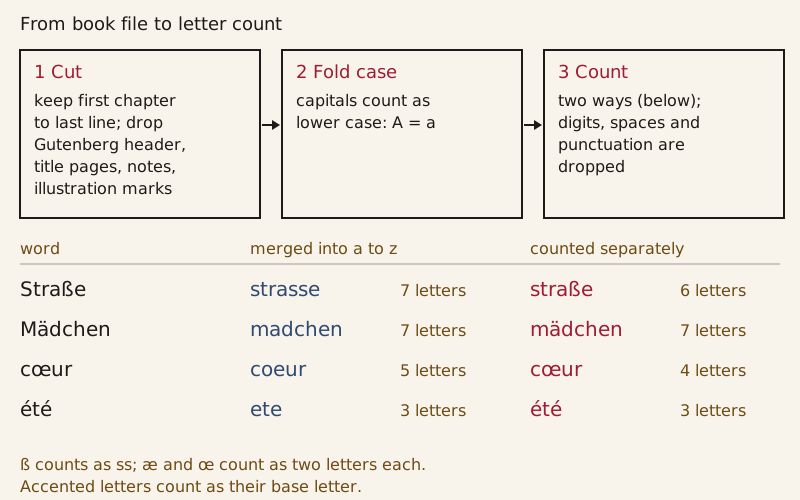
Three steps from book file to count. Merged, ß counts as ss and an accented letter as its base letter; counted separately, each keeps a row of its own.
Neither rule is the only correct one. Merging keeps all three languages on the same 26 columns for comparison; the separate count shows how often each accented letter is printed.
The three books of each language are added together, so longer books weigh more: Effi Briest supplies 471,192 of the 617,757 German letters.
Project Gutenberg's record for each of the nine books reads "Public domain in the USA." Their authors died between 1817 and 1924. Only the counts are published here.
What are the most and least common letters in English?
In the three English novels together, the order runs e, t, a, o, n, i, h, s, r, d, with e at 12.52%, t at 9.03% and a at 8.04%. At the bottom sit z (0.09%), j (0.12%), x (0.13%) and q (0.14%). The letter z turns up 1,792 times in 2,056,552 letters, about once in every 1,150.
The three English books do not agree exactly. The share of e runs from 12.29% in Moby-Dick to 12.93% in Pride and Prejudice, and l shows the widest gap of any English letter, from 3.69% in A Tale of Two Cities to 4.49% in Moby-Dick.
That 12.93% for Pride and Prejudice is e's share of 537,128 letters. The same file gives 12.87% of 563,924 letters when everything between Project Gutenberg's start and end lines is kept and only the plain letters A to Z are counted. This count takes in George Saintsbury's 1894 preface, the title pages and the illustration captions. The novel is the same in both counts; the extra text makes the difference.
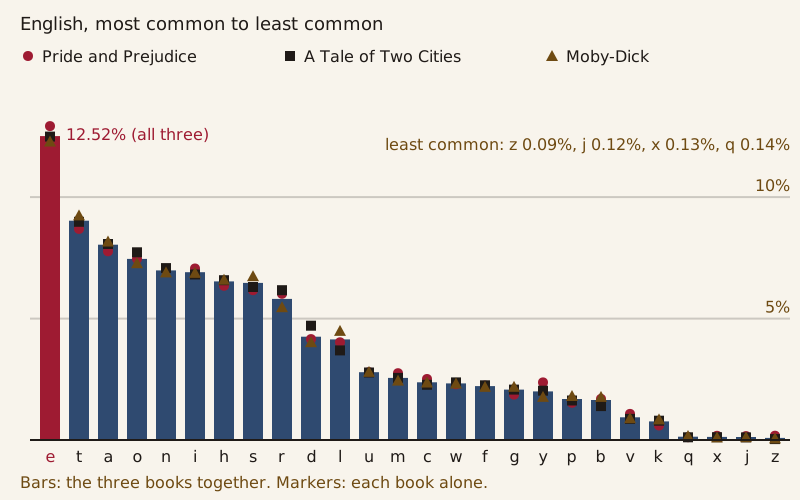
English letter shares, most common first. Bars pool the three novels; markers show each book alone, letter by letter.
This pattern of high and low counts is what the term frequency fingerprint describes. In a cipher that swaps each letter for one fixed letter, a long enough message keeps the pattern under new letter names. On a short message the tallest bar is a weak clue, which is why the Caesar cipher page compares all 26 counts instead of hunting for e alone.
The Morse code page sets these English shares against the length of each letter's signal.
How do ä, ö, ü and ß change the German count?
The German novels put e further ahead: 15.97% of the merged letters, with n second at 10.21%, about one letter in ten. In the separate count, ü makes up 0.69% of the German letters, ä 0.50%, ß 0.46% and ö 0.23%, or 1.89% between them.
Merging these four letters also changes the ranking. Counted separately, s is fifth at 6.33%, behind r. Counted as ss, each ß adds two letters to s, which rises to 7.22% and takes fourth place.
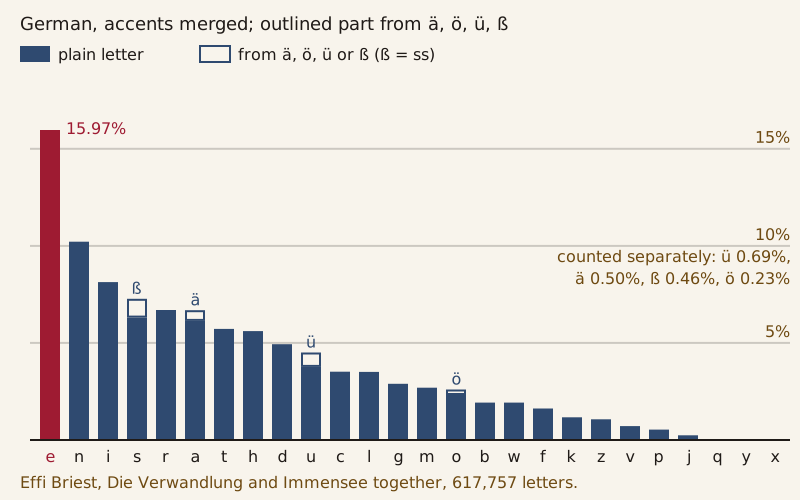
German letter shares with umlauts and ß merged. The outlined tops of the s, a, u and o bars are the part that comes from ß (as ss), ä, ü and ö.
The German books disagree among themselves more than the English ones do. The share of e runs from 15.63% in Effi Briest to 17.19% in Immensee, a gap of 1.56 points, the widest for any single letter between books of one language on this page. Anyone who prefers another rule, such as writing ä as ae, can rebuild the table from the separate counts in the CSV.
Where do é and the other accents land in French?
The French novels give e the largest share of the three languages: 17.15% of the merged letters, or about one in 5.8. Counted separately, plain e drops to 14.82% and é becomes a letter of its own at 1.77%, which puts é 15th, ahead of v, q, f, b, g and h.
Together, é, è, ê and ë make up 2.33% of the merged French letters. Separating accents also reorders the top three: merged, a is second at 8.62% and s third at 8.06%, but counted separately plain a falls to 8.04%, just behind s.
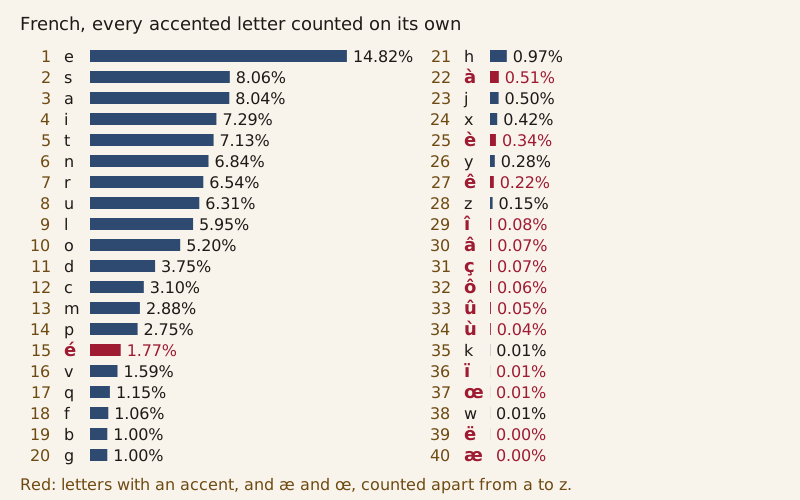
French letters counted separately, ranks 1 to 40. Letters with an accent, and æ and œ, are in red; é ranks 15th.
The ligature œ barely registers, for a reason inside the files: Vingt mille lieues sous les mers and Notre-Dame de Paris spell words such as coeur and oeil with two letters, and only Madame Bovary uses œ, 143 times. Counting œ as o plus e keeps the three French books comparable.
How much do the numbers change from book to book?
Whole books agree closely with one another. The share of e moves by 0.63 points across the three English novels, 0.85 across the French ones and 1.56 across the German ones.
 Generated illustration
Whole books agree closely: the share of e moves by 0.63 points across the three English novels, 0.85 across the French ones and 1.56 across the German ones.
Short stretches of text agree far less. Cut each book into consecutive 100-letter blocks, and the middle 90% of English blocks give e anywhere from 8% to 18% of their letters; at 1,000 letters that range narrows to 10.5% to 14.5%. The middle 90% of 100-letter blocks runs from 11% to 21% in German and from 12% to 22% in French.
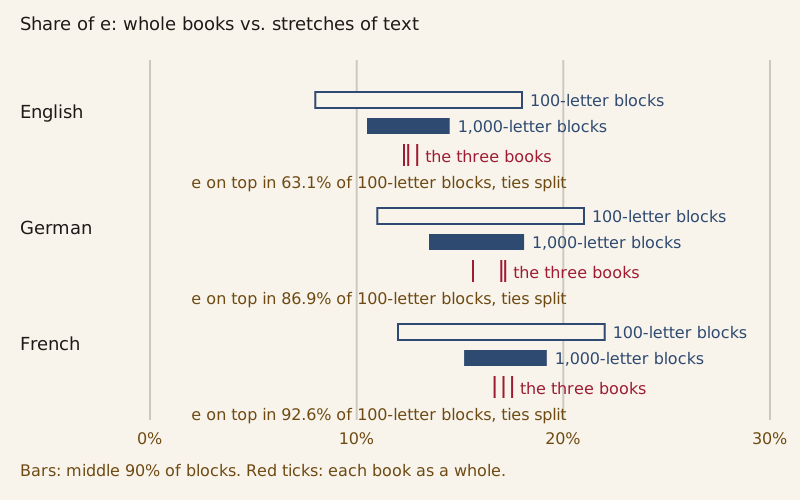
Share of e in each whole book (red ticks) against the middle 90% of 1,000-letter and 100-letter blocks. The shorter the stretch, the wider the spread.
The letter e is the most common letter in 63.1% of English 100-letter blocks, 86.9% of German blocks and 92.6% of French ones, with ties split evenly. Taking the most common letter of a 100-letter English block to be e, with a random pick among tied letters, is therefore wrong more than a third of the time, and about two times in three for 20-letter blocks. These shares describe nine novels; letters, newspapers and other kinds of text were not counted.
The Caesar cipher page runs the same test on random 100-letter stretches of another book, the Sherlock Holmes stories, so its percentages come from a different text.
Which letter pairs are most common?
Pairs are counted only inside words, as two letters side by side with nothing between them, and every pair is written in lower case. In the English books, th leads at 3.95% of all such pairs, followed by he at 3.68% and in at 2.55%. The German books' top three are en (4.33%), ch (4.04%) and er (3.93%), and the French books' are es (3.08%), le (2.72%) and re (2.54%).
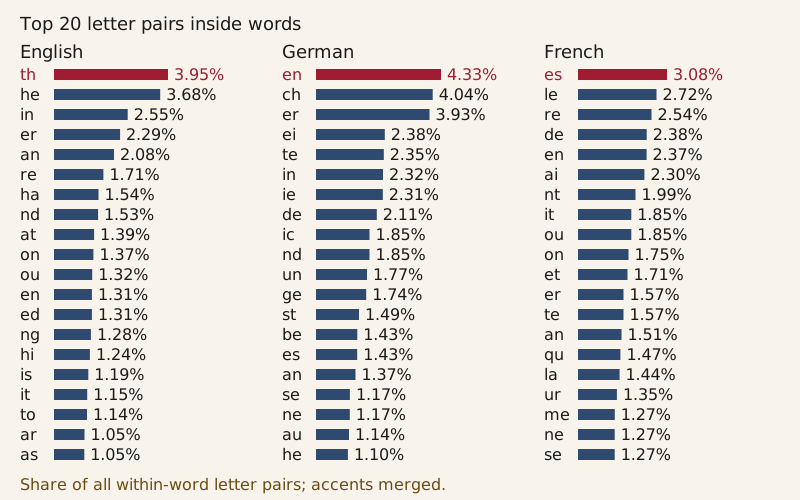
The 20 most common pairs of adjacent letters inside words, as a share of all such pairs. Accents are merged, and every pair is written in lower case.
Some pairs never occur at all: 183 of the 676 possible pairs never appear inside an English word in these books, 171 in German and 230 in French. In all nine books, every q followed by another letter in the same word is followed by u.
Pairs matter to type as well as to codebreaking, and the kerning page checks how a font spaces the pairs these English books use most often.
To see what happens to these counts when the shift can change from letter to letter, go to the Vigenère cipher next.
Sources
- 1
Austen, Jane. Pride and Prejudice. Project Gutenberg eBook #1342, https://www.gutenberg.org/ebooks/1342 (text file retrieved via the gutenberg.pglaf.org mirror, 2026-10-16).
https://www.gutenberg.org/ebooks/1342 (full text)
- 2
Dickens, Charles. A Tale of Two Cities. Project Gutenberg eBook #98, https://www.gutenberg.org/ebooks/98 (text file retrieved via the gutenberg.pglaf.org mirror, 2026-10-16).
https://www.gutenberg.org/ebooks/98 (full text)
- 3
Melville, Herman. Moby-Dick; or, The Whale. Project Gutenberg eBook #2701, https://www.gutenberg.org/ebooks/2701 (text file retrieved via the gutenberg.pglaf.org mirror, 2026-10-16).
https://www.gutenberg.org/ebooks/2701 (full text)
- 4
Fontane, Theodor. Effi Briest. Project Gutenberg eBook #5323, https://www.gutenberg.org/ebooks/5323 (text file retrieved via the gutenberg.pglaf.org mirror, 2026-10-16).
https://www.gutenberg.org/ebooks/5323 (full text)
- 5
Kafka, Franz. Die Verwandlung. Project Gutenberg eBook #22367, https://www.gutenberg.org/ebooks/22367 (text file retrieved via the gutenberg.pglaf.org mirror, 2026-10-16).
https://www.gutenberg.org/ebooks/22367 (full text)
- 6
Storm, Theodor. Immensee. Project Gutenberg eBook #6651, https://www.gutenberg.org/ebooks/6651 (text file retrieved via the gutenberg.pglaf.org mirror, 2026-10-16).
https://www.gutenberg.org/ebooks/6651 (full text)
- 7
Verne, Jules. Vingt mille lieues sous les mers. Project Gutenberg eBook #5097, https://www.gutenberg.org/ebooks/5097 (text file retrieved via the gutenberg.pglaf.org mirror, 2026-10-16).
https://www.gutenberg.org/ebooks/5097 (full text)
- 8
Flaubert, Gustave. Madame Bovary. Project Gutenberg eBook #14155, https://www.gutenberg.org/ebooks/14155 (text file retrieved via the gutenberg.pglaf.org mirror, 2026-10-16).
https://www.gutenberg.org/ebooks/14155 (full text)
- 9
Hugo, Victor. Notre-Dame de Paris. Project Gutenberg eBook #19657, https://www.gutenberg.org/ebooks/19657 (text file retrieved via the gutenberg.pglaf.org mirror, 2026-10-16).
https://www.gutenberg.org/ebooks/19657 (full text)
- 10
Project Gutenberg. Offline catalog pg_catalog.csv and the catalog record (RDF) of each of the nine eBooks, https://www.gutenberg.org/ebooks/offline_catalogs.html (files retrieved via the gutenberg.pglaf.org mirror, 2026-10-16).
https://www.gutenberg.org/ebooks/offline_catalogs.html (catalog entries for the nine eBooks)
- 11
Unicode, Inc. Unicode Character Database, version 18.0.0: UnicodeData.txt and CaseFolding.txt. https://www.unicode.org/Public/18.0.0/ucd/ (retrieved 2026-10-16).
https://www.unicode.org/Public/18.0.0/ucd/ (UnicodeData.txt and CaseFolding.txt, entries for the letters counted)
- 12
The Unicode Consortium. The Unicode Standard, Version 18.0.0, chapter 7, section 7.1 (Latin), "Capital Sharp S." The Unicode Consortium, 2026.
https://www.unicode.org/versions/Unicode18.0.0/core-spec/chapter-7/ (section 7.1)
Download the data: letter counts by language (CSV) · letter counts by book (CSV) · letter pairs (CSV) · 100-letter and other blocks (CSV) · the nine books and the cut (CSV)
Corrections
No corrections yet. Report an error through the corrections address in the page footer; every change is logged here as YYYY-MM-DD — what changed and why.
Decode next:
- Vigenère Cipher: a repeating keyword sets the Caesar shift letter by letter, and counting still finds the keyword's length.
- Kerning: six words to space by eye, then the spacing values the font file actually stores for each pair.
Cite this page
Codes & Letters. “Letter Frequency: E Is Commoner in German Than in English.” Codes & Letters. Published 2026-10-16. Last substantive revision 2026-10-16. https://codesandletters.com/ciphers/letter-frequency/. Accessed [the date you read it].